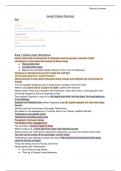
ISTQB 1.1 - What is Testing?
What is testing? (O) - answerA way to *assess the quality* of the software
and
*reduce the risk of* software *failure* in operation.
Quality (K) - answerThe *degree* to which a component, system or process *meets
specified requirements* and/or *user/customer needs and expectations*.
Testing includes what activities? - answer- Test execution (including checking of results)
- Test planning
- Analyzing, designing, and implementing tests
- Reporting test progress and results
- Evaluating the quality of a test object
Testing (K) - answerThe process consisting of *all lifecycle activities*,
both static and dynamic,
*concerned with planning, preparation and evaluation*
of software products and related work products
- *to determine* that they *satisfy specified requirements*,
- to demonstrate that *they are fit for purpose* and
- to *detect defects*.
(Execute the software and find the failures that are caused by defects in the software.)
Dynamic Testing - answerTesting that
*involves the execution*
of the software of a component or system being tested.
Static Testing - answerTesting that
*does not involve the execution*
of the component or system being tested.
Includes reviewing work products such as
- requirements
- user stories
- source code
Business Analyst and Tester - answerThe Business Analyst
sits with the customer and gathers requirements.
The Tester
reviews if they testable and achievable.
, Examples of "work products" - answer- Requirements
- User stories
- Design
- Code
- Source code
Verification (K) - answerConfirmation by examination and through provision of objective
evidence that
*specified requirements*
have been fulfilled.
Checking whether the system meets
*specified requirements*;
what is on paper.
Following what is written in the
- requirements,
- user stories,
- other specifications.
Validation (K) - answerConfirmation by examination and through provision of objective
evidence that
*the requirements for a specific intended use or application*
have been fulfilled.
Checking whether the system meets
*user and other stakeholder needs*
in its operational environment.
Going the extra step of making sure
(beyond verifying with written requirement documents)
that this is what the customer wants.
Test Object (K) - answerThe component or system to be tested.
Requirement - answerA provision that contains criteria to be fulfilled.
User Story - answerSee Also: Agile software development, requirement
A *high-level user or business requirement* commonly used in Agile software
development, typically consisting of one sentence in the everyday or business language
*capturing
what functionality a user needs and the reason behind this, any non-functional criteria,
and also includes acceptance criteria*.
Typical Objective of Testing 1 (O) - answerTo *evaluate work products* such as
What is testing? (O) - answerA way to *assess the quality* of the software
and
*reduce the risk of* software *failure* in operation.
Quality (K) - answerThe *degree* to which a component, system or process *meets
specified requirements* and/or *user/customer needs and expectations*.
Testing includes what activities? - answer- Test execution (including checking of results)
- Test planning
- Analyzing, designing, and implementing tests
- Reporting test progress and results
- Evaluating the quality of a test object
Testing (K) - answerThe process consisting of *all lifecycle activities*,
both static and dynamic,
*concerned with planning, preparation and evaluation*
of software products and related work products
- *to determine* that they *satisfy specified requirements*,
- to demonstrate that *they are fit for purpose* and
- to *detect defects*.
(Execute the software and find the failures that are caused by defects in the software.)
Dynamic Testing - answerTesting that
*involves the execution*
of the software of a component or system being tested.
Static Testing - answerTesting that
*does not involve the execution*
of the component or system being tested.
Includes reviewing work products such as
- requirements
- user stories
- source code
Business Analyst and Tester - answerThe Business Analyst
sits with the customer and gathers requirements.
The Tester
reviews if they testable and achievable.
, Examples of "work products" - answer- Requirements
- User stories
- Design
- Code
- Source code
Verification (K) - answerConfirmation by examination and through provision of objective
evidence that
*specified requirements*
have been fulfilled.
Checking whether the system meets
*specified requirements*;
what is on paper.
Following what is written in the
- requirements,
- user stories,
- other specifications.
Validation (K) - answerConfirmation by examination and through provision of objective
evidence that
*the requirements for a specific intended use or application*
have been fulfilled.
Checking whether the system meets
*user and other stakeholder needs*
in its operational environment.
Going the extra step of making sure
(beyond verifying with written requirement documents)
that this is what the customer wants.
Test Object (K) - answerThe component or system to be tested.
Requirement - answerA provision that contains criteria to be fulfilled.
User Story - answerSee Also: Agile software development, requirement
A *high-level user or business requirement* commonly used in Agile software
development, typically consisting of one sentence in the everyday or business language
*capturing
what functionality a user needs and the reason behind this, any non-functional criteria,
and also includes acceptance criteria*.
Typical Objective of Testing 1 (O) - answerTo *evaluate work products* such as