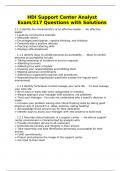
HDI Support Center Analyst
Exam/217 Questions with Solutions
1.1.1 Identify the characteristics of an effective leader. - -An effective
leader:
> Leads by constructive example
> Motivates others
> Encourages participation, creative thinking, and initiative
> Demonstrates a positive attitude
> Practices active listening skills
> Displays ethical behavior
- 1.1.2 Identify ways to exhibit personal accountability. - -Ways to exhibit
personal accountability include:
> Taking ownership of incidents or service requests
> Admitting to errors
> Adhering to a work schedule
> Knowing your responsibilities and fulfilling them
> Meeting personal commitments
> Adhering to organization policies and procedures
> Representing the organization positively outside the regular work
environment
- 1.1.3 Identify techniques to best manage your work life - -To best manage
your work life:
> Be on time or early with every assignment or meeting
> Always approach your manager with solutions, not problems
> Trust your manager - You may not understand why a specific decision is
made
> Increase your problem solving and critical thinking skills by taking good
physical care of yourself (i.e. sleep, exercise, eating healthy)
> Acknowledge those around you for their dedication
> Identify ways to assist your manager with new projects to build trust
- 1.2.1 Describe ethical behavior in a support center. - -An ethical support
center environment is characterized by analysts who:
> Provide consistent service to all customers
> Demonstrate honesty and integrity in their actions
> Take ownership and hold themselves personally accountable for their
actions
> Fulfill commitments
> Protect and enhance the image of the support center
> Are loyal to their team
, - 1.3.1 Identify strategies for multitasking in a support environment. - -
Multitasking in a support environment includes the ability to:
> Switch between tasks smoothly throughout the day
> Prioritize tasks throughout the day as circumstances require, with minimal
supervision
> Organize work effectively
- 1.3.2 Explain how to manage the use of your time efficiently - -Techniques
to improve and manage the use of your time include:
> Planning projects and activities in advance
> Prioritizing tasks to ensure that you spend time on tasks that contribute to
the achievement of your goals
> Addressing the most important action items first
> Accurately estimating and planning how long non-routine tasks will take
> Being more efficient when performing routine tasks
> Using a time management tool or daily "to-do" list
> Learning to say "no" when appropriate
- 1.4.1 Identify considerations for effective use of e-mail communication. - -
Effective e-mail communication includes:
> Understanding your audience so that you can tailor and optimize message
content
> Labeling your message with a subject line that reflects the message
content
> Structuring your message so that it's easy, quick to read and understand --
including an opening, bullet points, and closing
> Using clear, concise business language so that your message is
communicated effectively
> Proofreading your message before you send it to ensure it is
communicating what you intend
> Using plain text and avoid fancy fonts, colors, and RTF or HTML formatting
> Including the original message with replies to provide a context for the
message
> Using appropriate punctuation
> Avoiding abbreviations (e.g. "BTW" instead of "by the way") and emoticons
> Using appropriate capitalization (avoiding the use of all capital or all lower-
case letters)
- 1.5.1 List ideas for staying informed about industry trends and best
practices. - -A support professional can stay informed about the industry by:
> Attending courses and seminars
> Networking with other professionals at industry events
> Subscribing to industry publications
> Joining industry groups
> Subscribing to or participating in online discussion groups
, - 1.6.1 Identify ways that an SCA can deliver consistent, quality customer
service. - -An SCA (Support Center Analyst) delivers consistent, quality
customer service by:
> Responding to customer incidents in a timely manner
> Understanding and documenting customer needs
> Taking ownership of customer incidents
> Making specific commitments, then consistently meeting or exceeding
those commitments, while remaining faithful to organizational policies
> Resolving or assisting in the resolution of incidents within established
service levels
> Enhancing the customer's relationship with the support center and
organization
> Promoting the image of the support center
- 1.6.2 Describe the primary responsibilities of the support center analyst in
the support organization. - -An SCA is responsible for:
> Understanding the mission and goals of the support organization
> Communicating any issues/concerns to support center management
> Following support center policies and procedures
> Reporting any inaccuracies or incorrect data to support center
management
> Representing the support center in a professional manner
- 1.7.1 Explain techniques for cross-cultural communication. - -To
communicate more effectively across cultures:
> Listen actively
> Match the customer's communication style
> Use standard language expressions (i.e. eliminate slang) and simple
sentences
> Moderate the pace of the call to accommodate the customer
> Let customer know if you have any difficulty understanding them
> Pause to consider what is being said to better understand the customer
> Use e-mail, faxes, or handwritten notes to ensure understanding
> Ask the customer to repeat the question
> Use closed-ended questions to verify understanding
> Paraphrase the customer's question or request in your own words to verify
your understanding
- 1.7.2 Identify the impacts of language barriers when communicating with
customers. - -A language barrier can lead to:
> The analyst misunderstanding the customer's situation/problem
> The customer misunderstanding the analyst's instructions
> The customer or the analyst becoming frustrated
> Poor customer satisfaction
> Unintended insults
> Miscommunication
, > Increased risk of escalation
- 1.7.3 Identify options used for language assistance. - -Options available for
language assistance include:
> Translation applications or services (web-based translation tools or PC
tools)
> An interpreter (Other support center staff, other people at the customer's
site or at the support center who have an understanding of the language)
- 1.7.4 Explain when to obtain assistance when supporting a customer
whose primary language is different than your own. - -You should obtain
assistance when supporting a customer whose primary language is different
that your own whenever:
> Frustration levels are increasing
> There is little or no understanding between you and the customer
> The words the customer is using do not seem logical
- 1.8.1 Define Emotional Intelligence. - -Emotional Intelligence is:
> The ability to recognize and know what emotions you are feeling
> Managing one's emotions so that they do not overwhelm a situation and
one's thinking capability
> Being able to recognize the emotions that others are feeling
> Helping to manage other's emotions in order to ensure that those
emotions do not overwhelm situations and thinking capacities
> The ability to create sincere and authentic relationships that produce value
and productivity
- 1.8.2 Explain why Emotional Intelligence is important to the role of a
support center analyst. - -Emotional Intelligence is important to the role of
the support center analyst because:
> It is important to understand a customer's emotional need as well as their
business need
> It makes one more aware of their own reactions and how it impacts the
quality of the relationship between them and customers, peers, and
management
> It is important to understand how people work
- 1.8.3 Explain the three major components of Emotional Intelligence. - -The
three major components of Emotional Intelligence are:
1. Self Awareness
2. Emotional Managements of Self and Others
3. Emotional Connection
- 1.8.4 Describe an emotional hijack. - -An emotional hijack happens when:
> There is a perceived threat, whether it is real or not, from a situation or
person
Exam/217 Questions with Solutions
1.1.1 Identify the characteristics of an effective leader. - -An effective
leader:
> Leads by constructive example
> Motivates others
> Encourages participation, creative thinking, and initiative
> Demonstrates a positive attitude
> Practices active listening skills
> Displays ethical behavior
- 1.1.2 Identify ways to exhibit personal accountability. - -Ways to exhibit
personal accountability include:
> Taking ownership of incidents or service requests
> Admitting to errors
> Adhering to a work schedule
> Knowing your responsibilities and fulfilling them
> Meeting personal commitments
> Adhering to organization policies and procedures
> Representing the organization positively outside the regular work
environment
- 1.1.3 Identify techniques to best manage your work life - -To best manage
your work life:
> Be on time or early with every assignment or meeting
> Always approach your manager with solutions, not problems
> Trust your manager - You may not understand why a specific decision is
made
> Increase your problem solving and critical thinking skills by taking good
physical care of yourself (i.e. sleep, exercise, eating healthy)
> Acknowledge those around you for their dedication
> Identify ways to assist your manager with new projects to build trust
- 1.2.1 Describe ethical behavior in a support center. - -An ethical support
center environment is characterized by analysts who:
> Provide consistent service to all customers
> Demonstrate honesty and integrity in their actions
> Take ownership and hold themselves personally accountable for their
actions
> Fulfill commitments
> Protect and enhance the image of the support center
> Are loyal to their team
, - 1.3.1 Identify strategies for multitasking in a support environment. - -
Multitasking in a support environment includes the ability to:
> Switch between tasks smoothly throughout the day
> Prioritize tasks throughout the day as circumstances require, with minimal
supervision
> Organize work effectively
- 1.3.2 Explain how to manage the use of your time efficiently - -Techniques
to improve and manage the use of your time include:
> Planning projects and activities in advance
> Prioritizing tasks to ensure that you spend time on tasks that contribute to
the achievement of your goals
> Addressing the most important action items first
> Accurately estimating and planning how long non-routine tasks will take
> Being more efficient when performing routine tasks
> Using a time management tool or daily "to-do" list
> Learning to say "no" when appropriate
- 1.4.1 Identify considerations for effective use of e-mail communication. - -
Effective e-mail communication includes:
> Understanding your audience so that you can tailor and optimize message
content
> Labeling your message with a subject line that reflects the message
content
> Structuring your message so that it's easy, quick to read and understand --
including an opening, bullet points, and closing
> Using clear, concise business language so that your message is
communicated effectively
> Proofreading your message before you send it to ensure it is
communicating what you intend
> Using plain text and avoid fancy fonts, colors, and RTF or HTML formatting
> Including the original message with replies to provide a context for the
message
> Using appropriate punctuation
> Avoiding abbreviations (e.g. "BTW" instead of "by the way") and emoticons
> Using appropriate capitalization (avoiding the use of all capital or all lower-
case letters)
- 1.5.1 List ideas for staying informed about industry trends and best
practices. - -A support professional can stay informed about the industry by:
> Attending courses and seminars
> Networking with other professionals at industry events
> Subscribing to industry publications
> Joining industry groups
> Subscribing to or participating in online discussion groups
, - 1.6.1 Identify ways that an SCA can deliver consistent, quality customer
service. - -An SCA (Support Center Analyst) delivers consistent, quality
customer service by:
> Responding to customer incidents in a timely manner
> Understanding and documenting customer needs
> Taking ownership of customer incidents
> Making specific commitments, then consistently meeting or exceeding
those commitments, while remaining faithful to organizational policies
> Resolving or assisting in the resolution of incidents within established
service levels
> Enhancing the customer's relationship with the support center and
organization
> Promoting the image of the support center
- 1.6.2 Describe the primary responsibilities of the support center analyst in
the support organization. - -An SCA is responsible for:
> Understanding the mission and goals of the support organization
> Communicating any issues/concerns to support center management
> Following support center policies and procedures
> Reporting any inaccuracies or incorrect data to support center
management
> Representing the support center in a professional manner
- 1.7.1 Explain techniques for cross-cultural communication. - -To
communicate more effectively across cultures:
> Listen actively
> Match the customer's communication style
> Use standard language expressions (i.e. eliminate slang) and simple
sentences
> Moderate the pace of the call to accommodate the customer
> Let customer know if you have any difficulty understanding them
> Pause to consider what is being said to better understand the customer
> Use e-mail, faxes, or handwritten notes to ensure understanding
> Ask the customer to repeat the question
> Use closed-ended questions to verify understanding
> Paraphrase the customer's question or request in your own words to verify
your understanding
- 1.7.2 Identify the impacts of language barriers when communicating with
customers. - -A language barrier can lead to:
> The analyst misunderstanding the customer's situation/problem
> The customer misunderstanding the analyst's instructions
> The customer or the analyst becoming frustrated
> Poor customer satisfaction
> Unintended insults
> Miscommunication
, > Increased risk of escalation
- 1.7.3 Identify options used for language assistance. - -Options available for
language assistance include:
> Translation applications or services (web-based translation tools or PC
tools)
> An interpreter (Other support center staff, other people at the customer's
site or at the support center who have an understanding of the language)
- 1.7.4 Explain when to obtain assistance when supporting a customer
whose primary language is different than your own. - -You should obtain
assistance when supporting a customer whose primary language is different
that your own whenever:
> Frustration levels are increasing
> There is little or no understanding between you and the customer
> The words the customer is using do not seem logical
- 1.8.1 Define Emotional Intelligence. - -Emotional Intelligence is:
> The ability to recognize and know what emotions you are feeling
> Managing one's emotions so that they do not overwhelm a situation and
one's thinking capability
> Being able to recognize the emotions that others are feeling
> Helping to manage other's emotions in order to ensure that those
emotions do not overwhelm situations and thinking capacities
> The ability to create sincere and authentic relationships that produce value
and productivity
- 1.8.2 Explain why Emotional Intelligence is important to the role of a
support center analyst. - -Emotional Intelligence is important to the role of
the support center analyst because:
> It is important to understand a customer's emotional need as well as their
business need
> It makes one more aware of their own reactions and how it impacts the
quality of the relationship between them and customers, peers, and
management
> It is important to understand how people work
- 1.8.3 Explain the three major components of Emotional Intelligence. - -The
three major components of Emotional Intelligence are:
1. Self Awareness
2. Emotional Managements of Self and Others
3. Emotional Connection
- 1.8.4 Describe an emotional hijack. - -An emotional hijack happens when:
> There is a perceived threat, whether it is real or not, from a situation or
person