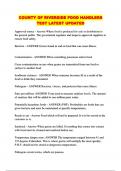
COUNTY OF RIVERSIDE FOOD HANDLERS
TEST LATEST UPDATED
Approved source - Answer Where food is produced for sale or distribution to
the general public. The government regulates and inspects approved suppliers to
ensure food safety.
Bacteria - ANSWER Germs found in and on food that can cause illness.
Contamination - ANSWER When something poisonous enters food.
Cross-contamination occurs when germs are transmitted from one food or
surface to another food.
foodborne sickness - ANSWER When someone becomes ill as a result of the
food or drink they consumed.
Pathogens - ANSWER Bacteria, viruses, and protozoa that cause illness.
Parts per million: ANSWER Term used to measure sanitiser levels. The amount
of sanitiser that will be added to one million parts water.
Potentially hazardous foods - ANSWER (PHF). Perishables are foods that can
grow bacteria and must be maintained at specific temperatures.
Ready to eat - Answer Food which will not be prepared. It is to be served to the
customer as is.
Sanitized - Answer When germs are killed. Everything that comes into contact
with food must be cleaned and sanitized before use.
Temperature danger zone: ANSWER The temperature ranged between 41 and
135 degrees Fahrenheit. This is where germs will multiply the most quickly.
P.H.F. should not be stored at dangerous temperatures.
Pathogens create toxins, which are poisons.
, First and foremost, answer. Follow the company's food defense plan and
procedures.
Inspect your workspace and surrounds.
Identify anything out of the ordinary.
Secure all ingredients, supplies, and finished products.
Please notify management if you observe anything weird or questionable.
Requires everyone who works in public food service to receive a food handler's
card within one week of being recruited. Riverside County
Symptoms of foodborne disease include flu-like symptoms, upset stomach,
vomiting, diarrhea, fever, and chills.
Physical contamination - ANSWER This occurs when something visible and
palpable enters a food product. (hair, glass, metal, fingernails, flies).
Chemical contamination: ANSWER Can happen if a chemical gets into a food
item.(Bleach)
Pathogenic pollution - ANSWER Most dangerous and impossible to perceive.
There could potentially be thousands of germs. Some are especially harmful.
It is difficult to identify whether food is infected with pathogens.
The most common cause of foodborne disease is bacteria.
Bacteria are the most hazardous germs for people with weakened immune
systems.
Bacteria are everywhere.
Found naturally on food, surfaces, and humans. - ANSWER Pathogenic
bacteria.
Produce poison or toxin that is unaffected by heat from cooking. - Answer:
Bacteria.
TEST LATEST UPDATED
Approved source - Answer Where food is produced for sale or distribution to
the general public. The government regulates and inspects approved suppliers to
ensure food safety.
Bacteria - ANSWER Germs found in and on food that can cause illness.
Contamination - ANSWER When something poisonous enters food.
Cross-contamination occurs when germs are transmitted from one food or
surface to another food.
foodborne sickness - ANSWER When someone becomes ill as a result of the
food or drink they consumed.
Pathogens - ANSWER Bacteria, viruses, and protozoa that cause illness.
Parts per million: ANSWER Term used to measure sanitiser levels. The amount
of sanitiser that will be added to one million parts water.
Potentially hazardous foods - ANSWER (PHF). Perishables are foods that can
grow bacteria and must be maintained at specific temperatures.
Ready to eat - Answer Food which will not be prepared. It is to be served to the
customer as is.
Sanitized - Answer When germs are killed. Everything that comes into contact
with food must be cleaned and sanitized before use.
Temperature danger zone: ANSWER The temperature ranged between 41 and
135 degrees Fahrenheit. This is where germs will multiply the most quickly.
P.H.F. should not be stored at dangerous temperatures.
Pathogens create toxins, which are poisons.
, First and foremost, answer. Follow the company's food defense plan and
procedures.
Inspect your workspace and surrounds.
Identify anything out of the ordinary.
Secure all ingredients, supplies, and finished products.
Please notify management if you observe anything weird or questionable.
Requires everyone who works in public food service to receive a food handler's
card within one week of being recruited. Riverside County
Symptoms of foodborne disease include flu-like symptoms, upset stomach,
vomiting, diarrhea, fever, and chills.
Physical contamination - ANSWER This occurs when something visible and
palpable enters a food product. (hair, glass, metal, fingernails, flies).
Chemical contamination: ANSWER Can happen if a chemical gets into a food
item.(Bleach)
Pathogenic pollution - ANSWER Most dangerous and impossible to perceive.
There could potentially be thousands of germs. Some are especially harmful.
It is difficult to identify whether food is infected with pathogens.
The most common cause of foodborne disease is bacteria.
Bacteria are the most hazardous germs for people with weakened immune
systems.
Bacteria are everywhere.
Found naturally on food, surfaces, and humans. - ANSWER Pathogenic
bacteria.
Produce poison or toxin that is unaffected by heat from cooking. - Answer:
Bacteria.