NURS 6501 Advance Pathophysiology WEEK 10 Quiz
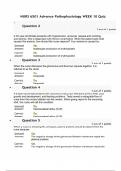
• Question 2 1 out of 1 points NURS 6501 Advance Pathophysiology WEEK 10 Quiz A 45-year-old female presents with hypertension, anorexia, nausea and vomiting, and anemia. She is diagnosed with chronic renal failure. When the patient asks what caused this anemia, how should the nurse respond? Your anemia is caused by: Selected Answer: Correct Answer: b. Inadequate production of erythropoietin b. Inadequate production of erythropoietin When the nurse discusses the glomerulus and Bowman capsule together, it is referred to as the renal: Selected Answer: Correct Answer: a. Corpuscle a. Corpuscle A 3-year-old female presents with recurrent urinary tract infections (UTIs), fever, poor growth and development, and feeding problems. Tests reveal a retrograde flow of urine from the urinary bladder into the ureters. When giving report to the oncoming shift, the nurse will call this condition: Selected Answer: Correct Answer: a. Vesicoureteral reflux (VUR) a. Vesicoureteral reflux (VUR) When a nurse is checking the urinalysis, plasma proteins should be absent from the urine because: Selected Answer: Correct Answer: d. The negative charge of the glomerular filtration membrane repels the plasma proteins. d. The negative charge of the glomerular filtration membrane repels the • • • plasma proteins. When a child is admitted with acute renal failure, a clinician realizes the most common cause of acute renal failure is: Selected Answer: Correct Answer: d. Hemolytic uremic syndrome (HUS) d. Hemolytic uremic syndrome (HUS) A 5-year-old male was diagnosed with glomerulonephritis. History reveals that he had an infection 3 weeks before the onset of this condition. The infection was most likely located in the: Selected Answer: Correct Answer: c. Respiratory tract c. Respiratory tract A 60-year-old male is diagnosed with renal failure. While the nurse is reviewing lab results, which of the following lab values would be most consistent with this diagnosis? Selected Answer: Correct Answer: a. Elevated plasma creatinine level a. Elevated plasma creatinine level Anemia accompanies chronic renal failure because of: Selected Answer: Correct Answer: c. Inadequate production of erythropoietin c. Inadequate production of erythropoietin • • • • The urologist is teaching about the nephrons that determine the concentration of the urine. The urologist is discussing the nephrons. Selected Answer: Correct Answer: a. Juxtamedullary a. Juxtamedullary A nurse is reviewing urinalysis results and notices glucose is present in the urine. A nurse realizes glucose will be excreted in the urine when: Selected Answer: Correct Answer: b. The carrier molecules have reached their maximum b. The carrier molecules have reached their maximum A 29-year-old female presents with cloudy urine, flank pain, hematuria, and fever. Which of the following does the nurse suspect the patient is most likely experiencing? Selected Answer: Correct Answer: a. Acute cystitis a. Acute cystitis A 15-year-old female presents with flank pain, irritability, malaise, and fever. Tests reveal glomerulonephritis. When the parents ask what could have caused this, how should the nurse respond? Selected Answer: Correct Answer: a. Poststreptococcal infection a. Poststreptococcal infection A 15-year-old male was diagnosed with pharyngitis. Eight days later he developed acute glomerulonephritis. While reviewing the culture results, which of the following is the most likely cause of this disease? • • • • Selected Answer: Correct Answer: d. Group A ß-hemolytic streptococcus d. Group A ß-hemolytic streptococcus Which of the following clusters of symptoms would make a clinician suspect a child has developed glomerulonephritis? Selected Answer: Correct Answer: d. Gross hematuria, flank pain, and hypertension d. Gross hematuria, flank pain, and hypertension A 2-year-old male is diagnosed with Wilms tumor. Which of the following clinical conditions is often associated with this disease? Selected Answer: Correct Answer: b. Aniridia b. Aniridia A 7-year-old male presents to his primary care provider for incontinence. His mother indicates that he has never been continent. Which of the following is the most likely diagnosis the nurse will observe on the chart? Selected Answer: Correct Answer: c. Primary enuresis c. Primary enuresis A urologist is discussing a structure that supplies blood to the medulla. What is the urologist describing? Selected Answer: a. Renal arteries
Written for
- Institution
-
Walden University
- Course
-
NURS 6501 (NURS6501)
Document information
- Uploaded on
- October 26, 2024
- Number of pages
- 10
- Written in
- 2024/2025
- Type
- Exam (elaborations)
- Contains
- Questions & answers

Also available in package deal