Complete samenvatting
Advanced sociological theory
Week 1 – The structure of sociological explanation
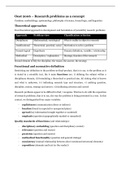
Problems are the starting point for theory formation and empirical research:
- Problem theory empirical research new problem …
Inequality problem = openness/closure of educational/health systems
Cohesion problem = amount of contact between members of a religious group
Cultural problem = use of online resources and networks
Common sense argumentation: the routine knowledge we have of our everyday world and
activities
- Illusory superiority effect = people rate themselves higher in different abilities
Types of explanations:
1. Covering law explanations = the phenomenon is explained by a causal law
2. Statistical explanations = the phenomenon is explained by a statistical relationship
3. Mechanism explanations = the phenomenon is explained by means of an action-based
explanation
Explanations should make understandable how macro-conditions affect individual behavior
and how behavioral reactions of many lead back to macro-outcome.
Syllogism = building block of a theory or model
Five important aspects of theory building:
1. Be precise
2. Avoid black boxes
3. Include micro level
4. Model the micro-macro transformation
5. Behavioral theory
Week 2 – Cooperation in social dilemmas (I)
Iban Khaldun
Cooperation is necessary for people’s survival and to become more productive
Close contact and affection is necessary for cooperation
‘Stick of the loyal authority’
Thomas Hobbes, three causes of conflicts:
1. Competition
2. Mistrust
3. Thirst for glory
Solution: we need a leader who takes control
Emile Durkheim, critique of ‘utilitarianism’:
, - Mechanical solidarity = social integration of members of a society who have common
values and beliefs
- Organic solidarity = social integration that arises out of the need of individuals for one
another’s services
Game theory is designed to address situations in which the outcome of a person’s decision
depends not just on how they choose among several options, but also on the choices made by
the people they are interacting with.
A game is any situation with the following aspects:
- There is a set of participants (players)
- Each player has a set of options for how to behave (strategies)
- For each choice of strategies, each player receives a payoff (the higher, the better)
Best reply = the best choice of one player, given a belief about what the other player will do
Dominant strategy = strategy that is a best response to every strategy of the other player
Nash-equilibrium = a strategy combination
Pareto optimality = if there is no other strategy combination that yields payoffs that are not
lower for any player and at least one player earns a higher payoff
Pure strategy = choose a specific option (C or D) with certainty
Mixed strategy = choose between options with a certain probability (randomly choose C or D)
Security dilemma = nations often seek their own security through means which challenge the
security of others
Week 3 – Cooperation in social dilemmas (II)
The repeated prisoner’s dilemma:
- PD gets played 10 times, after each round they get updated about another’s behavior
(C or D) from the last round
- The payoff for the RPD is the count of his or her payoffs in each round
T>P>R>S
T: temptation of defection
P: mutual cooperation
R: mutual defection
S: if you cooperate against a defector
Strategies:
- All D = always defect
- Tit-for-Tat = start with cooperation and play whatever the other played in the round
before
- Tit-for-two-Tats = defect only after the other player defects on the preceding two moves
Crucial trade-off:
- Short term gains for defection higher
- Long-term gains for cooperation higher
When is cooperation possible?
- Strategies are conditional: cooperation is rewarded by cooperation, defection is
punished through defection
- Dependence of players on each other is strong enough: enough rounds to be played
- Long-term benefits of cooperation are larger than the short-term temptation to defect
- All D is always and equilibrium
Advanced sociological theory
Week 1 – The structure of sociological explanation
Problems are the starting point for theory formation and empirical research:
- Problem theory empirical research new problem …
Inequality problem = openness/closure of educational/health systems
Cohesion problem = amount of contact between members of a religious group
Cultural problem = use of online resources and networks
Common sense argumentation: the routine knowledge we have of our everyday world and
activities
- Illusory superiority effect = people rate themselves higher in different abilities
Types of explanations:
1. Covering law explanations = the phenomenon is explained by a causal law
2. Statistical explanations = the phenomenon is explained by a statistical relationship
3. Mechanism explanations = the phenomenon is explained by means of an action-based
explanation
Explanations should make understandable how macro-conditions affect individual behavior
and how behavioral reactions of many lead back to macro-outcome.
Syllogism = building block of a theory or model
Five important aspects of theory building:
1. Be precise
2. Avoid black boxes
3. Include micro level
4. Model the micro-macro transformation
5. Behavioral theory
Week 2 – Cooperation in social dilemmas (I)
Iban Khaldun
Cooperation is necessary for people’s survival and to become more productive
Close contact and affection is necessary for cooperation
‘Stick of the loyal authority’
Thomas Hobbes, three causes of conflicts:
1. Competition
2. Mistrust
3. Thirst for glory
Solution: we need a leader who takes control
Emile Durkheim, critique of ‘utilitarianism’:
, - Mechanical solidarity = social integration of members of a society who have common
values and beliefs
- Organic solidarity = social integration that arises out of the need of individuals for one
another’s services
Game theory is designed to address situations in which the outcome of a person’s decision
depends not just on how they choose among several options, but also on the choices made by
the people they are interacting with.
A game is any situation with the following aspects:
- There is a set of participants (players)
- Each player has a set of options for how to behave (strategies)
- For each choice of strategies, each player receives a payoff (the higher, the better)
Best reply = the best choice of one player, given a belief about what the other player will do
Dominant strategy = strategy that is a best response to every strategy of the other player
Nash-equilibrium = a strategy combination
Pareto optimality = if there is no other strategy combination that yields payoffs that are not
lower for any player and at least one player earns a higher payoff
Pure strategy = choose a specific option (C or D) with certainty
Mixed strategy = choose between options with a certain probability (randomly choose C or D)
Security dilemma = nations often seek their own security through means which challenge the
security of others
Week 3 – Cooperation in social dilemmas (II)
The repeated prisoner’s dilemma:
- PD gets played 10 times, after each round they get updated about another’s behavior
(C or D) from the last round
- The payoff for the RPD is the count of his or her payoffs in each round
T>P>R>S
T: temptation of defection
P: mutual cooperation
R: mutual defection
S: if you cooperate against a defector
Strategies:
- All D = always defect
- Tit-for-Tat = start with cooperation and play whatever the other played in the round
before
- Tit-for-two-Tats = defect only after the other player defects on the preceding two moves
Crucial trade-off:
- Short term gains for defection higher
- Long-term gains for cooperation higher
When is cooperation possible?
- Strategies are conditional: cooperation is rewarded by cooperation, defection is
punished through defection
- Dependence of players on each other is strong enough: enough rounds to be played
- Long-term benefits of cooperation are larger than the short-term temptation to defect
- All D is always and equilibrium