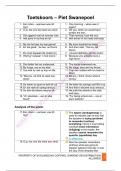
Toetskoors – Piet Swanepoel
1. Een môre – wanneer was dit 1. One morning – when was it
tog? again?
2. O ja, toe ons die toets sou skryf, 2. Oh yes, when we would have
written the test,
3. Die oggend voel ek sommer siek 3. That morning I just felt sick
4. met pyne in my kop en lyf. 4. with aches in my head and body.
5. My ma het aan my kop gevoel 5. My mom touched my head
6. En toe gesê: “Ja-nee, ou Doors 6. And then said, “Yes-no, old
Doors
7. Ek moet bepaald die dokter kry 7. I should definitely get the doctor
8. Want jy’t sowaar ‘n hoë koors.” 8. Because you actually have a
high fever.”
9. Die dokter het my ondersoek, 9. The doctor examined me,
10. My longe, ore en my keel. 10. My lungs, ears and my throat.
11. Toe knik hy met sy kop vir Ma: 11. Then he nodded with his head to
Mom:
12. “Mevrou, ek dink ek weet wat 12. Ma’am, I think I know what is
skeel.” wrong.”
13. Hy neem sy spuit en trek dit vol 13. He takes his syringe and fills it up
14. En toe raak ek opreg benoud, 14. And then I became truly anxious,
15. Hy trek die lakens weg en sê: 15. He pulls the sheets to the side
and says,
16. “Vir skoolsiek – een in elke 16. “For being school sick – one in
boud!” each buttock!”
Analysis of the poem
17. Een môre – wanneer was dit The hypen (aandagstreep) is
tog? used to indicate (aan te dui) that
the speaker is trying (probeer)
to remember (onthou)
something, hence it is providing
(verskaf) extra information
(inligting) to the reader: the
speaker cannot remember the
specific (spesifieke) day.
w-alliterasie
18. O ja, toe ons die toets sou skryf, Now the speaker remembers
(onthou) what was going to
happen (gebeur) that day: it was
the day of the dreaded test.
PROPERTY OF M SOUNES NO COPYING, SHARING OR DISTRIBUTION
1
ALLOWED
1. Een môre – wanneer was dit 1. One morning – when was it
tog? again?
2. O ja, toe ons die toets sou skryf, 2. Oh yes, when we would have
written the test,
3. Die oggend voel ek sommer siek 3. That morning I just felt sick
4. met pyne in my kop en lyf. 4. with aches in my head and body.
5. My ma het aan my kop gevoel 5. My mom touched my head
6. En toe gesê: “Ja-nee, ou Doors 6. And then said, “Yes-no, old
Doors
7. Ek moet bepaald die dokter kry 7. I should definitely get the doctor
8. Want jy’t sowaar ‘n hoë koors.” 8. Because you actually have a
high fever.”
9. Die dokter het my ondersoek, 9. The doctor examined me,
10. My longe, ore en my keel. 10. My lungs, ears and my throat.
11. Toe knik hy met sy kop vir Ma: 11. Then he nodded with his head to
Mom:
12. “Mevrou, ek dink ek weet wat 12. Ma’am, I think I know what is
skeel.” wrong.”
13. Hy neem sy spuit en trek dit vol 13. He takes his syringe and fills it up
14. En toe raak ek opreg benoud, 14. And then I became truly anxious,
15. Hy trek die lakens weg en sê: 15. He pulls the sheets to the side
and says,
16. “Vir skoolsiek – een in elke 16. “For being school sick – one in
boud!” each buttock!”
Analysis of the poem
17. Een môre – wanneer was dit The hypen (aandagstreep) is
tog? used to indicate (aan te dui) that
the speaker is trying (probeer)
to remember (onthou)
something, hence it is providing
(verskaf) extra information
(inligting) to the reader: the
speaker cannot remember the
specific (spesifieke) day.
w-alliterasie
18. O ja, toe ons die toets sou skryf, Now the speaker remembers
(onthou) what was going to
happen (gebeur) that day: it was
the day of the dreaded test.
PROPERTY OF M SOUNES NO COPYING, SHARING OR DISTRIBUTION
1
ALLOWED