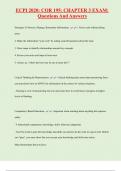
ECPI 2020: COR 195: CHAPTER 3 EXAM:
Questions And Answers
Strategies To Process, Manage, Remember Information: 1. Never read without taking
notes
2. Make the information "your own" by asking yourself questions about the topic
3. Draw maps to identify relationships amount key concepts
4. Revise your notes and maps at least once
5. Always as, "what's the best way for me to learn this"?
Critical Thinking & Memorization: - Critical thinking takes more than memorizing facts -
you must know how to APPLY the information in the context of various situations.
- Nursing is a lot of memorizing, but you must learn how to recall facts to progress to higher
levels of thinking.
Competency-Based Education: - Important when teaching about anything that requires
safety
- 4 interrelated components: knowledge, skills, behavior, judgement.
- You first work to gain the knowledge and skills you need to do the work in a given role. Before
you "pass", you must show that you can put your knowledge and skills into action.
Must demonstrate that you have:
, ECPI 2020: COR 195: CHAPTER 3 EXAM:
Questions And Answers
1. The behaviors needed to effectively manage every situation
2. The judgement to address situations in which straightforward answers aren't apparent.
Use the ABCD (Authority, Bias, Citations, Dates) method to evaluate the reliability of web pages
and other works: A - AUTHORITY: How well known is the author?
B - BIAS: Does the site try to persuade the reader rather than inform?
C - CITATIONS: Are full citations given to support this work?
D - DATES: How recent are the dates listed?
"Grab The Spoon": - You're accountable for knowing the limits of your own knowledge.
- Keep patient safety #1.
- Get help if you're unsure.
Accessing, Analyzing, Applying Information: 1. Make connections with people in key
roles: introduce yourself to librarians, educators, informatics nurses.
2. Ask for help if you get stuck.
3. Verify information with the primary sources
4. Compare the information with at least two other reputable sources on the same topic
Questions And Answers
Strategies To Process, Manage, Remember Information: 1. Never read without taking
notes
2. Make the information "your own" by asking yourself questions about the topic
3. Draw maps to identify relationships amount key concepts
4. Revise your notes and maps at least once
5. Always as, "what's the best way for me to learn this"?
Critical Thinking & Memorization: - Critical thinking takes more than memorizing facts -
you must know how to APPLY the information in the context of various situations.
- Nursing is a lot of memorizing, but you must learn how to recall facts to progress to higher
levels of thinking.
Competency-Based Education: - Important when teaching about anything that requires
safety
- 4 interrelated components: knowledge, skills, behavior, judgement.
- You first work to gain the knowledge and skills you need to do the work in a given role. Before
you "pass", you must show that you can put your knowledge and skills into action.
Must demonstrate that you have:
, ECPI 2020: COR 195: CHAPTER 3 EXAM:
Questions And Answers
1. The behaviors needed to effectively manage every situation
2. The judgement to address situations in which straightforward answers aren't apparent.
Use the ABCD (Authority, Bias, Citations, Dates) method to evaluate the reliability of web pages
and other works: A - AUTHORITY: How well known is the author?
B - BIAS: Does the site try to persuade the reader rather than inform?
C - CITATIONS: Are full citations given to support this work?
D - DATES: How recent are the dates listed?
"Grab The Spoon": - You're accountable for knowing the limits of your own knowledge.
- Keep patient safety #1.
- Get help if you're unsure.
Accessing, Analyzing, Applying Information: 1. Make connections with people in key
roles: introduce yourself to librarians, educators, informatics nurses.
2. Ask for help if you get stuck.
3. Verify information with the primary sources
4. Compare the information with at least two other reputable sources on the same topic