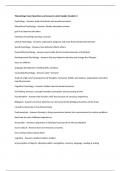
Thanatology Exam Questions and Answers Latest Update Graded A+
Psychology - Answers study of behavior and mental processes
Educational Psychology - Answers Studies education systems
goal is to improve education
methods of teaching, learning, curricula
Clinical Psychology - Answers understand, diagnose and treat abnormal/deviant behavior
Social Psychology - Answers how behavior effects others
Personality Psychology - Answers personality tied to mental processes of individual
Developmental Psychology - Answers the way behaviors develop and change thru lifespan
focus on children
language development, thinking skills, emotions
Counseling Psychology - Answers Latin "to know"
study of origins and consequences of thoughts, memories, beliefs, perceptions, explanations and other
mental processes
Cognitive Psychology - Answers Studies internal mental processes
ie) thinking, memory, concept formation, perception and processing of info.
Functionalism - Answers the function, NOT the structure of conscious experience
Biological - Answers all of our behaviors can be traced to the biological functions of the brain.
caused by chemicals of our physical body
Psychoanalysis - Answers therapy to bring unconscious desires into consciousness to resolve problems.
date back to early childhood experiences
Humanistic - Answers uniqueness of individual and search for self actualization
Socio-cultural - Answers how one interacts w/society
how society/culture impact them
Cognitive - Answers simplest matters studied
ie) perception of objects, attention pattern recognition, memory, language, reading & writing
, Structuralism - Answers reducing experience to its most basic parts, determining the laws by which the
parts are synthesized.
investigating the structure and content of mental state by introspection.
Psychiatrist - Answers medical doctor
completed training in field of mental health/psychiatric residency
Psychologist - Answers has doctor of philosophy degree in psychology but are NOT medical doctors
Motivation - Answers initiates, directs, and sustains behavior satisfying physiological or psychological
needs.
1. Physiological needs(food, sleep,activity)
2. Safety needs(security, protection)
3.Love & Belongingness needs(love, friendship, comradeship)
4.Esteem needs(self respect, personal worth, autonomy)
5.Self actualization (full potential) - Answers Maslow's Hierarchy of Needs
2 main factors that govern human motivation
- maintenance (working conditions)
-motivation (growth)
once maintenance goals achieved, the employee can work toward motivational goals to excel. - Answers
Herzberg's Two Factor Theory
X: employees lazy, only concerned for money
Y: employees will excel if given right environment & opportunity - Answers McGregor's Theory X and
Theory Y
Theory Z - Answers employees motivated if they actively participate in decision making at all levels of
organization.
Expectancy Theory - Answers motivation to accomplish task is linked to receiving reward
Drive Theory - Answers eliminating unpleasant states due to biological needs
ie) drinking when thirsty
Equity Theory - Answers motivated by past experience of amount of reward given for effort put forth
Psychology - Answers study of behavior and mental processes
Educational Psychology - Answers Studies education systems
goal is to improve education
methods of teaching, learning, curricula
Clinical Psychology - Answers understand, diagnose and treat abnormal/deviant behavior
Social Psychology - Answers how behavior effects others
Personality Psychology - Answers personality tied to mental processes of individual
Developmental Psychology - Answers the way behaviors develop and change thru lifespan
focus on children
language development, thinking skills, emotions
Counseling Psychology - Answers Latin "to know"
study of origins and consequences of thoughts, memories, beliefs, perceptions, explanations and other
mental processes
Cognitive Psychology - Answers Studies internal mental processes
ie) thinking, memory, concept formation, perception and processing of info.
Functionalism - Answers the function, NOT the structure of conscious experience
Biological - Answers all of our behaviors can be traced to the biological functions of the brain.
caused by chemicals of our physical body
Psychoanalysis - Answers therapy to bring unconscious desires into consciousness to resolve problems.
date back to early childhood experiences
Humanistic - Answers uniqueness of individual and search for self actualization
Socio-cultural - Answers how one interacts w/society
how society/culture impact them
Cognitive - Answers simplest matters studied
ie) perception of objects, attention pattern recognition, memory, language, reading & writing
, Structuralism - Answers reducing experience to its most basic parts, determining the laws by which the
parts are synthesized.
investigating the structure and content of mental state by introspection.
Psychiatrist - Answers medical doctor
completed training in field of mental health/psychiatric residency
Psychologist - Answers has doctor of philosophy degree in psychology but are NOT medical doctors
Motivation - Answers initiates, directs, and sustains behavior satisfying physiological or psychological
needs.
1. Physiological needs(food, sleep,activity)
2. Safety needs(security, protection)
3.Love & Belongingness needs(love, friendship, comradeship)
4.Esteem needs(self respect, personal worth, autonomy)
5.Self actualization (full potential) - Answers Maslow's Hierarchy of Needs
2 main factors that govern human motivation
- maintenance (working conditions)
-motivation (growth)
once maintenance goals achieved, the employee can work toward motivational goals to excel. - Answers
Herzberg's Two Factor Theory
X: employees lazy, only concerned for money
Y: employees will excel if given right environment & opportunity - Answers McGregor's Theory X and
Theory Y
Theory Z - Answers employees motivated if they actively participate in decision making at all levels of
organization.
Expectancy Theory - Answers motivation to accomplish task is linked to receiving reward
Drive Theory - Answers eliminating unpleasant states due to biological needs
ie) drinking when thirsty
Equity Theory - Answers motivated by past experience of amount of reward given for effort put forth