ID&E Lecture 1
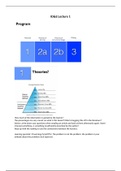
How much of the information is gained by the learner?
The percentages are very round, on what is this based? What is begging this off in the literature?
Advice: write down your questions when reading an article and look at them afterwards again. Have I
misread something, is something insufficiently described by the author?
Keep up with the reading to see the connections between the lectures.
Learning pyramid Learning PyraMYTH. The problem is not the problem: the problem is your
attitude about the problem (Jack Sparrow).
,cMOOC and xMOOC: how can you apply the theory on the practice? The image is for background
information. Content-based XMOOC and Connectivist CMOOC
Merrill: 5 principles: You take a problem, you activate prior knowledge, you demonstrate the new
information, you let the learner apply the new learned thing and you let them integrate the
knowledge with the previous learned knowledge.
What are theories? (4 conceptualizations)
Prescriptive: how can the principles be used for designs.
Articles which use theory: 174 explicitly, 120 vaguely and 209 not.
It also differs between kinds of articles: descriptive, correlational, comparison, mixed and other.
Question things when you read them.
, What are the alignment issues in articles?
Can theories be used in addition or will they just cause pitfalls?
Learning mechanism: behaviorism, food-experiment. What is the learning mechanism of the
dog? They recorded the dogs head as a black box. You can look with different paradigms to
the animal experiments.
Cognition/emotion: When a cats belly is full, it will not pull the lever for more food.
Whole task: cognitive overload?
Context: social constructivism.
Meer verschillen kennen en kunnen uitleggen tussen deze 3 paradigma’s.
How much of the information is gained by the learner?
The percentages are very round, on what is this based? What is begging this off in the literature?
Advice: write down your questions when reading an article and look at them afterwards again. Have I
misread something, is something insufficiently described by the author?
Keep up with the reading to see the connections between the lectures.
Learning pyramid Learning PyraMYTH. The problem is not the problem: the problem is your
attitude about the problem (Jack Sparrow).
,cMOOC and xMOOC: how can you apply the theory on the practice? The image is for background
information. Content-based XMOOC and Connectivist CMOOC
Merrill: 5 principles: You take a problem, you activate prior knowledge, you demonstrate the new
information, you let the learner apply the new learned thing and you let them integrate the
knowledge with the previous learned knowledge.
What are theories? (4 conceptualizations)
Prescriptive: how can the principles be used for designs.
Articles which use theory: 174 explicitly, 120 vaguely and 209 not.
It also differs between kinds of articles: descriptive, correlational, comparison, mixed and other.
Question things when you read them.
, What are the alignment issues in articles?
Can theories be used in addition or will they just cause pitfalls?
Learning mechanism: behaviorism, food-experiment. What is the learning mechanism of the
dog? They recorded the dogs head as a black box. You can look with different paradigms to
the animal experiments.
Cognition/emotion: When a cats belly is full, it will not pull the lever for more food.
Whole task: cognitive overload?
Context: social constructivism.
Meer verschillen kennen en kunnen uitleggen tussen deze 3 paradigma’s.