Lecture 3 ID&E Expertise development
Aims of the lecture
1. Develop knowledge concerning the construct ‘expertise’
2. Understand how expertise can be developed and boosted
Overview
1. Expertise characteristics
2. Expertise development
• Phase models (Dreyfus & Dreyfus, Benner, Fitts & Posner, ZPD)
• Sternberg’s intelligence
• Dunphy & Williamson (2004)
3. Boosting expertise
• Ericsson’s Deliberate Practice
4. Adaptive expertise
1. Expertise characteristics
Importance of expertise
• Development
• Training
• Design
• Professionals, accountability
• Assessment and evaluation
Perspectives concerning expertise
• Behaviorism: expertise = observable behavior (performance)
• Cognitive psychology: cognitive processes underlying cognitive processes behavior
• Socio-constructivism, adequate execution of tasks in context (environment), also focused on
subjective aspects (e.g., practical knowledge) and task experience
, Cognitive + socio-cognitive
Difficult to find representative tasks
Automation (chunking; Miller, 1956)
Why is it important for a person to do things automatically?
- Create space in your working memory (because knowledge is already stored in the LTM).
Encapsulated: knowledge is just there, it does not have to go through a working memory, knowledge
is structured/organized (see next slide on coughing).
Structured knowledge by experts
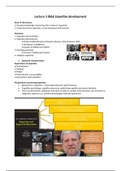
Expertise of chess players (De Groot, 1914-2006)
• Chess experts have a superior memory in meaningful
patterns on the chess board (1965)
• But only when it concerns actual chess positions (not
random positions or positions without structure)
• Gains for research on expertise:
o Being able to generate meaningful
patterns is conditional for expertise
development
o Measure expertise with
authentic/representative tasks
• In a random arrangement there cannot be seen a
chess pattern.
o Explanation: recognize patterns (cognitive load).
• Grandmaster vs. club players: look 5 sec at the chess position. Reconstruct the position.
Grandmaster is better (93% correct) than Club players (51%) in real chess positions.
Aims of the lecture
1. Develop knowledge concerning the construct ‘expertise’
2. Understand how expertise can be developed and boosted
Overview
1. Expertise characteristics
2. Expertise development
• Phase models (Dreyfus & Dreyfus, Benner, Fitts & Posner, ZPD)
• Sternberg’s intelligence
• Dunphy & Williamson (2004)
3. Boosting expertise
• Ericsson’s Deliberate Practice
4. Adaptive expertise
1. Expertise characteristics
Importance of expertise
• Development
• Training
• Design
• Professionals, accountability
• Assessment and evaluation
Perspectives concerning expertise
• Behaviorism: expertise = observable behavior (performance)
• Cognitive psychology: cognitive processes underlying cognitive processes behavior
• Socio-constructivism, adequate execution of tasks in context (environment), also focused on
subjective aspects (e.g., practical knowledge) and task experience
, Cognitive + socio-cognitive
Difficult to find representative tasks
Automation (chunking; Miller, 1956)
Why is it important for a person to do things automatically?
- Create space in your working memory (because knowledge is already stored in the LTM).
Encapsulated: knowledge is just there, it does not have to go through a working memory, knowledge
is structured/organized (see next slide on coughing).
Structured knowledge by experts
Expertise of chess players (De Groot, 1914-2006)
• Chess experts have a superior memory in meaningful
patterns on the chess board (1965)
• But only when it concerns actual chess positions (not
random positions or positions without structure)
• Gains for research on expertise:
o Being able to generate meaningful
patterns is conditional for expertise
development
o Measure expertise with
authentic/representative tasks
• In a random arrangement there cannot be seen a
chess pattern.
o Explanation: recognize patterns (cognitive load).
• Grandmaster vs. club players: look 5 sec at the chess position. Reconstruct the position.
Grandmaster is better (93% correct) than Club players (51%) in real chess positions.