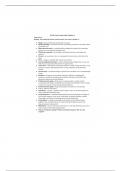
PSY101 Unit 4 Study Guide (Matthews)
Topic: Stress
Reading: The healthy life (Hooker and Pressman). Screencasts: Module 4.1.
● Health - physical health and mental health of a person
● Health psychology - research into the role of psychology and behavior in health, disease,
and medical care.
● Biopsychosocial model - a multidisciplinary paradigm that examines the connections
between socio environmental, biological, and
● Mind-body connection - the exchange of information between your thoughts and
emotions.
● Stressor - any occurrence, force, or circumstance that causes stress on the body or the
mind.
● Stress - a things or a problem that a person worries about
● General Adaptation Syndrome - outlines the physiological changes that occur in your
body when you experience either positive or negative stress.
● Acute stress - a brief period of time lasting less than a month, starting soon after a severe
traumatic occurrence and characterized by a strong, unpleasant, and dysfunctional
reaction.
● Chronic stress - Continuous feelings of pressure and overwhelm over an extended length
of time.
● Resilience - the process of successfully adjusting to difficult or demanding life
experiences, particularly through mental, emotional, and behavioral flexibility and
adjusting to internal and external demands.
● Problem-focused coping - all the proactive measures taken to control stressful
circumstances and change a troubled person-environment relationship in order to change
or remove the sources of stress through individual behavior.
● Emotion-focused coping - things just focusing on the emotions not the problem
● Control - full focus and control
● Self-efficacy - a person's confidence in their ability to carry out the actions required to
achieve particular performance goals
● Social integration - a multidimensional construct that can be described as the degree to
which people engage in various social relationships, including friendships, romantic
relationships, and feelings of belonging and social role identification.
● Social support - a support system made up of members of one's family, friends,
neighbors, and community that can be contacted for psychological, material, and
financial assistance when needed.
● Biofeedback - a process that teaches someone how to alter their physiological activity in
order to improve their health and performance.
● What is stressful for antelope? What is stressful for primates? How do each
respond?
, ● What are some negative effects of stress on the mind, body, emotions, and behavior?
● What are some examples of problem-focused and emotion-focused coping? How can
they both be useful?
● What is the upside (positive effects) of stress? How does believing stress is bad
(rather than stress itself) influence the risk of death and the activity of blood
vessels?
● What are the stages of change?
Topic: Disorders
Reading: Anxiety and anxiety related disorders (Barlow and Ellard), Mood disorders
(Gershon and Thompson), Schizophrenia spectrum disorders (Barch). Screencasts: Modules
3.2, 3.3, 3.4.
Diagnosis
● Disordered - by a cognitive, emotional regulation, or behavioral disorder that is
clinically severe.
● Deviant - a set of behaviors or a single behavior that deviates from socially acceptable
moral, legal, or ethical criteria
● Distressing - general signs of sadness, anxiety, and stress
● Dysfunctional - Disturbances in a person's thinking, emotional control, or behavior that
manifest considerable malfunction in the psychological, biological, or developmental
mechanisms underpinning mental functioning are referred to as dysfunction.
● Comorbid - the coexistence of multiple disorders in one person.
● DSM-5 - is a manual for the evaluation and diagnosis of mental disorders; it does not
contain advice or recommendations for treating any disorder.
● Biopsychosocial model - a multidisciplinary paradigm that examines the connections
between socio environmental, biological, and psychological aspects.
● Prevalence - the percentage of a population that, over time, possesses a particular trait.
● Continuum (spectrum) - a strategy built on the premise that behavior can range from
normal functioning to severe abnormality.
● Can symptoms vary over time?
● Just because you think someone’s thinking or behavior is unusual, does that mean it
is disordered?
Anxiety disorders
● Generalized anxiety disorder - involves excessive worry that interferes with daily
activities and is persistent.
● Panic disorder - a type of anxiety condition when you frequently experience panic or
dread attacks.
Topic: Stress
Reading: The healthy life (Hooker and Pressman). Screencasts: Module 4.1.
● Health - physical health and mental health of a person
● Health psychology - research into the role of psychology and behavior in health, disease,
and medical care.
● Biopsychosocial model - a multidisciplinary paradigm that examines the connections
between socio environmental, biological, and
● Mind-body connection - the exchange of information between your thoughts and
emotions.
● Stressor - any occurrence, force, or circumstance that causes stress on the body or the
mind.
● Stress - a things or a problem that a person worries about
● General Adaptation Syndrome - outlines the physiological changes that occur in your
body when you experience either positive or negative stress.
● Acute stress - a brief period of time lasting less than a month, starting soon after a severe
traumatic occurrence and characterized by a strong, unpleasant, and dysfunctional
reaction.
● Chronic stress - Continuous feelings of pressure and overwhelm over an extended length
of time.
● Resilience - the process of successfully adjusting to difficult or demanding life
experiences, particularly through mental, emotional, and behavioral flexibility and
adjusting to internal and external demands.
● Problem-focused coping - all the proactive measures taken to control stressful
circumstances and change a troubled person-environment relationship in order to change
or remove the sources of stress through individual behavior.
● Emotion-focused coping - things just focusing on the emotions not the problem
● Control - full focus and control
● Self-efficacy - a person's confidence in their ability to carry out the actions required to
achieve particular performance goals
● Social integration - a multidimensional construct that can be described as the degree to
which people engage in various social relationships, including friendships, romantic
relationships, and feelings of belonging and social role identification.
● Social support - a support system made up of members of one's family, friends,
neighbors, and community that can be contacted for psychological, material, and
financial assistance when needed.
● Biofeedback - a process that teaches someone how to alter their physiological activity in
order to improve their health and performance.
● What is stressful for antelope? What is stressful for primates? How do each
respond?
, ● What are some negative effects of stress on the mind, body, emotions, and behavior?
● What are some examples of problem-focused and emotion-focused coping? How can
they both be useful?
● What is the upside (positive effects) of stress? How does believing stress is bad
(rather than stress itself) influence the risk of death and the activity of blood
vessels?
● What are the stages of change?
Topic: Disorders
Reading: Anxiety and anxiety related disorders (Barlow and Ellard), Mood disorders
(Gershon and Thompson), Schizophrenia spectrum disorders (Barch). Screencasts: Modules
3.2, 3.3, 3.4.
Diagnosis
● Disordered - by a cognitive, emotional regulation, or behavioral disorder that is
clinically severe.
● Deviant - a set of behaviors or a single behavior that deviates from socially acceptable
moral, legal, or ethical criteria
● Distressing - general signs of sadness, anxiety, and stress
● Dysfunctional - Disturbances in a person's thinking, emotional control, or behavior that
manifest considerable malfunction in the psychological, biological, or developmental
mechanisms underpinning mental functioning are referred to as dysfunction.
● Comorbid - the coexistence of multiple disorders in one person.
● DSM-5 - is a manual for the evaluation and diagnosis of mental disorders; it does not
contain advice or recommendations for treating any disorder.
● Biopsychosocial model - a multidisciplinary paradigm that examines the connections
between socio environmental, biological, and psychological aspects.
● Prevalence - the percentage of a population that, over time, possesses a particular trait.
● Continuum (spectrum) - a strategy built on the premise that behavior can range from
normal functioning to severe abnormality.
● Can symptoms vary over time?
● Just because you think someone’s thinking or behavior is unusual, does that mean it
is disordered?
Anxiety disorders
● Generalized anxiety disorder - involves excessive worry that interferes with daily
activities and is persistent.
● Panic disorder - a type of anxiety condition when you frequently experience panic or
dread attacks.