Key Terms
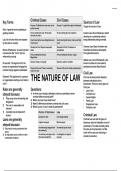
Criminal Cases Civil Cases Sources of Law
Purpose: To Maintain law and order and to Purpose: To uphold the rights of individuals 3 types of sources of Law:
protect society.
Rule: A general norm mandating or
guiding conduct. Person starting the case: Prosecutor ( Person starting the case: Claimant Custom Law: Rule of behaviour which
Normally the state ) develops in a community without
Law: Set of rules which are imposed Courts hearing the cases: Magistrates and Courts hearing the Cases: County and High being deliberately being invented.
by the state or country. Crown Court court
Standard of Proof: Beyond reasonable Standard of Proof: The balance of Common Law: Basis of modern law.
Norms of Behaviour: A social rule that doubt probabilities Unwritten law that has developed
is deemed as the “norm” and are Person making the decision: Person making the decision: Judge
from judicial decisions.
enforced by society Magistrates
Statute Law: Act of Parliament ( also
Decision: Guilty or not guilty Decision: Liable or not liable
Prosecutor: The legal term for the known as statue is a law made by
person or organisation bringing the Powers of the court: Prison, community Powers of the court: Usually compensation
parliament and has Royal Assent.
criminal charge against a defendant order, fine, ban
Civil Law
Claimant: The legal term for a person
or organisation starting a civil claim in
court
THE NATURE OF LAW Civil Law is about private disputes
between individuals and or
businesses. There are many types of
Civil Law:
Rules are generally Questions: • Law of tort
obeyed because: 1) In which court would a defendant, who has committed a minor • Contract Law
criminal offence be dealt with? • Human Rights
1) They carry sense of morality and
2) Where are most Laws made now? • Family Law
obligations
3) Name 3 differences between criminal and civil cases • Employment Law
2) The rule is reasonable and
4) Which source of Law is made by parliament? • Company Law
relevant
3) A penalty may be imposed if
broken Criminal Law
Laws are generally Criminal Law sets out the types of
behaviour which is forbidden at risk of
obeyed because: punishment. The state normally starts
1) They lead to harsh punishments like the case as the prosecutor, but the
prison victim of the case can also bring a
2) to help people avoid conflict or other private prosecution.
undesirable situations
Criminal Cases Civil Cases Sources of Law
Purpose: To Maintain law and order and to Purpose: To uphold the rights of individuals 3 types of sources of Law:
protect society.
Rule: A general norm mandating or
guiding conduct. Person starting the case: Prosecutor ( Person starting the case: Claimant Custom Law: Rule of behaviour which
Normally the state ) develops in a community without
Law: Set of rules which are imposed Courts hearing the cases: Magistrates and Courts hearing the Cases: County and High being deliberately being invented.
by the state or country. Crown Court court
Standard of Proof: Beyond reasonable Standard of Proof: The balance of Common Law: Basis of modern law.
Norms of Behaviour: A social rule that doubt probabilities Unwritten law that has developed
is deemed as the “norm” and are Person making the decision: Person making the decision: Judge
from judicial decisions.
enforced by society Magistrates
Statute Law: Act of Parliament ( also
Decision: Guilty or not guilty Decision: Liable or not liable
Prosecutor: The legal term for the known as statue is a law made by
person or organisation bringing the Powers of the court: Prison, community Powers of the court: Usually compensation
parliament and has Royal Assent.
criminal charge against a defendant order, fine, ban
Civil Law
Claimant: The legal term for a person
or organisation starting a civil claim in
court
THE NATURE OF LAW Civil Law is about private disputes
between individuals and or
businesses. There are many types of
Civil Law:
Rules are generally Questions: • Law of tort
obeyed because: 1) In which court would a defendant, who has committed a minor • Contract Law
criminal offence be dealt with? • Human Rights
1) They carry sense of morality and
2) Where are most Laws made now? • Family Law
obligations
3) Name 3 differences between criminal and civil cases • Employment Law
2) The rule is reasonable and
4) Which source of Law is made by parliament? • Company Law
relevant
3) A penalty may be imposed if
broken Criminal Law
Laws are generally Criminal Law sets out the types of
behaviour which is forbidden at risk of
obeyed because: punishment. The state normally starts
1) They lead to harsh punishments like the case as the prosecutor, but the
prison victim of the case can also bring a
2) to help people avoid conflict or other private prosecution.
undesirable situations