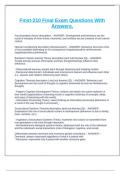
Fmst-210 Final Exam Questions With
Answers.
Psychoanalytic theory description. - ANSWER- Development and behaviour are the
result of interplay of inner drives, memories, and conflicts we are unaware of and cannot
control.
Operant conditioning description (behaviourism). - ANSWER- Behaviour becomes more
or less probable depending on its consequence (negative/positive reinforcement;
negative/positive punishment).
Bandura's Social Learning Theory description (and sub theories [2]). - ANSWER-
People actively process information and their thoughts/feelings influence their
behaviour.
- Observational learning: people learn through observing and imitating models.
- Reciprocal determinism: individuals and environment interact and influence each other
(i.e., parents and children influencing each other).
Cognitive Theories description ( and sub theories [2]). - ANSWER- Behaviour and
development are the result of thought or cognition (motivated by how we think/process
thought).
- Piaget's Cognitive Development Theory: children and adults are active explorers of
their world (organizations of learning results in cognitive schemas of concepts, ideas,
and ways of interacting with the world).
- Information Processing Theory: views thinking as information processing (behaviour is
a result of the way thought is processed_.
Sociocultural Systems Theories description (and sub theories [2]). - ANSWER-
Emphasizes the role of sociocultural context in development (behaviour is due to family,
town, contexts, etc.).
- Vygotsky's Sociocultural Systems Theory: examines how culture is transmitted from
one generation to the next through interaction.
- Bronfenbrenners biological systems theory: addresses both the role of the individual
and the individual's social interactions (role of biological, cognitive, and social).
Differentiate between dominant and recessive genetic inheritance. - ANSWER- -
Dominant: always expressed regardless of what it is paired with.
- Recessive: expressed only if paired with another recessive gene.
, Outline maternal characteristics' effect on development [4]. - ANSWER- 1.) Age:
increase in mother age = increase in still births (high risk = over 35 years of age).
2.) Nutrition: improper nutrition = pregnancy complications (common to be lacking folic
acid in developing countries).
3.) Emotional well-being: chronic/severe stress poses risk to the fetus (stress hormone
crosses the placenta resulting in long-term effects).
4.) Prenatal care:
Contextual Influences on Pubertal Timing [3]. - ANSWER- 1.) Nutrition (particularly in
females): ovulation and menstruation is triggered by leptin concentration (protein from
fat). Increase in lectin = increase in hormones = triggers onset on puberty and release
of egg.
2.) Stress: more stress = earlier onset of puberty.
3.) SES: poor families are linked with early onset of puberty (low SES = poor nutrition =
more fat = more leptin = earlier puberty).
Psychosocial Effects of Early and Late Puberty. - ANSWER- "Off-timed" puberty is
linked to general anxiety, and depression.
- Early: before 8 (for girls) and 9 (for boys). Early maturation is linked with more
problems than late: girls feel less positive about their bodies leading to eating disorders,
anxiety/depression, bullying, sexual harassment.
- Late: after 13 (girls) and 14 (boys).
Contextual factors influencing the effects of pubertal time. - ANSWER- Both boys and
girls who are early have a tendency to seek out relationships with older peers who
share similar physical characteristics.
- An early girl/boy will engage in age-innapropriate behaviour.
- E.g., early sexual activity, risks of pregnancy, STIs, mental health problems, abortion.
Parent characteristics as a risk factor for child maltreatment. - ANSWER- - Some
parents perceive normal child behaviour as non-compliancy (parents with no normal
knowledge of child development).
- Abuse drugs/alcohol.
- These parents will get easily frustrated, don't have good impulse control, or are
ignorant.
Marijuana use in teens/young adults (statistics). - ANSWER- - Average age of first use:
14 y/o.
- 24% of 15-24 y/o's have used in the last 3 months.
- Males use cannabis more often, and perceive it as less-risky.
Outline guided participation (what theory, description, difference with scaffolding). -
ANSWER- - Apart of Vygotsy's sociocultural perspective of cognitive change.
Answers.
Psychoanalytic theory description. - ANSWER- Development and behaviour are the
result of interplay of inner drives, memories, and conflicts we are unaware of and cannot
control.
Operant conditioning description (behaviourism). - ANSWER- Behaviour becomes more
or less probable depending on its consequence (negative/positive reinforcement;
negative/positive punishment).
Bandura's Social Learning Theory description (and sub theories [2]). - ANSWER-
People actively process information and their thoughts/feelings influence their
behaviour.
- Observational learning: people learn through observing and imitating models.
- Reciprocal determinism: individuals and environment interact and influence each other
(i.e., parents and children influencing each other).
Cognitive Theories description ( and sub theories [2]). - ANSWER- Behaviour and
development are the result of thought or cognition (motivated by how we think/process
thought).
- Piaget's Cognitive Development Theory: children and adults are active explorers of
their world (organizations of learning results in cognitive schemas of concepts, ideas,
and ways of interacting with the world).
- Information Processing Theory: views thinking as information processing (behaviour is
a result of the way thought is processed_.
Sociocultural Systems Theories description (and sub theories [2]). - ANSWER-
Emphasizes the role of sociocultural context in development (behaviour is due to family,
town, contexts, etc.).
- Vygotsky's Sociocultural Systems Theory: examines how culture is transmitted from
one generation to the next through interaction.
- Bronfenbrenners biological systems theory: addresses both the role of the individual
and the individual's social interactions (role of biological, cognitive, and social).
Differentiate between dominant and recessive genetic inheritance. - ANSWER- -
Dominant: always expressed regardless of what it is paired with.
- Recessive: expressed only if paired with another recessive gene.
, Outline maternal characteristics' effect on development [4]. - ANSWER- 1.) Age:
increase in mother age = increase in still births (high risk = over 35 years of age).
2.) Nutrition: improper nutrition = pregnancy complications (common to be lacking folic
acid in developing countries).
3.) Emotional well-being: chronic/severe stress poses risk to the fetus (stress hormone
crosses the placenta resulting in long-term effects).
4.) Prenatal care:
Contextual Influences on Pubertal Timing [3]. - ANSWER- 1.) Nutrition (particularly in
females): ovulation and menstruation is triggered by leptin concentration (protein from
fat). Increase in lectin = increase in hormones = triggers onset on puberty and release
of egg.
2.) Stress: more stress = earlier onset of puberty.
3.) SES: poor families are linked with early onset of puberty (low SES = poor nutrition =
more fat = more leptin = earlier puberty).
Psychosocial Effects of Early and Late Puberty. - ANSWER- "Off-timed" puberty is
linked to general anxiety, and depression.
- Early: before 8 (for girls) and 9 (for boys). Early maturation is linked with more
problems than late: girls feel less positive about their bodies leading to eating disorders,
anxiety/depression, bullying, sexual harassment.
- Late: after 13 (girls) and 14 (boys).
Contextual factors influencing the effects of pubertal time. - ANSWER- Both boys and
girls who are early have a tendency to seek out relationships with older peers who
share similar physical characteristics.
- An early girl/boy will engage in age-innapropriate behaviour.
- E.g., early sexual activity, risks of pregnancy, STIs, mental health problems, abortion.
Parent characteristics as a risk factor for child maltreatment. - ANSWER- - Some
parents perceive normal child behaviour as non-compliancy (parents with no normal
knowledge of child development).
- Abuse drugs/alcohol.
- These parents will get easily frustrated, don't have good impulse control, or are
ignorant.
Marijuana use in teens/young adults (statistics). - ANSWER- - Average age of first use:
14 y/o.
- 24% of 15-24 y/o's have used in the last 3 months.
- Males use cannabis more often, and perceive it as less-risky.
Outline guided participation (what theory, description, difference with scaffolding). -
ANSWER- - Apart of Vygotsy's sociocultural perspective of cognitive change.