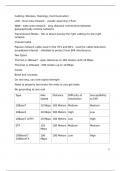
Cabling, Wireless, Topology, Communication
LAN - local area network - usually spanning 1 floor
WAN - wide area network - long distance connections between
geographically remote networks
Transmission Media - this is about having the right cabling for the right
network
Coaxial Cable
Popular network cable used in the 70's and 80's - used for cable television,
broadband Internet - shielded to protect from EMI interference
Two Types
Thinnet is 10baseT - span distances to 185 meters with 10 Mbps
Thicknet is 10base5 - 500 meters up to 10 Mbps
Issues
Bend and it breaks
Go too long, you lose signal strength
Need to properly terminate the ends or you get leaks
No grounding at one end
Type Max Distance Difficulty of Susceptibility
Speed Installation to EMI
10BaseT 10 Mbps 185 Meters Medium Medium
10Base5 10 Mbps 500 Meters High Low
10BaseT (UTP) 10 Mbps 100 Meters Low High
STP 155 100 Meters Medium Medium
Mbps
100BaseT/ 100 100 Meters Low High
100BaseTX Mbps
1
, 1000BaseT 1 Gbps 100 Meters Low High
Fiber Optic 2+ 2+ Hight to Medium None
Gbps Kilometers
Baseband - can transmit only a single signal at a time
Broadband - can transmit multiple signals simultaneously
Twisted Pair - thin and flexible - 4 pairs of wires - can be shielded - STP
without shield it is UTP - 10BaseT, 100BaseT, or 1000BaseT
UTP Throughp Notes
Category ut
CAT 1 Voice Not suitable for networks but usable for modems
Only
CAT 2 4 Mbps Not suitable for most networks, often employed for
host-to-host terminal connections on mainframes
CAT 3 10 Mbps Primarily used n 10BaseT Ethernet networks as
telephone cables only 4 Mbps if used for token ring
networks
CAT 4 16 Mbps Primarily used in Token Ring Networks
CAT 5 100 Mbps Used in 100BaseTX, FDDI, and ATM networks
CAT 6 1,000 Used in high-speed networks
Mbps
CAT 7 10 Gbps Used in 10G speed networks
Attenuation is the degradation of the signal - increases as speed increases -
supplemented through repeaters and concentrators to amplify the signal for
the next journey
2
LAN - local area network - usually spanning 1 floor
WAN - wide area network - long distance connections between
geographically remote networks
Transmission Media - this is about having the right cabling for the right
network
Coaxial Cable
Popular network cable used in the 70's and 80's - used for cable television,
broadband Internet - shielded to protect from EMI interference
Two Types
Thinnet is 10baseT - span distances to 185 meters with 10 Mbps
Thicknet is 10base5 - 500 meters up to 10 Mbps
Issues
Bend and it breaks
Go too long, you lose signal strength
Need to properly terminate the ends or you get leaks
No grounding at one end
Type Max Distance Difficulty of Susceptibility
Speed Installation to EMI
10BaseT 10 Mbps 185 Meters Medium Medium
10Base5 10 Mbps 500 Meters High Low
10BaseT (UTP) 10 Mbps 100 Meters Low High
STP 155 100 Meters Medium Medium
Mbps
100BaseT/ 100 100 Meters Low High
100BaseTX Mbps
1
, 1000BaseT 1 Gbps 100 Meters Low High
Fiber Optic 2+ 2+ Hight to Medium None
Gbps Kilometers
Baseband - can transmit only a single signal at a time
Broadband - can transmit multiple signals simultaneously
Twisted Pair - thin and flexible - 4 pairs of wires - can be shielded - STP
without shield it is UTP - 10BaseT, 100BaseT, or 1000BaseT
UTP Throughp Notes
Category ut
CAT 1 Voice Not suitable for networks but usable for modems
Only
CAT 2 4 Mbps Not suitable for most networks, often employed for
host-to-host terminal connections on mainframes
CAT 3 10 Mbps Primarily used n 10BaseT Ethernet networks as
telephone cables only 4 Mbps if used for token ring
networks
CAT 4 16 Mbps Primarily used in Token Ring Networks
CAT 5 100 Mbps Used in 100BaseTX, FDDI, and ATM networks
CAT 6 1,000 Used in high-speed networks
Mbps
CAT 7 10 Gbps Used in 10G speed networks
Attenuation is the degradation of the signal - increases as speed increases -
supplemented through repeaters and concentrators to amplify the signal for
the next journey
2