1|Page
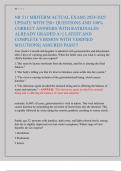
NR 511 MIDTERM ACTUAL EXAM|| 2024-2025
UPDATE WITH 250+ QUESTIONS AND 100%
CORRECT ANSWERS WITH RATIONALES
ALREADY GRADED A+|| LATEST AND
COMPLETE VERSION WITH VERIFIED
SOLUTIONS|| ASSURED PASS!!!
Your client's 2-month-old daughter is admitted with gastroenteritis and dehydration
after 2 days of vomiting and diarrhea. When the father asks you what is causing the
child's diarrhea, how do you respond?
1."She must be lactose intolerant from the formula, and this is altering the fluid
balance."
2."Her body's telling you that it's time to introduce some solids into her system."
3."The virus is causing irritation of the gastrointestinal lining, which causes
diarrhea."
4."The infectious agent invaded the stomach lining and is affecting the balance of
water and nutrients." - ANSWER: "The infectious agent invaded the stomach
lining and is affecting the balance of water and nutrients."
rationale: In 80% of cases, gastroenteritis is viral in nature. This viral infection
causes diarrhea by stimulating the secretion of electrolytes into the intestine. This
is rapidly followed by water along the osmotic gradient, resulting in watery stools.
Sandy, age 52, presents with jaundice, dark urine, and light-colored stools, stating
that she is slightly improved over last week's symptoms. Which stage of viral
hepatitis do you suspect?
1.Incubation.
2.Prodromal.
3.Icteric.
,2|Page
4.Convalescent. - ANSWER: Icteric
rationale: In the icteric stage of viral hepatitis, there is jaundice, dark urine, and
light-colored stools. There are continued prodromal complaints, with gradual
improvement.
Rose, a client with gastroesophageal reflux disease (GERD), has many other
concurrent conditions. In teaching Rose about medications to avoid, what do you
recommend she refrain from using?
1.Antibiotics.
2.Nonsteroidal anti-inflammatory drugs (NSAIDs).
3.Oral contraceptives.
4.Antifungals. - ANSWER: NSAIDS
rationale: Clients with GERD should avoid taking NSAIDs because they tend to
aggravate the already irritated gastric mucosa.
Lucy, age 49, has pain in both the left and right lower quadrants. What might you
suspect?
1.A gastric ulcer.
2.Gastritis.
3.Pelvic inflammatory disease.
4.Pancreatitis. - ANSWER: PID
rationale: The pain associated with pelvic inflammatory disease can be palpated in
both the right and left lower quadrants.
,3|Page
In a 2-month-old infant with vomiting and diarrhea, the most effective way of
determining a fluid deficit is to check for:
1.Decreased peripheral perfusion.
2.Hyperventilation.
3.Irritability.
4. Hyperthermia. - ANSWER: Decreased peripheral perfusion
rationale: In a 2-month-old infant with vomiting and diarrhea, the most effective
way of determining a fluid deficit is to check for decreased peripheral perfusion,
dry oral mucous membranes, and sunken fontanels. The body compensates for loss
of fluid by shifting the interstitial fluid into the intravascular space, thereby
maintaining perfusion of vital organs. If the fluid loss continues, circulating
volume is diminished and vasoconstriction occurs in the peripheral vessels,
resulting in decreased perfusion
You suspect that Harry has a peptic ulcer and tell him that it has been found to be
strongly associated with:
1.Anxiety and panic attacks.
2.Long-term use of nonsteroidal anti-inflammatory drugs (NSAIDs).
3.Infection by Helicobacter pylori.
4.A family history of peptic ulcers. - ANSWER: Infection by H. Pylori
rationale: About 90% of cases of peptic ulcers have been found to be caused by
infection with the bacteria H pylori
You suspect that Nikki has a gastroduodenal ulcer caused by Helicobacter pylori
and plan to treat her empirically. What medications should you order?
1.A proton pump inhibitor (omeprazole), tetracycline or amoxicillin, and
metronidazole (Flagyl).
, 4|Page
2.Bismuth subsalicylate (Pepto-Bismol) and omeprazole (Prilosec).
3.Amoxicillin (Amoxil) and omeprazole (Prilosec).
4.Clarithromycin (Biaxin) and metronidazole (Flagyl) - ANSWER: Amoxicillin
(Amoxil) and omeprazole (Prilosec)
rationale: Both drugs listed are used in the eradication of H pylori, but do not
complete the regimen.
A 7-year-old male presents with his mother to the urgent care clinic complaining of
abdominal pain. He started to complain of pain prior to going to bed; however, it
has gotten progressively worse and is now preventing him from sleeping. He is
nauseous but hasn't vomited and didn't eat dinner due to the pain. The patient
appears pale and is complaining of right-sided abdominal pain. His vitals are as
follows: blood pressure 130/85, pulse 120, temperature 100.5°F, pulse oximetry
98% on room air. On physical exam he is tender in the right lower quadrant. His
complete blood count (CBC) shows a white blood cell count (WBC) of 17.0. What
is the patient's likely diagnosis?
1.Appendicitis.
2.Cholecystitis.
3.Constipation.
4.Gastroenteritis - ANSWER: appendicitis
rationale: This is the clinical scenario typical for appendicitis
What is the recommended treatment to eradicate a Helicobacter pylori infection?
1.Ranitidine, amoxicillin, and clarithromycin for 2 weeks.
2.Amoxicillin, clarithromycin, and omeprazole for 2 weeks.
3.Bismuth, amoxicillin, and clarithromycin for 2 weeks.
NR 511 MIDTERM ACTUAL EXAM|| 2024-2025
UPDATE WITH 250+ QUESTIONS AND 100%
CORRECT ANSWERS WITH RATIONALES
ALREADY GRADED A+|| LATEST AND
COMPLETE VERSION WITH VERIFIED
SOLUTIONS|| ASSURED PASS!!!
Your client's 2-month-old daughter is admitted with gastroenteritis and dehydration
after 2 days of vomiting and diarrhea. When the father asks you what is causing the
child's diarrhea, how do you respond?
1."She must be lactose intolerant from the formula, and this is altering the fluid
balance."
2."Her body's telling you that it's time to introduce some solids into her system."
3."The virus is causing irritation of the gastrointestinal lining, which causes
diarrhea."
4."The infectious agent invaded the stomach lining and is affecting the balance of
water and nutrients." - ANSWER: "The infectious agent invaded the stomach
lining and is affecting the balance of water and nutrients."
rationale: In 80% of cases, gastroenteritis is viral in nature. This viral infection
causes diarrhea by stimulating the secretion of electrolytes into the intestine. This
is rapidly followed by water along the osmotic gradient, resulting in watery stools.
Sandy, age 52, presents with jaundice, dark urine, and light-colored stools, stating
that she is slightly improved over last week's symptoms. Which stage of viral
hepatitis do you suspect?
1.Incubation.
2.Prodromal.
3.Icteric.
,2|Page
4.Convalescent. - ANSWER: Icteric
rationale: In the icteric stage of viral hepatitis, there is jaundice, dark urine, and
light-colored stools. There are continued prodromal complaints, with gradual
improvement.
Rose, a client with gastroesophageal reflux disease (GERD), has many other
concurrent conditions. In teaching Rose about medications to avoid, what do you
recommend she refrain from using?
1.Antibiotics.
2.Nonsteroidal anti-inflammatory drugs (NSAIDs).
3.Oral contraceptives.
4.Antifungals. - ANSWER: NSAIDS
rationale: Clients with GERD should avoid taking NSAIDs because they tend to
aggravate the already irritated gastric mucosa.
Lucy, age 49, has pain in both the left and right lower quadrants. What might you
suspect?
1.A gastric ulcer.
2.Gastritis.
3.Pelvic inflammatory disease.
4.Pancreatitis. - ANSWER: PID
rationale: The pain associated with pelvic inflammatory disease can be palpated in
both the right and left lower quadrants.
,3|Page
In a 2-month-old infant with vomiting and diarrhea, the most effective way of
determining a fluid deficit is to check for:
1.Decreased peripheral perfusion.
2.Hyperventilation.
3.Irritability.
4. Hyperthermia. - ANSWER: Decreased peripheral perfusion
rationale: In a 2-month-old infant with vomiting and diarrhea, the most effective
way of determining a fluid deficit is to check for decreased peripheral perfusion,
dry oral mucous membranes, and sunken fontanels. The body compensates for loss
of fluid by shifting the interstitial fluid into the intravascular space, thereby
maintaining perfusion of vital organs. If the fluid loss continues, circulating
volume is diminished and vasoconstriction occurs in the peripheral vessels,
resulting in decreased perfusion
You suspect that Harry has a peptic ulcer and tell him that it has been found to be
strongly associated with:
1.Anxiety and panic attacks.
2.Long-term use of nonsteroidal anti-inflammatory drugs (NSAIDs).
3.Infection by Helicobacter pylori.
4.A family history of peptic ulcers. - ANSWER: Infection by H. Pylori
rationale: About 90% of cases of peptic ulcers have been found to be caused by
infection with the bacteria H pylori
You suspect that Nikki has a gastroduodenal ulcer caused by Helicobacter pylori
and plan to treat her empirically. What medications should you order?
1.A proton pump inhibitor (omeprazole), tetracycline or amoxicillin, and
metronidazole (Flagyl).
, 4|Page
2.Bismuth subsalicylate (Pepto-Bismol) and omeprazole (Prilosec).
3.Amoxicillin (Amoxil) and omeprazole (Prilosec).
4.Clarithromycin (Biaxin) and metronidazole (Flagyl) - ANSWER: Amoxicillin
(Amoxil) and omeprazole (Prilosec)
rationale: Both drugs listed are used in the eradication of H pylori, but do not
complete the regimen.
A 7-year-old male presents with his mother to the urgent care clinic complaining of
abdominal pain. He started to complain of pain prior to going to bed; however, it
has gotten progressively worse and is now preventing him from sleeping. He is
nauseous but hasn't vomited and didn't eat dinner due to the pain. The patient
appears pale and is complaining of right-sided abdominal pain. His vitals are as
follows: blood pressure 130/85, pulse 120, temperature 100.5°F, pulse oximetry
98% on room air. On physical exam he is tender in the right lower quadrant. His
complete blood count (CBC) shows a white blood cell count (WBC) of 17.0. What
is the patient's likely diagnosis?
1.Appendicitis.
2.Cholecystitis.
3.Constipation.
4.Gastroenteritis - ANSWER: appendicitis
rationale: This is the clinical scenario typical for appendicitis
What is the recommended treatment to eradicate a Helicobacter pylori infection?
1.Ranitidine, amoxicillin, and clarithromycin for 2 weeks.
2.Amoxicillin, clarithromycin, and omeprazole for 2 weeks.
3.Bismuth, amoxicillin, and clarithromycin for 2 weeks.