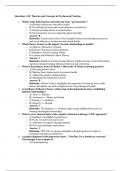
Questions 1-10: Theories and Concepts in Psychosocial Nursing
1. Which of the following best describes the term "psychosocial"?
o A) Biological processes that affect health
o B) Psychological factors and social influences on behavior
o C) Genetic predispositions to mental illness
o D) Environmental stressors impacting physical health
o Answer: B
Rationale: Psychosocial refers to the interplay between psychological processes
and social influences on behavior and mental health.
2. Which theory focuses on the impact of social relationships on health?
o A) Maslow's Hierarchy of Needs
o B) Erikson's Psychosocial Development
o C) Bandura's Social Learning Theory
o D) Lazarus and Folkman's Stress Theory
o Answer: C
Rationale: Bandura's Social Learning Theory emphasizes that social relationships
and observational learning influence behavior and well-being.
3. What is the primary focus of Maslow's Hierarchy of Needs in nursing practice?
o A) Ensuring patient safety
o B) Meeting basic human needs to promote health
o C) Addressing genetic predispositions
o D) Managing environmental stressors
o Answer: B
Rationale: Maslow's theory highlights the importance of meeting basic needs
before individuals can achieve higher levels of psychological health.
4. According to Erikson's theory, which stage of development involves establishing
intimate relationships?
o A) Trust vs. Mistrust
o B) Autonomy vs. Shame and Doubt
o C) Intimacy vs. Isolation
o D) Integrity vs. Despair
o Answer: C
Rationale: The Intimacy vs. Isolation stage (young adulthood) focuses on
forming meaningful relationships.
5. What is a key characteristic of the cognitive-behavioral therapy (CBT) approach?
o A) Emphasis on childhood experiences
o B) Focus on unconscious processes
o C) Alteration of negative thought patterns
o D) Use of psychotropic medications
o Answer: C
Rationale: CBT aims to change maladaptive thought patterns to improve
emotional regulation and behavior.
6. A patient diagnosed with depression states, "I feel like I'm a burden to everyone."
This thought is an example of:
o A) Catastrophizing
, o B) Personalization
o C) Overgeneralization
o D) Dichotomous thinking
o Answer: A
Rationale: Catastrophizing involves magnifying the negative aspects of
situations, leading to feelings of hopelessness.
7. Which psychological defense mechanism involves refusing to accept reality or facts?
o A) Denial
o B) Projection
o C) Displacement
o D) Rationalization
o Answer: A
Rationale: Denial is a defense mechanism where an individual refuses to accept
reality or facts to cope with distress.
8. What is the primary goal of motivational interviewing in nursing?
o A) To confront patients about their behaviors
o B) To help patients identify intrinsic motivation for change
o C) To provide direct advice on lifestyle changes
o D) To focus solely on past behaviors
o Answer: B
Rationale: Motivational interviewing aims to enhance a patient's intrinsic
motivation to change by exploring their ambivalence.
9. Which assessment tool is commonly used to evaluate a patient’s mental health
status?
o A) Mini-Mental State Examination (MMSE)
o B) Glascow Coma Scale
o C) Functional Independence Measure (FIM)
o D) Apgar Score
o Answer: A
Rationale: The MMSE is a widely used tool for assessing cognitive function and
mental status.
10. In the context of nursing practice, what does the term "therapeutic communication"
refer to?
o A) Providing medical information to patients
o B) Engaging in a friendly conversation with patients
o C) Using specific techniques to enhance the nurse-patient relationship
o D) Discussing personal experiences with patients
o Answer: C
Rationale: Therapeutic communication involves using specific techniques to
facilitate open dialogue and promote trust between the nurse and patient.
Questions 11-20: Mental Health Disorders and Interventions
11. Which of the following symptoms is characteristic of generalized anxiety disorder
(GAD)?
o A) Hallucinations
1. Which of the following best describes the term "psychosocial"?
o A) Biological processes that affect health
o B) Psychological factors and social influences on behavior
o C) Genetic predispositions to mental illness
o D) Environmental stressors impacting physical health
o Answer: B
Rationale: Psychosocial refers to the interplay between psychological processes
and social influences on behavior and mental health.
2. Which theory focuses on the impact of social relationships on health?
o A) Maslow's Hierarchy of Needs
o B) Erikson's Psychosocial Development
o C) Bandura's Social Learning Theory
o D) Lazarus and Folkman's Stress Theory
o Answer: C
Rationale: Bandura's Social Learning Theory emphasizes that social relationships
and observational learning influence behavior and well-being.
3. What is the primary focus of Maslow's Hierarchy of Needs in nursing practice?
o A) Ensuring patient safety
o B) Meeting basic human needs to promote health
o C) Addressing genetic predispositions
o D) Managing environmental stressors
o Answer: B
Rationale: Maslow's theory highlights the importance of meeting basic needs
before individuals can achieve higher levels of psychological health.
4. According to Erikson's theory, which stage of development involves establishing
intimate relationships?
o A) Trust vs. Mistrust
o B) Autonomy vs. Shame and Doubt
o C) Intimacy vs. Isolation
o D) Integrity vs. Despair
o Answer: C
Rationale: The Intimacy vs. Isolation stage (young adulthood) focuses on
forming meaningful relationships.
5. What is a key characteristic of the cognitive-behavioral therapy (CBT) approach?
o A) Emphasis on childhood experiences
o B) Focus on unconscious processes
o C) Alteration of negative thought patterns
o D) Use of psychotropic medications
o Answer: C
Rationale: CBT aims to change maladaptive thought patterns to improve
emotional regulation and behavior.
6. A patient diagnosed with depression states, "I feel like I'm a burden to everyone."
This thought is an example of:
o A) Catastrophizing
, o B) Personalization
o C) Overgeneralization
o D) Dichotomous thinking
o Answer: A
Rationale: Catastrophizing involves magnifying the negative aspects of
situations, leading to feelings of hopelessness.
7. Which psychological defense mechanism involves refusing to accept reality or facts?
o A) Denial
o B) Projection
o C) Displacement
o D) Rationalization
o Answer: A
Rationale: Denial is a defense mechanism where an individual refuses to accept
reality or facts to cope with distress.
8. What is the primary goal of motivational interviewing in nursing?
o A) To confront patients about their behaviors
o B) To help patients identify intrinsic motivation for change
o C) To provide direct advice on lifestyle changes
o D) To focus solely on past behaviors
o Answer: B
Rationale: Motivational interviewing aims to enhance a patient's intrinsic
motivation to change by exploring their ambivalence.
9. Which assessment tool is commonly used to evaluate a patient’s mental health
status?
o A) Mini-Mental State Examination (MMSE)
o B) Glascow Coma Scale
o C) Functional Independence Measure (FIM)
o D) Apgar Score
o Answer: A
Rationale: The MMSE is a widely used tool for assessing cognitive function and
mental status.
10. In the context of nursing practice, what does the term "therapeutic communication"
refer to?
o A) Providing medical information to patients
o B) Engaging in a friendly conversation with patients
o C) Using specific techniques to enhance the nurse-patient relationship
o D) Discussing personal experiences with patients
o Answer: C
Rationale: Therapeutic communication involves using specific techniques to
facilitate open dialogue and promote trust between the nurse and patient.
Questions 11-20: Mental Health Disorders and Interventions
11. Which of the following symptoms is characteristic of generalized anxiety disorder
(GAD)?
o A) Hallucinations