WJEC Psychology Component 2
Questions and Answers 2024
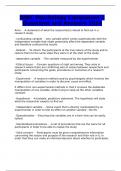
Aims - -A statement of what the researcher(s) intend to find out in a
research study.
-confounding variable - -Any variable which varies systematically with the
independent variable that might potentially affect the dependent variable
and therefore confound the results
-Debrief - -To inform the participants of the true nature of the study and to
restore them to the same state they were in at the start of the study.
-dependent variable - -The variable measured by the experimenter
-Ethical issues - -Concern questions of right and wrong. They arise in
research where there are conflicting sets of values between researchers and
participants concerning the goals, procedures or outcomes of a research
study.
-Experiment - -A research method used by psychologists which involves the
manipulation of variables in order to discover cause and effect.
It differs from non-experimental methods in that it involves the deliberate
manipulation of one variable, while trying to keep all the other variables
constant
-Hypothesis - -A testable, predictive statement. The hypothesis will state
what the researcher expects to find out
-independent variable - -Some event that is directly manipulated by an
experimenter in order to test its effect on another variable - the DV
-Operationalise - -Ensuring that variables are in a form that can be easily
tested.
-Standardised procedures - -A set of procedures that are the same for all
participants in order to be able to repeat the study
-Valid consent - -Participants must be given comprehensive information
concerning the nature and purpose of the research and their role in it, in
order that they can make an informed decision about whether to participate.
, -Control - -Refers to the extent to which any variable is held constant or
regulated by a researcher
-External validity - -the degree to which research findings generalize
beyond the specific context of the experiment being conducted
-internal validity - -The degree to which an observed effect was due to the
experimental manipulation rather than other factors such as
confounding/extraneous variables
-Mundane realism - -Refers to how a study mirrors the real world
-Validity - -Refers to whether an observed effect is a genuine one
-Alternative hypothesis - -The hypothesis that states the expected results
-Confederate - -An individual in a study who is not a real participant and has
been instructed how to behave by the investigator.
-Directional hypothesis (one-tailed) - -States the direction of the predicted
difference between two conditions or two groups of participants
-Experimental hypothesis - -The term used to describe the alternative
hypothesis in an experiment
-Non-directional hypothesis - -Predicts simply that there is a difference
between two conditions or two groups of participants, without stating the
direction of the difference.
-Null hypothesis - -A statement of no difference
-Pilot study - -A small scale trial run of a study to test any aspects of the
design, with a view to making improvements
-repeated measures design - -All participants take part in all conditions of
the experiment/all levels of the IV
We compare the performance (DV) of the participant on the two tests
-what are the disadvantages of repeated measures design? - -Order of
conditions may affect performance (order effect) e.g) participants may do
better on the second test because of a practice effect/ because they are less
anxious/ may do worse due to boredom effect
When participants do second test they may guess the purpose of the
experiment which may affect their behaviour
Questions and Answers 2024
Aims - -A statement of what the researcher(s) intend to find out in a
research study.
-confounding variable - -Any variable which varies systematically with the
independent variable that might potentially affect the dependent variable
and therefore confound the results
-Debrief - -To inform the participants of the true nature of the study and to
restore them to the same state they were in at the start of the study.
-dependent variable - -The variable measured by the experimenter
-Ethical issues - -Concern questions of right and wrong. They arise in
research where there are conflicting sets of values between researchers and
participants concerning the goals, procedures or outcomes of a research
study.
-Experiment - -A research method used by psychologists which involves the
manipulation of variables in order to discover cause and effect.
It differs from non-experimental methods in that it involves the deliberate
manipulation of one variable, while trying to keep all the other variables
constant
-Hypothesis - -A testable, predictive statement. The hypothesis will state
what the researcher expects to find out
-independent variable - -Some event that is directly manipulated by an
experimenter in order to test its effect on another variable - the DV
-Operationalise - -Ensuring that variables are in a form that can be easily
tested.
-Standardised procedures - -A set of procedures that are the same for all
participants in order to be able to repeat the study
-Valid consent - -Participants must be given comprehensive information
concerning the nature and purpose of the research and their role in it, in
order that they can make an informed decision about whether to participate.
, -Control - -Refers to the extent to which any variable is held constant or
regulated by a researcher
-External validity - -the degree to which research findings generalize
beyond the specific context of the experiment being conducted
-internal validity - -The degree to which an observed effect was due to the
experimental manipulation rather than other factors such as
confounding/extraneous variables
-Mundane realism - -Refers to how a study mirrors the real world
-Validity - -Refers to whether an observed effect is a genuine one
-Alternative hypothesis - -The hypothesis that states the expected results
-Confederate - -An individual in a study who is not a real participant and has
been instructed how to behave by the investigator.
-Directional hypothesis (one-tailed) - -States the direction of the predicted
difference between two conditions or two groups of participants
-Experimental hypothesis - -The term used to describe the alternative
hypothesis in an experiment
-Non-directional hypothesis - -Predicts simply that there is a difference
between two conditions or two groups of participants, without stating the
direction of the difference.
-Null hypothesis - -A statement of no difference
-Pilot study - -A small scale trial run of a study to test any aspects of the
design, with a view to making improvements
-repeated measures design - -All participants take part in all conditions of
the experiment/all levels of the IV
We compare the performance (DV) of the participant on the two tests
-what are the disadvantages of repeated measures design? - -Order of
conditions may affect performance (order effect) e.g) participants may do
better on the second test because of a practice effect/ because they are less
anxious/ may do worse due to boredom effect
When participants do second test they may guess the purpose of the
experiment which may affect their behaviour