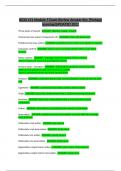
BIOD 151 Module 5 Exam Review Answer Key (Portage
learning)UPDATED 2022
Three types of muscle - ANSWER: skeletal, cardiac, smooth
Central nervous system components (2) - ANSWER: brain and spinal cord
Peripheral nervous system - ANSWER: peripheral nerves that carry signals to muscles
Conscious control - ANSWER: person can consciously decide when to use these
muscles
Motor actions - ANSWER: -messages from the central nervous system
-Start in brain and move out to peripheral nerves
Sensory input / sensation - ANSWER: -information carried by nerves from the
external environment to the central nervous system
-Start in peripheral nerves and move toward brain
Tendons - ANSWER: connective tissues that connect skeletal muscle to bone at each
end
Ligaments - ANSWER: connective tissue that connects bone to bone
Origin - ANSWER: bony site of attachment that is stationary during movement
Insertion - ANSWER: bony site of attachment that is moved by the muscle
contraction
Action - ANSWER: what effect is produced by the muscle's contraction
Innervation - ANSWER: peripheral nerve that supplies a muscle with the message
from the brain
Orbicularis oculi action - ANSWER: eye closure
Orbicularis oculi innervation - ANSWER: facial nerve
Orbicularis oris action - ANSWER: mouth closure
Orbicularis oris innervation - ANSWER: facial nerve
Zygomaticus major/minor action - ANSWER: pull corners of lips upward
Zygomaticus major/minor innervation - ANSWER: facial nerve
,Risorius action - ANSWER: pulls corners of the mouth posteriorly (grin or grimace)
Risorius innervation - ANSWER: facial nerve
frontalis action - ANSWER: raise eyebrows
frontalis innervation - ANSWER: facial nerve
Buccinator action - ANSWER: compress cheeks
buccinator innervation - ANSWER: facial nerve
masseter action - ANSWER: jaw closure
masseter innervation - ANSWER: trigeminal nerve
temporalis action - ANSWER: elevates mandible, closes jaw
temporalis innervation - ANSWER: trigeminal nerve
lateral flexion of the neck action - ANSWER: side bending of the neck (moving one of
the ears to the same side of shoulder)
flexion of the neck action - ANSWER: action of moving chin towards sternum
bilaterally - ANSWER: both sides
unilaterally - ANSWER: one side
Semispinalis capitis origin - ANSWER: articular process of inferior cervical and
transverse process of superior thoracic vertebrae
Semispinalis capitis insertion - ANSWER: occipital bone
Semispinalis capitis action (bilateral) - ANSWER: extend head (pulls neck backward)
Semispinalis capitis action (unilateral) - ANSWER: laterally flexes neck to same side
Semispinalis capitis innervation - ANSWER: spinal nerves
Sternocleidomastoid origin - ANSWER: sternal end of clavicle and manubrium
Sternocleidomastoid insertion - ANSWER: mastoid region of skull
Sternocleidomastoid action (bilateral) - ANSWER: neck flexion i.e., pulling neck down
, Sternocleidomastoid action (unilateral) - ANSWER: turns face to opposite side
Sternocleidomastoid innervation - ANSWER: accessory nerve
Splenius capitis origin - ANSWER: spinous process/ ligaments of inferior cervical
vertebrae
Splenius capitis insertion - ANSWER: mastoid process (temporal bone), occipital bone
of skull
Splenius capitis action (bilateral) - ANSWER: extend head
Splenius capitis action (unilateral) - ANSWER: laterally flexes neck to same side
Splenius capitis innervation - ANSWER: cervical spine
Longissimus cervicis origin - ANSWER: transverse processes of superior thoracic
vertebrae
Longissimus cervicis insertion - ANSWER: transverse process of middle and superior
cervical vertebrae
Longissimus cervicis action (bilateral) - ANSWER: extend head
Longissimus cervicis action (unilateral) - ANSWER: laterally flexes neck to same side
Longissimus cervicis innervation - ANSWER: cervical and thoracic spinal nerves
Longissimus thoracis origin - ANSWER: transverse process of all thoracic and lumbar
vertebrae
Longissimus thoracis insertion - ANSWER: transverse processes of all thoracic
vertebrae
Longissimus thoracis action (bilateral) - ANSWER: extension of spine
Longissimus thoracis (unilateral) - ANSWER: lateral flexion of spine
Longissimus thoracis innervation - ANSWER: thoracic and lumbar spinal nerves
Thyrohyoid origin - ANSWER: thyroid cartilage of larynx
Thyrohyoid insertion - ANSWER: hyoid bone
Thyrohyoid action - ANSWER: elevates thyroid, depresses hyoid bone
Thyrohyoid innervation - ANSWER: hypoglossal nerve
learning)UPDATED 2022
Three types of muscle - ANSWER: skeletal, cardiac, smooth
Central nervous system components (2) - ANSWER: brain and spinal cord
Peripheral nervous system - ANSWER: peripheral nerves that carry signals to muscles
Conscious control - ANSWER: person can consciously decide when to use these
muscles
Motor actions - ANSWER: -messages from the central nervous system
-Start in brain and move out to peripheral nerves
Sensory input / sensation - ANSWER: -information carried by nerves from the
external environment to the central nervous system
-Start in peripheral nerves and move toward brain
Tendons - ANSWER: connective tissues that connect skeletal muscle to bone at each
end
Ligaments - ANSWER: connective tissue that connects bone to bone
Origin - ANSWER: bony site of attachment that is stationary during movement
Insertion - ANSWER: bony site of attachment that is moved by the muscle
contraction
Action - ANSWER: what effect is produced by the muscle's contraction
Innervation - ANSWER: peripheral nerve that supplies a muscle with the message
from the brain
Orbicularis oculi action - ANSWER: eye closure
Orbicularis oculi innervation - ANSWER: facial nerve
Orbicularis oris action - ANSWER: mouth closure
Orbicularis oris innervation - ANSWER: facial nerve
Zygomaticus major/minor action - ANSWER: pull corners of lips upward
Zygomaticus major/minor innervation - ANSWER: facial nerve
,Risorius action - ANSWER: pulls corners of the mouth posteriorly (grin or grimace)
Risorius innervation - ANSWER: facial nerve
frontalis action - ANSWER: raise eyebrows
frontalis innervation - ANSWER: facial nerve
Buccinator action - ANSWER: compress cheeks
buccinator innervation - ANSWER: facial nerve
masseter action - ANSWER: jaw closure
masseter innervation - ANSWER: trigeminal nerve
temporalis action - ANSWER: elevates mandible, closes jaw
temporalis innervation - ANSWER: trigeminal nerve
lateral flexion of the neck action - ANSWER: side bending of the neck (moving one of
the ears to the same side of shoulder)
flexion of the neck action - ANSWER: action of moving chin towards sternum
bilaterally - ANSWER: both sides
unilaterally - ANSWER: one side
Semispinalis capitis origin - ANSWER: articular process of inferior cervical and
transverse process of superior thoracic vertebrae
Semispinalis capitis insertion - ANSWER: occipital bone
Semispinalis capitis action (bilateral) - ANSWER: extend head (pulls neck backward)
Semispinalis capitis action (unilateral) - ANSWER: laterally flexes neck to same side
Semispinalis capitis innervation - ANSWER: spinal nerves
Sternocleidomastoid origin - ANSWER: sternal end of clavicle and manubrium
Sternocleidomastoid insertion - ANSWER: mastoid region of skull
Sternocleidomastoid action (bilateral) - ANSWER: neck flexion i.e., pulling neck down
, Sternocleidomastoid action (unilateral) - ANSWER: turns face to opposite side
Sternocleidomastoid innervation - ANSWER: accessory nerve
Splenius capitis origin - ANSWER: spinous process/ ligaments of inferior cervical
vertebrae
Splenius capitis insertion - ANSWER: mastoid process (temporal bone), occipital bone
of skull
Splenius capitis action (bilateral) - ANSWER: extend head
Splenius capitis action (unilateral) - ANSWER: laterally flexes neck to same side
Splenius capitis innervation - ANSWER: cervical spine
Longissimus cervicis origin - ANSWER: transverse processes of superior thoracic
vertebrae
Longissimus cervicis insertion - ANSWER: transverse process of middle and superior
cervical vertebrae
Longissimus cervicis action (bilateral) - ANSWER: extend head
Longissimus cervicis action (unilateral) - ANSWER: laterally flexes neck to same side
Longissimus cervicis innervation - ANSWER: cervical and thoracic spinal nerves
Longissimus thoracis origin - ANSWER: transverse process of all thoracic and lumbar
vertebrae
Longissimus thoracis insertion - ANSWER: transverse processes of all thoracic
vertebrae
Longissimus thoracis action (bilateral) - ANSWER: extension of spine
Longissimus thoracis (unilateral) - ANSWER: lateral flexion of spine
Longissimus thoracis innervation - ANSWER: thoracic and lumbar spinal nerves
Thyrohyoid origin - ANSWER: thyroid cartilage of larynx
Thyrohyoid insertion - ANSWER: hyoid bone
Thyrohyoid action - ANSWER: elevates thyroid, depresses hyoid bone
Thyrohyoid innervation - ANSWER: hypoglossal nerve