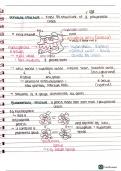
* Introduction 2
↳ the cells
Biological Molecules Inorganic I a
of all
living organisms consists o ↳ different molecules :
O Carbohydrates - Carbon Hydrogen Oxygen
, both contain CHO +:: are
*
Inorganic ions >
- cons which don't contain carbon (with some exceptions)
> carbs
,
lipids +
② lipids Carbon hydrogen , Oxygen long
very similar but lipids have a
-
③ proteins Carbon, hydrogen Oxygen Nitrogen
,
chain of hydrogens
↳ Cations
-
, ,
-
positive charge :
⑪ nucleic acids Carbon hydrogen nerve impulse transmissions
nitrogen phosphorus
-
, ,
oxygen , ,
① Calcium-ca't -- muscle contraction
+↑ rigidity in bores and teeh
↳ they all contain carbon. :
they are organic
-
cofactor for enzymes
nerve impulset ransmission
② sodium-Nat---kidney function
*
Polymerization - most carbohydrates puting ,
+ nucleic acids are -
co-transport of glucose amino acids
from smaller monomer
Polymer made nerve impulse transmissions
/ flowers
③ potassium -
k"-- stomatal opening + develops healthy leaves
↳ regulating fluid balance
monomers join to form polymers by polymerisation
-
to determine pH levels CO2
used -
involved intransporty
⑪ hydrogen-H
+
wed in reactions
photosynther's
mmm
-
-
catalyses reactions
⑤ Ammonium-NHL of nitrogen 4 plants
"
, -> source
condensation reactions + broken down, by ?
⑥
Tron-fe binds w/Oz within naemoglein
olypeptide
>
-
hydrolysis reactions
condensation the removal of water
& to : to
>
- 00 + H20 form a chemical
solynucleotides
bond between 2 molecules * Anious -
negative charge
Chloride-CliMaintains blood igas exce
the addition of water to pH s ee
,
0-0 + H20 is
0 + o break a chemical bord ①
-
cell membrane formation
"
nucleic acid + ATP formation
② phosphate PO ,
-
-
-
-
bone formation
·
catalysis of reactions
③ hydroxide-OH- >
-pl determination
① hydren-HOse maintenance ta
q bled
nitrogen supply to plants for
⑤ Nitrate NO3
-
protein formation
-
animo acid +
↳ the cells
Biological Molecules Inorganic I a
of all
living organisms consists o ↳ different molecules :
O Carbohydrates - Carbon Hydrogen Oxygen
, both contain CHO +:: are
*
Inorganic ions >
- cons which don't contain carbon (with some exceptions)
> carbs
,
lipids +
② lipids Carbon hydrogen , Oxygen long
very similar but lipids have a
-
③ proteins Carbon, hydrogen Oxygen Nitrogen
,
chain of hydrogens
↳ Cations
-
, ,
-
positive charge :
⑪ nucleic acids Carbon hydrogen nerve impulse transmissions
nitrogen phosphorus
-
, ,
oxygen , ,
① Calcium-ca't -- muscle contraction
+↑ rigidity in bores and teeh
↳ they all contain carbon. :
they are organic
-
cofactor for enzymes
nerve impulset ransmission
② sodium-Nat---kidney function
*
Polymerization - most carbohydrates puting ,
+ nucleic acids are -
co-transport of glucose amino acids
from smaller monomer
Polymer made nerve impulse transmissions
/ flowers
③ potassium -
k"-- stomatal opening + develops healthy leaves
↳ regulating fluid balance
monomers join to form polymers by polymerisation
-
to determine pH levels CO2
used -
involved intransporty
⑪ hydrogen-H
+
wed in reactions
photosynther's
mmm
-
-
catalyses reactions
⑤ Ammonium-NHL of nitrogen 4 plants
"
, -> source
condensation reactions + broken down, by ?
⑥
Tron-fe binds w/Oz within naemoglein
olypeptide
>
-
hydrolysis reactions
condensation the removal of water
& to : to
>
- 00 + H20 form a chemical
solynucleotides
bond between 2 molecules * Anious -
negative charge
Chloride-CliMaintains blood igas exce
the addition of water to pH s ee
,
0-0 + H20 is
0 + o break a chemical bord ①
-
cell membrane formation
"
nucleic acid + ATP formation
② phosphate PO ,
-
-
-
-
bone formation
·
catalysis of reactions
③ hydroxide-OH- >
-pl determination
① hydren-HOse maintenance ta
q bled
nitrogen supply to plants for
⑤ Nitrate NO3
-
protein formation
-
animo acid +