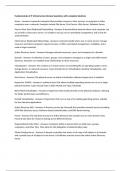
Fundamentals of IT Infrastructure Review Questions with complete Solutions
Server - Answers A powerful computer that provides resources, data, services, or programs to other
computers over a network. Examples include File Server, Print Server, Web Server, Database Server.
Peer-to-Peer (Non-Dedicated) Networking - Answers A decentralized network where each computer can
act as both a client and a server. It is simple to set up, has no centralized management, and is best for
small networks.
Client-Server (Dedicated) Networking - Answers A network model where one or more servers manage
resources and client computers request services. It offers centralized management, scalability, and is
used in larger networks.
Active Directory Server - Answers Manages network resources, users, and computers in a domain.
Domain - Answers A collection of users, groups, and computers managed as a single unit within Active
Directory. Domains can establish trust relationships to share resources.
Virtualization - Answers The creation of a virtual version of something like an operating system, server,
storage device, or network resources. Types include Server Virtualization, Desktop Virtualization, and
Application Virtualization.
Host Server - Answers The physical server on which virtualization software (hypervisor) is installed.
Hypervisor (VMM) - Answers A software layer that allows multiple operating systems to run on a single
physical machine. Types include Type 1 (Bare-Metal) and Type 2 (Hosted).
Bare-Metal Virtualization - Answers A hypervisor that installs directly on the physical hardware, allowing
for better performance and efficiency.
Hosted Virtualization - Answers A hypervisor that runs on top of an existing operating system, suitable
for less intensive applications.
Active Directory (AD) - Answers A directory service by Microsoft that provides network services including
LDAP-like directory access, Kerberos-based authentication, and DNS-based naming.
Forest - Answers The top-level structure in Active Directory that contains one or more domain trees.
Forest trusts allow for resource sharing across different forests.
Organizational Units (OUs) - Answers Containers within a domain that can hold users, groups,
computers, and other OUs. They allow for the delegation of administrative tasks.
Global Catalog Server - Answers A domain controller that stores a full copy of all objects in its domain
and a partial copy of all objects in the forest. It facilitates searches across the entire Active Directory
forest.
Server - Answers A powerful computer that provides resources, data, services, or programs to other
computers over a network. Examples include File Server, Print Server, Web Server, Database Server.
Peer-to-Peer (Non-Dedicated) Networking - Answers A decentralized network where each computer can
act as both a client and a server. It is simple to set up, has no centralized management, and is best for
small networks.
Client-Server (Dedicated) Networking - Answers A network model where one or more servers manage
resources and client computers request services. It offers centralized management, scalability, and is
used in larger networks.
Active Directory Server - Answers Manages network resources, users, and computers in a domain.
Domain - Answers A collection of users, groups, and computers managed as a single unit within Active
Directory. Domains can establish trust relationships to share resources.
Virtualization - Answers The creation of a virtual version of something like an operating system, server,
storage device, or network resources. Types include Server Virtualization, Desktop Virtualization, and
Application Virtualization.
Host Server - Answers The physical server on which virtualization software (hypervisor) is installed.
Hypervisor (VMM) - Answers A software layer that allows multiple operating systems to run on a single
physical machine. Types include Type 1 (Bare-Metal) and Type 2 (Hosted).
Bare-Metal Virtualization - Answers A hypervisor that installs directly on the physical hardware, allowing
for better performance and efficiency.
Hosted Virtualization - Answers A hypervisor that runs on top of an existing operating system, suitable
for less intensive applications.
Active Directory (AD) - Answers A directory service by Microsoft that provides network services including
LDAP-like directory access, Kerberos-based authentication, and DNS-based naming.
Forest - Answers The top-level structure in Active Directory that contains one or more domain trees.
Forest trusts allow for resource sharing across different forests.
Organizational Units (OUs) - Answers Containers within a domain that can hold users, groups,
computers, and other OUs. They allow for the delegation of administrative tasks.
Global Catalog Server - Answers A domain controller that stores a full copy of all objects in its domain
and a partial copy of all objects in the forest. It facilitates searches across the entire Active Directory
forest.