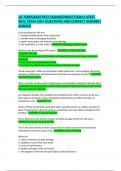
3A TURFGRASS PEST MANAGEMENT EXAM LATEST
REAL EXAM 200+ QUESTIONS AND CORRECT ANSWER|
AGRADE
Four principles for this are:
1. Produce healthy plants that resist pests.
2. Identify what is damaging the plant.
3. Expect some pests and tolerate some damage.
4. Use pesticides as a last resort. - ANSWER: Managing turfgrass pests
What are the five turfgrass IPM steps? - ANSWER: 1. Detect the pest
2. Identify the pest
3. Determine the amount of damage and whether it is below or above tolerance
threshold
4. Select and use a management tactic
5. Evaluate the effectiveness of the strategy and keep records.
Visual inspection, coffee can technique, white paper test, root sampling, disclosing
solutions, pitfall traps, and pheromone-bait traps are examples of what? - ANSWER:
Monitoring techniques
Why is it better to keep track of degree day accumulations instead of calendar days?
- ANSWER: Both plant growth and pest development depend on the amount of heat
that surrounds an organism.
An organism shouldn't be classified and treated as this until it is proven to be one.
Most species of insects, fungi, nematodes and bacteria are either harmless or
beneficial to turf. - ANSWER: Pest
Many of these are directly associated with a specific species or cultivar (variety) of
grass. Knowing the cultivar growing in a particular area may help you diagnose the
problem. - ANSWER: Turfgrass disorder
This is defined as the density of pests at which damage to the turf will occur. -
ANSWER: Economic injury level (EIL)
This is the pest density at which action must be taken to prevent the pest from
reaching the economic injury level. - ANSWER: Action threshold
What are:
1. Client's tolerance of pest damage
2. Visibility or use of the turn stand
3. Level of maintenance
4. Health and vigor of the turf stand
5. The degree of risk from the pest injury to the plant host
, 6. Expected pest reduction by natural controls - ANSWER: Factors affecting turfgrass
injury level
What are the two types of pest management tactics? - ANSWER: immediate, short-
term suppression and long-term maintenance
Some species or cultivars of grasses are resistant to damaging pests because of these
that live inside grass plants. These produce chemicals in the plant that provide
resistance to some pests. - ANSWER: Endophytic fungi
This control type includes raking, thatch removal and aeration. Routing maintenance
practices such as moving, fertilizing and irrigating are important. - ANSWER: Cultural
control
This control method are tactics that physically separate the pest from the host plant.
Examples include hand-removal, traps, barriers and repellents. - ANSWER:
Mechanical and physical controls
This is an example of a disease that you can readily control by physically removing it.
- ANSWER: Slime mold
This method isn't practical to manage weeds in established turf, however, it may be
the only appropriate weed control operation for newly plant stands of tender grass. -
ANSWER: Hand-removal
A pest stand cannot be both: - ANSWER: pest-free and benefit from biological
control
This natural microbial insecticide product kills many insect larvae, including
armyworms, cutworms, sod webworms, and other catepillars. - ANSWER: Bacillus
thuringiensis or Bt
Pesticides are typically classified in four ways: - ANSWER: 1. Type of pest controlled
2. Pesticide chemistry
3. Mode of action
4. Pesticide formulation
Choose a pesticide that: - ANSWER: 1. Labeled for the site
2. Able to produce the desired level of control
3. Least disruptive to the environment
4. Least toxic to predators, parasites and natural enemies
5. Least toxic to people and pets
6. Not phytotoxic to turn or other ornamental plants
7. Economically practical
8. Compatible with other plant management practices
9. Acceptable to the public
REAL EXAM 200+ QUESTIONS AND CORRECT ANSWER|
AGRADE
Four principles for this are:
1. Produce healthy plants that resist pests.
2. Identify what is damaging the plant.
3. Expect some pests and tolerate some damage.
4. Use pesticides as a last resort. - ANSWER: Managing turfgrass pests
What are the five turfgrass IPM steps? - ANSWER: 1. Detect the pest
2. Identify the pest
3. Determine the amount of damage and whether it is below or above tolerance
threshold
4. Select and use a management tactic
5. Evaluate the effectiveness of the strategy and keep records.
Visual inspection, coffee can technique, white paper test, root sampling, disclosing
solutions, pitfall traps, and pheromone-bait traps are examples of what? - ANSWER:
Monitoring techniques
Why is it better to keep track of degree day accumulations instead of calendar days?
- ANSWER: Both plant growth and pest development depend on the amount of heat
that surrounds an organism.
An organism shouldn't be classified and treated as this until it is proven to be one.
Most species of insects, fungi, nematodes and bacteria are either harmless or
beneficial to turf. - ANSWER: Pest
Many of these are directly associated with a specific species or cultivar (variety) of
grass. Knowing the cultivar growing in a particular area may help you diagnose the
problem. - ANSWER: Turfgrass disorder
This is defined as the density of pests at which damage to the turf will occur. -
ANSWER: Economic injury level (EIL)
This is the pest density at which action must be taken to prevent the pest from
reaching the economic injury level. - ANSWER: Action threshold
What are:
1. Client's tolerance of pest damage
2. Visibility or use of the turn stand
3. Level of maintenance
4. Health and vigor of the turf stand
5. The degree of risk from the pest injury to the plant host
, 6. Expected pest reduction by natural controls - ANSWER: Factors affecting turfgrass
injury level
What are the two types of pest management tactics? - ANSWER: immediate, short-
term suppression and long-term maintenance
Some species or cultivars of grasses are resistant to damaging pests because of these
that live inside grass plants. These produce chemicals in the plant that provide
resistance to some pests. - ANSWER: Endophytic fungi
This control type includes raking, thatch removal and aeration. Routing maintenance
practices such as moving, fertilizing and irrigating are important. - ANSWER: Cultural
control
This control method are tactics that physically separate the pest from the host plant.
Examples include hand-removal, traps, barriers and repellents. - ANSWER:
Mechanical and physical controls
This is an example of a disease that you can readily control by physically removing it.
- ANSWER: Slime mold
This method isn't practical to manage weeds in established turf, however, it may be
the only appropriate weed control operation for newly plant stands of tender grass. -
ANSWER: Hand-removal
A pest stand cannot be both: - ANSWER: pest-free and benefit from biological
control
This natural microbial insecticide product kills many insect larvae, including
armyworms, cutworms, sod webworms, and other catepillars. - ANSWER: Bacillus
thuringiensis or Bt
Pesticides are typically classified in four ways: - ANSWER: 1. Type of pest controlled
2. Pesticide chemistry
3. Mode of action
4. Pesticide formulation
Choose a pesticide that: - ANSWER: 1. Labeled for the site
2. Able to produce the desired level of control
3. Least disruptive to the environment
4. Least toxic to predators, parasites and natural enemies
5. Least toxic to people and pets
6. Not phytotoxic to turn or other ornamental plants
7. Economically practical
8. Compatible with other plant management practices
9. Acceptable to the public