Learning Unit 1
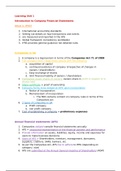
Introduction to Company Financial Statements
What is IFRS?
1. International accounting standards
2. Setting out details on how transactions and events
3. are measured and reported in the AFS
4. Global framework (consistency worldwide)
5. IFRS provides general guidance not detailed rules
Companies in SA
1. A company is a legal person in terms of the Companies Act 71 of 2008
2. The company form / legal entity assists with the following
a. acquisition of capital
b. continued existence of company (irrespective of changes in
owners / shareholders)
c. Easy exchange of shares
d. limit financial liability of owners / shareholders
3. Companies issues shares to owners, owners share in profit in relation to %
shares held
4. Share certificate = proof of ownership
5. Company forms to be lodged at CIPC upon incorporation
a. Notice of incorporation
b. Memorandum of incorporation
i. The MOI contains content on company rules in terms of the
Companies Act
6. 2 types of companies in SA
a. Profit company
b. non profit company
7. Cost of establishing a company = preliminary expenses
Annual financial statements (AFS)
1. Companies obliged compile financial statements annually
2. AFS = structured representation of the financial position and performance
3. Provide information on assets, liabilities, equity, income and expenses for
users to make business decisions.
4. Users of AFS = Shareholders, investors, management, borrowers,
suppliers, creditors, SARS, bankers, etc.
5. As per the Companies Act, AFS has to adhere to IFRS (depending on
category / size)
6. AFS are submitted at the Annual General meeting of Shareholders (AGM)
, Share transactions
1. Number of shares and classes of shares are set out in the MOI =
Authorized share capital
2. A company does not have to issue all the authorized share capital
3. Share capital issued issues = Issued share capital
4. See disclosure example on page 9 of the Study Guide
5. Types of shares
a. Ordinary shares
i. Most common
ii. full voting rights
iii. Not fixed dividend rate
b. Preference shares
i. Debt instrument (fixed dividends) & equity ( capital
appreciation)
ii. Fixed dividends, higher claim on assets
iii. Paid first in event of bankruptcy
iv. Not have voting rights
1. Cumulative preference shares - skipped dividends
accumulate (if not declared / paid should be disclosed)
2. Non- cumulative = does not accumulate annually if not
paid
3. Redeemable preference shares (redemption on specific
date)
c. Capitalisation shares
Introduction to Company Financial Statements
What is IFRS?
1. International accounting standards
2. Setting out details on how transactions and events
3. are measured and reported in the AFS
4. Global framework (consistency worldwide)
5. IFRS provides general guidance not detailed rules
Companies in SA
1. A company is a legal person in terms of the Companies Act 71 of 2008
2. The company form / legal entity assists with the following
a. acquisition of capital
b. continued existence of company (irrespective of changes in
owners / shareholders)
c. Easy exchange of shares
d. limit financial liability of owners / shareholders
3. Companies issues shares to owners, owners share in profit in relation to %
shares held
4. Share certificate = proof of ownership
5. Company forms to be lodged at CIPC upon incorporation
a. Notice of incorporation
b. Memorandum of incorporation
i. The MOI contains content on company rules in terms of the
Companies Act
6. 2 types of companies in SA
a. Profit company
b. non profit company
7. Cost of establishing a company = preliminary expenses
Annual financial statements (AFS)
1. Companies obliged compile financial statements annually
2. AFS = structured representation of the financial position and performance
3. Provide information on assets, liabilities, equity, income and expenses for
users to make business decisions.
4. Users of AFS = Shareholders, investors, management, borrowers,
suppliers, creditors, SARS, bankers, etc.
5. As per the Companies Act, AFS has to adhere to IFRS (depending on
category / size)
6. AFS are submitted at the Annual General meeting of Shareholders (AGM)
, Share transactions
1. Number of shares and classes of shares are set out in the MOI =
Authorized share capital
2. A company does not have to issue all the authorized share capital
3. Share capital issued issues = Issued share capital
4. See disclosure example on page 9 of the Study Guide
5. Types of shares
a. Ordinary shares
i. Most common
ii. full voting rights
iii. Not fixed dividend rate
b. Preference shares
i. Debt instrument (fixed dividends) & equity ( capital
appreciation)
ii. Fixed dividends, higher claim on assets
iii. Paid first in event of bankruptcy
iv. Not have voting rights
1. Cumulative preference shares - skipped dividends
accumulate (if not declared / paid should be disclosed)
2. Non- cumulative = does not accumulate annually if not
paid
3. Redeemable preference shares (redemption on specific
date)
c. Capitalisation shares