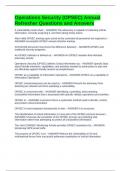
Operations Security (OPSEC) Annual
Refresher Questions and Answers
A vulnerability exists when: - ANSWER-The adversary is capable of collecting critical
information, correctly analyzing it, and then taking timely action.
After initial OPSEC training upon arrival to the command all personnel are required to: -
ANSWER-Accomplish OPSEC annual refresher training.
All EUCOM personnel must know the difference between: - ANSWER-OPSEC and
traditional security programs.
An OPSEC indicator is defined as: - ANSWER-An OPSEC situation that indicates
adversary activity
Operations Security (OPSEC) defines Critical Information as: - ANSWER-Specific facts
about friendly intentions, capabilities, and activities needed by adversaries to plan and
act effectively against friendly mission accomplishment.
OPSEC as a capability of Information Operations - ANSWER-OPSEC as a capability of
Information Operations
OPSEC countermeasures can be used to: - ANSWER-Prevent the adversary from
detecting an indicator and from exploiting a vulnerability.
OPSEC is concerned with: - ANSWER-Identifying, controlling, and protecting
unclassified information that is associated with specific military operations and activities.
OPSEC is: - ANSWER-A process that is a systematic method used to identify, control,
and protect critical information
OPSEC?s most important characteristic is that: - ANSWER-It is a process.
The identification of critical information is a key part of the OPSEC process because: -
ANSWER-It focuses the remainder of the OPSEC process on protecting vital
information rather than attempting to protect all unclassified information.
The Joint COMSEC Monitoring Activity provides OPSEC assistance by: - ANSWER-
Monitoring NIPR email traffic.
The purpose of OPSEC is to: - ANSWER-Reduce the vulnerability of US and
multinational forces from successful adversary exploitation of critical information.
Refresher Questions and Answers
A vulnerability exists when: - ANSWER-The adversary is capable of collecting critical
information, correctly analyzing it, and then taking timely action.
After initial OPSEC training upon arrival to the command all personnel are required to: -
ANSWER-Accomplish OPSEC annual refresher training.
All EUCOM personnel must know the difference between: - ANSWER-OPSEC and
traditional security programs.
An OPSEC indicator is defined as: - ANSWER-An OPSEC situation that indicates
adversary activity
Operations Security (OPSEC) defines Critical Information as: - ANSWER-Specific facts
about friendly intentions, capabilities, and activities needed by adversaries to plan and
act effectively against friendly mission accomplishment.
OPSEC as a capability of Information Operations - ANSWER-OPSEC as a capability of
Information Operations
OPSEC countermeasures can be used to: - ANSWER-Prevent the adversary from
detecting an indicator and from exploiting a vulnerability.
OPSEC is concerned with: - ANSWER-Identifying, controlling, and protecting
unclassified information that is associated with specific military operations and activities.
OPSEC is: - ANSWER-A process that is a systematic method used to identify, control,
and protect critical information
OPSEC?s most important characteristic is that: - ANSWER-It is a process.
The identification of critical information is a key part of the OPSEC process because: -
ANSWER-It focuses the remainder of the OPSEC process on protecting vital
information rather than attempting to protect all unclassified information.
The Joint COMSEC Monitoring Activity provides OPSEC assistance by: - ANSWER-
Monitoring NIPR email traffic.
The purpose of OPSEC is to: - ANSWER-Reduce the vulnerability of US and
multinational forces from successful adversary exploitation of critical information.