Chapter 9 Notes PSYS
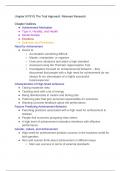
Chapter outline
Hans Eysenck’s Theory of Personality
Temperament
Evolutionary Personality Psychology
Application: Children’s Temperaments and School
Assessment: Brain Electrical Activity and Cerebal Asynmetry
Strengths and Criticisms of the Biological Approach
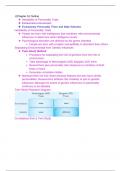
Hans Eysenck’s Theory of Personality
➢ Structure of Personality
○ Eysenck employed factor analysis to identify supertraits
○ All traits can be subsumed within three basic personality
■ Extraversion– introversion
■ Neuroticism
■ Psychoticism
➢ Eysenck divided the elements of personality into units that can be
arranged hierarchically
○ Basic structure – Specific response level
➢ Initial factor analytic research yielded in two basic dimensions
○ Extraversion – introversion
○ Neuroticism
➢ Personality dimensions are independent of one another
, ➢ Extraverts are outgoing, impulsive, uninhibited, and sociable
➢ Introverts are quiet, introspective, reserved, and distant except to intimate
friends
➢ People high on neuroticism are unstable or highly emotional, easily upset,
and angered
➢ Individuals low on neuroticism are less prone to emotional swings.
➢ Psychoticism – Third super trait found by Eysenck
○ People on the high end of psychoticism are egocentric, aggressive,
and impersonal
A Biological Basis for Personality
➢ Eysenck’s arguments
○ Consistency of extraversion – introversion over time
○ Cross-cultural researches indicate the three dimensions of
personality
○ Genetics play a vital role in determining a person’s placement on the
personality dimensions
Physiological Differences: Stimulation Sensitivity and Behavioral
Activation/Inhibition Systems
➢ Sensitivity to stimulation
Chapter outline
Hans Eysenck’s Theory of Personality
Temperament
Evolutionary Personality Psychology
Application: Children’s Temperaments and School
Assessment: Brain Electrical Activity and Cerebal Asynmetry
Strengths and Criticisms of the Biological Approach
Hans Eysenck’s Theory of Personality
➢ Structure of Personality
○ Eysenck employed factor analysis to identify supertraits
○ All traits can be subsumed within three basic personality
■ Extraversion– introversion
■ Neuroticism
■ Psychoticism
➢ Eysenck divided the elements of personality into units that can be
arranged hierarchically
○ Basic structure – Specific response level
➢ Initial factor analytic research yielded in two basic dimensions
○ Extraversion – introversion
○ Neuroticism
➢ Personality dimensions are independent of one another
, ➢ Extraverts are outgoing, impulsive, uninhibited, and sociable
➢ Introverts are quiet, introspective, reserved, and distant except to intimate
friends
➢ People high on neuroticism are unstable or highly emotional, easily upset,
and angered
➢ Individuals low on neuroticism are less prone to emotional swings.
➢ Psychoticism – Third super trait found by Eysenck
○ People on the high end of psychoticism are egocentric, aggressive,
and impersonal
A Biological Basis for Personality
➢ Eysenck’s arguments
○ Consistency of extraversion – introversion over time
○ Cross-cultural researches indicate the three dimensions of
personality
○ Genetics play a vital role in determining a person’s placement on the
personality dimensions
Physiological Differences: Stimulation Sensitivity and Behavioral
Activation/Inhibition Systems
➢ Sensitivity to stimulation