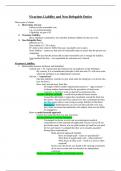
Vicarious Liability and Non-Delegable Duties
Three types of claims:
1. Direct Duty of Care:
Failure to take reasonable care.
e.g., not trained properly.
Culpability on part of D.
2. Vicarious Liability:
Show employee committed a tort and then attribute liability for that tort to D.
3. Non-Delegable Duty:
Different to VL.
Duty similar to 1st (D’s duty).
D’s duty is that whoever fulfils this task, reasonable care is taken.
Strict liability – cannot say that took all reasonable steps to ensure that the person was
competent.
The fact that the person did not take reasonable care is enough for liability.
You breached the duty – not responsible for someone else’s breach.
Vicarious Liability:
1. Relationship between tortfeasor and defendant:
General rule = VL requires that the tortfeasor be an employee of the defendant.
By contrast, it is a foundational principle of this area that VL will never arise
where the tortfeasor is an independent contractor.
Old test = “control test”
Idea that employer controls not just what tasks the employee is to do but also
how he does it.
Have since moved away from this.
No longer reflects modern employment practices – “gig economy” –
a labour market characterised by the prevalence of short-term
contracts or freelance work as opposed to permanent jobs.
Cassidy v Minister of Health – would have produced bizarre results.
Caused the defendant to argue that consultants caused the harm not
the nurses – because have less control over how consultants do their
job than nurses and so were trying to escape liability on that basis.
Denning LJ: skilled persons can carry out their job their own way,
but it does not mean that authorities who employ them are not liable
for negligence.
Move to multi-factorial approach:
Control not eradicated but now just one factor.
Barclays Bank plc v Various Claimants –
D arranged for doctor to carry out pre-employment medical
examinations on the claimant job-applicants. Doctor was to fill out
pro-forma report. Doctor was not paid retainer by bank but was paid
fee for each report. Cs alleged that they were sexually assaulted
during these examinations.
Multi-factorial approach includes:
How are people paid – salary or sporadically?
What does D supply them with – office/uniform?
What hours do they work – fixed or a service when
required?
In this case, the doctor was found to be carrying on business
of his own account and was therefore an independent
contractor.
Various Claimants v Catholic Child Welfare Society –
Three types of claims:
1. Direct Duty of Care:
Failure to take reasonable care.
e.g., not trained properly.
Culpability on part of D.
2. Vicarious Liability:
Show employee committed a tort and then attribute liability for that tort to D.
3. Non-Delegable Duty:
Different to VL.
Duty similar to 1st (D’s duty).
D’s duty is that whoever fulfils this task, reasonable care is taken.
Strict liability – cannot say that took all reasonable steps to ensure that the person was
competent.
The fact that the person did not take reasonable care is enough for liability.
You breached the duty – not responsible for someone else’s breach.
Vicarious Liability:
1. Relationship between tortfeasor and defendant:
General rule = VL requires that the tortfeasor be an employee of the defendant.
By contrast, it is a foundational principle of this area that VL will never arise
where the tortfeasor is an independent contractor.
Old test = “control test”
Idea that employer controls not just what tasks the employee is to do but also
how he does it.
Have since moved away from this.
No longer reflects modern employment practices – “gig economy” –
a labour market characterised by the prevalence of short-term
contracts or freelance work as opposed to permanent jobs.
Cassidy v Minister of Health – would have produced bizarre results.
Caused the defendant to argue that consultants caused the harm not
the nurses – because have less control over how consultants do their
job than nurses and so were trying to escape liability on that basis.
Denning LJ: skilled persons can carry out their job their own way,
but it does not mean that authorities who employ them are not liable
for negligence.
Move to multi-factorial approach:
Control not eradicated but now just one factor.
Barclays Bank plc v Various Claimants –
D arranged for doctor to carry out pre-employment medical
examinations on the claimant job-applicants. Doctor was to fill out
pro-forma report. Doctor was not paid retainer by bank but was paid
fee for each report. Cs alleged that they were sexually assaulted
during these examinations.
Multi-factorial approach includes:
How are people paid – salary or sporadically?
What does D supply them with – office/uniform?
What hours do they work – fixed or a service when
required?
In this case, the doctor was found to be carrying on business
of his own account and was therefore an independent
contractor.
Various Claimants v Catholic Child Welfare Society –