10/7/24, 7:00 PM
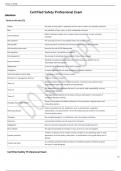
Certified Safety Professional Exam
JEREMIAH
Terms in this set (35)
Safety the state of being safe or relatively free from harm or other non-desirable outcomes
Risk the possibility of loss, injury, or other undesirable outcomes.
When a business decides not to produce high-risk products or enter uncertain
Risk Avoidance
markets
Risk retention The covering of a firm's unavoidable losses with its own funds
Risk transfer buying insurance to shift the risk of financial loss to an insurance company
Risk reduction and control primarily the role of EHS departments
Risk equation Hazard severity X probability of exposure
Risk Assessment the process of estimating the probability of injury from a hazard
identifies the potential hazards that exist without putting a value on the risk
Hazard analysis
associated with the hazards
Abatement to put an end to something that is finite in quantity
mitigation to lessen a hazard that can keep developing in certain conditions
Total Recordable Incident Rate (# of injuries x 200,000)/# of hours worked
McGregor's 3 management theories Theory X, Theory Y, Theory Z
Employees detest work and must be pressured, monitored, and pushed toward
Theory X
organizational goals with rewards and punishment
The assumption that employees like work, are creative, seek responsibility, and can
Theory Y
exercise self-direction.
a management philosophy that stresses employee participation in all aspects of
Theory Z
company decision making
There are two factors that affect motivation in the work place: Hygiene factors and
Herzberg Two-Factor Theory
motivating factors
Factors associated with job satisfaction—such as achievement, recognition,
Motivating factors responsibility, and advancement—all of which affect the job content or the rewards
of work performance
Trespass the wrongful damage to, or interference with, the property of another
Nuisance unreasonable interference with enjoyment of property
Negligence failure to exercise reasonable care and is the most preventable type tort.
Strict liability The legal responsibility for damage or injury even if you are not negligent
A seller's or lessor's oral or written promise, ancillary to an underlying sales or lease
Express warranty agreement, as to the quality, description, or performance of the goods being sold or
leased.
an unwritten guarantee that the product is of sufficient quality to fulfill the purpose
implied warranty
for which it was designed
Hygiene factors Extrinsic factors like salary, status, challenging work, and benefits
Certified Safety Professional Exam
1/2
Certified Safety Professional Exam
JEREMIAH
Terms in this set (35)
Safety the state of being safe or relatively free from harm or other non-desirable outcomes
Risk the possibility of loss, injury, or other undesirable outcomes.
When a business decides not to produce high-risk products or enter uncertain
Risk Avoidance
markets
Risk retention The covering of a firm's unavoidable losses with its own funds
Risk transfer buying insurance to shift the risk of financial loss to an insurance company
Risk reduction and control primarily the role of EHS departments
Risk equation Hazard severity X probability of exposure
Risk Assessment the process of estimating the probability of injury from a hazard
identifies the potential hazards that exist without putting a value on the risk
Hazard analysis
associated with the hazards
Abatement to put an end to something that is finite in quantity
mitigation to lessen a hazard that can keep developing in certain conditions
Total Recordable Incident Rate (# of injuries x 200,000)/# of hours worked
McGregor's 3 management theories Theory X, Theory Y, Theory Z
Employees detest work and must be pressured, monitored, and pushed toward
Theory X
organizational goals with rewards and punishment
The assumption that employees like work, are creative, seek responsibility, and can
Theory Y
exercise self-direction.
a management philosophy that stresses employee participation in all aspects of
Theory Z
company decision making
There are two factors that affect motivation in the work place: Hygiene factors and
Herzberg Two-Factor Theory
motivating factors
Factors associated with job satisfaction—such as achievement, recognition,
Motivating factors responsibility, and advancement—all of which affect the job content or the rewards
of work performance
Trespass the wrongful damage to, or interference with, the property of another
Nuisance unreasonable interference with enjoyment of property
Negligence failure to exercise reasonable care and is the most preventable type tort.
Strict liability The legal responsibility for damage or injury even if you are not negligent
A seller's or lessor's oral or written promise, ancillary to an underlying sales or lease
Express warranty agreement, as to the quality, description, or performance of the goods being sold or
leased.
an unwritten guarantee that the product is of sufficient quality to fulfill the purpose
implied warranty
for which it was designed
Hygiene factors Extrinsic factors like salary, status, challenging work, and benefits
Certified Safety Professional Exam
1/2