
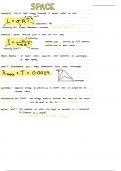
S
mosity-rateofigengy
pleased
or power ourpor o a
-
>
temperature (k)
↓ ↓ Y
Luminosity (w) Stefan-Boltzmann constant = 5 .
671108 Wm4
received
sity-power from a star per unit area
mins a
~
I = radiant flu
-
emitted from a
-
intensity
point
of
source
EM radiation
Y
intensity (wm2 ( distance
black bodies -
an
object which absorbs and radiates all wavelengths
~
of light equally
mumi's
displacement law-higher temperature ,
lower peak wavelength
intensity
& maxxT
N
A
=
0 0029 .
-
g wavelength
Allax position in comparison to
-
nearer star
apparent change of of a
distant stars
astronomical unit (AU) -
the
average distance between the centre of the earth
ne
and the centre the Sun IAU =
1 5 x10 "m
.
of
parsec
mu
(pc) -
the distance at which the
angle of parallax is I arcsecond
(1/3600th of a
degree
1pc =
2 .
06 x10 Au =
3 .
08 x 10m =
3 26 ly
.
, myear (ly)
-
the distance EM wave travels in in vacuum
an a
year a
| (y
= 9 .
46x10m =
3x10⁸ + (3600 + 24 x 365)
the position of nearby stars movel in elipses
We observe the stars from earth but earth orbits the sun
O
-
: the direction from the star to the observer changes ,
hower
light from distant stars remains almost parallel
d
position of Standard candles
a
mus
is and
G O sun we know the
luminosity of a star
>
↓ ↓
AU we can measure its intensity on earth, we
position of earth can calculate its distance
Cephid variables -
useful stars because they pulse and we know that the
mine
time period their is their
of pulse related to
luminosity
Hertzsprung-Russell diagram the luminosity
-
shows stellar of a star
against its temperature (logarithmic scale
most stars are in the
main sequence
temp decreases
-
>
mosity-rateofigengy
pleased
or power ourpor o a
-
>
temperature (k)
↓ ↓ Y
Luminosity (w) Stefan-Boltzmann constant = 5 .
671108 Wm4
received
sity-power from a star per unit area
mins a
~
I = radiant flu
-
emitted from a
-
intensity
point
of
source
EM radiation
Y
intensity (wm2 ( distance
black bodies -
an
object which absorbs and radiates all wavelengths
~
of light equally
mumi's
displacement law-higher temperature ,
lower peak wavelength
intensity
& maxxT
N
A
=
0 0029 .
-
g wavelength
Allax position in comparison to
-
nearer star
apparent change of of a
distant stars
astronomical unit (AU) -
the
average distance between the centre of the earth
ne
and the centre the Sun IAU =
1 5 x10 "m
.
of
parsec
mu
(pc) -
the distance at which the
angle of parallax is I arcsecond
(1/3600th of a
degree
1pc =
2 .
06 x10 Au =
3 .
08 x 10m =
3 26 ly
.
, myear (ly)
-
the distance EM wave travels in in vacuum
an a
year a
| (y
= 9 .
46x10m =
3x10⁸ + (3600 + 24 x 365)
the position of nearby stars movel in elipses
We observe the stars from earth but earth orbits the sun
O
-
: the direction from the star to the observer changes ,
hower
light from distant stars remains almost parallel
d
position of Standard candles
a
mus
is and
G O sun we know the
luminosity of a star
>
↓ ↓
AU we can measure its intensity on earth, we
position of earth can calculate its distance
Cephid variables -
useful stars because they pulse and we know that the
mine
time period their is their
of pulse related to
luminosity
Hertzsprung-Russell diagram the luminosity
-
shows stellar of a star
against its temperature (logarithmic scale
most stars are in the
main sequence
temp decreases
-
>


