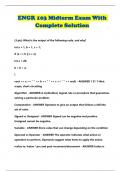
ENGR 103 Midterm Exam With
Complete Solution
(3 pts) What is the output of the following code, and why?
int a = 1, b = 1, c = 1;
if (a == b || c++){
int a = 20;
b = b + a;
}
cout << a << " " << b << " " << c << " " << endl; - ANSWER 1 21 1 Hint:
scope, short-circuiting
Algorithm - ANSWER A methodical, logical rule or procedure that guarantees
solving a particular problem.
Computation - ANSWER Operates to give an output that follows a definite
set of rules.
Signed vs Unsigned - ANSWER Signed can be negative and positive.
Unsigned cannot be negative.
Variable - ANSWER Store value that can change depending on the condition
Operand vs Operator - ANSWER The operator indicates what action or
operation to perform. Operands suggest what items to apply the action.
rvalue to. lvalue * pre and post-increment/decrement - ANSWER lvalue is
,object and rvalue is value.
% - ANSWER operator use to get remain
What is the value of my_value in the following exmaple? int my_value; -
ANSWER any number
What are two ways to create a constant in C++ Wht are the pros and cons? -
ANSWER const int my_constant= 42;
#define MY_CONSTANT 42
Given N bytes, what is the maximum and minumum represntable njmber of
signed and unsigned? - ANSWER INT_MAX
INT_MIN
max = 65535
min -32768
Describe the diffence between syntax vs semantics - ANSWER Syntax is
concerned with the form of the code, while Semantics is concerned with its
meaning and behavior. Both are imporatn for writting correct and effective
C++ code.
List and label the relational and logical operators, and what is the difference
between them? - ANSWER Relational operators are used to compare two
value and determine the relationship between them. They return Boolean
value of either 'true' or 'false'
Like
< (less than)
,> (greater than)
<= (less than or equal to)
>= (greater than or equal to)
== (equal to)
!= (not equal to)
Logical operators are used to perform Boolean operations on Boolean values.
&& (logical AND)
|| (logical OR)
! (logical NOT)
Give examples of when you use logical and relational operators in your every
life - ANSWER It is sunny outside and I want to go to the beach.
What is short circuiting and when is it useful? - ANSWER %% which stand for
"AND" and || Which stand for "OR"
When would you use an if versus switch - ANSWER If statement is when you
want to test one or more conditions and execute diferencet staments based
on the results of the test.
Swtich in other hand is you when you want to choose betwen sveral
alternative actions besed on the vlaue of a single expression.
What are the limitations with a switch? - ANSWER Limited data types like int
char short or long
No expression
, No range
No floating
What if you are missing a break in a switch? - ANSWER It will keep fall
through until the exectons will continue from oen case to. the next,
executing the coee in each case until it encounters a 'break' statement.
Can you nest switches and if/else? If so, how? - ANSWER Yes
int value = 1;
if (value > 0) {
switch (value) {
case 1:
// code for case 1
break;
case 2:
// code for case 2
break;
default:
// code for any other value
break;
}
} else {
Complete Solution
(3 pts) What is the output of the following code, and why?
int a = 1, b = 1, c = 1;
if (a == b || c++){
int a = 20;
b = b + a;
}
cout << a << " " << b << " " << c << " " << endl; - ANSWER 1 21 1 Hint:
scope, short-circuiting
Algorithm - ANSWER A methodical, logical rule or procedure that guarantees
solving a particular problem.
Computation - ANSWER Operates to give an output that follows a definite
set of rules.
Signed vs Unsigned - ANSWER Signed can be negative and positive.
Unsigned cannot be negative.
Variable - ANSWER Store value that can change depending on the condition
Operand vs Operator - ANSWER The operator indicates what action or
operation to perform. Operands suggest what items to apply the action.
rvalue to. lvalue * pre and post-increment/decrement - ANSWER lvalue is
,object and rvalue is value.
% - ANSWER operator use to get remain
What is the value of my_value in the following exmaple? int my_value; -
ANSWER any number
What are two ways to create a constant in C++ Wht are the pros and cons? -
ANSWER const int my_constant= 42;
#define MY_CONSTANT 42
Given N bytes, what is the maximum and minumum represntable njmber of
signed and unsigned? - ANSWER INT_MAX
INT_MIN
max = 65535
min -32768
Describe the diffence between syntax vs semantics - ANSWER Syntax is
concerned with the form of the code, while Semantics is concerned with its
meaning and behavior. Both are imporatn for writting correct and effective
C++ code.
List and label the relational and logical operators, and what is the difference
between them? - ANSWER Relational operators are used to compare two
value and determine the relationship between them. They return Boolean
value of either 'true' or 'false'
Like
< (less than)
,> (greater than)
<= (less than or equal to)
>= (greater than or equal to)
== (equal to)
!= (not equal to)
Logical operators are used to perform Boolean operations on Boolean values.
&& (logical AND)
|| (logical OR)
! (logical NOT)
Give examples of when you use logical and relational operators in your every
life - ANSWER It is sunny outside and I want to go to the beach.
What is short circuiting and when is it useful? - ANSWER %% which stand for
"AND" and || Which stand for "OR"
When would you use an if versus switch - ANSWER If statement is when you
want to test one or more conditions and execute diferencet staments based
on the results of the test.
Swtich in other hand is you when you want to choose betwen sveral
alternative actions besed on the vlaue of a single expression.
What are the limitations with a switch? - ANSWER Limited data types like int
char short or long
No expression
, No range
No floating
What if you are missing a break in a switch? - ANSWER It will keep fall
through until the exectons will continue from oen case to. the next,
executing the coee in each case until it encounters a 'break' statement.
Can you nest switches and if/else? If so, how? - ANSWER Yes
int value = 1;
if (value > 0) {
switch (value) {
case 1:
// code for case 1
break;
case 2:
// code for case 2
break;
default:
// code for any other value
break;
}
} else {