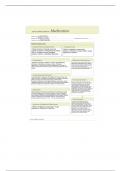
ACTIVE LEARNING TEMPLATE: Medication
jessica willard
STUDENT NAME _____________________________________
Morphine Sulfate
MEDICATION __________________________________________________________________________ REVIEW MODULE CHAPTER ___________
Opioid Agonists
CATEGORY CLASS ______________________________________________________________________
PURPOSE OF MEDICATION
Expected Pharmacological Action Therapeutic Use
- Mimics actions of naturally occurring Relief of moderate to severe pain -
opioids (endorphins, enkephalins) by binding Sedation -Reduction of bowel motility -Cough
with mu receptors causing analgesia, suppression (codeine)
sedation, euphoria, respiratory depression
Complications Medication Administration
Measure baseline vital signs before administration and monitor
-Respiratory depression -Sedation, dizziness, lightheadedness, throughout therapy. -Administer orally, IM, IV, SC, rectally, or
drowsiness -Constipation -Nausea, vomiting -Orthostatic epidurally. -Make sure patients swallow sustained-release forms
whole and do not crush or chew them. -Administer IV opioids by
hypotension -Urinary retention -Cough suppression -Potential for diluting as recommended and administering slowly over 4 to 5
min; have naloxone and resuscitation equipment
abuse -Tolerance with continued use and cross tolerance with other available. -Monitor PCA (patient-controlled analgesic pump) use
opioids and pump settings carefully. -Administer to patients with cancer
on a fixed, around-the-clock dosing schedule, not PRN
Contraindications/Precautions
-Contraindications: Pregnancy risk category D (long-term use, high
doses, near term; otherwise C); kidney failure; increased intracranial
pressure; biliary colic; biliary tract surgery; preterm labor - Nursing Interventions
Precautions: Schedule II controlled substance; older adults, infants;
reduced respiratory reserve; head injury; inflammatory bowel disease; Monitor vital signs and auscultate lungs -For
respiratory rates below 12 per min, withhold the
prostatic enlargement; hypotension; hepatic or kidney disease drug, stimulate breathing, and administer an
opioid antagonist if indicated; naloxone to
restore respiratory rate -Monitor patients when
ambulating to prevent injury -Encourage fiber
supplements, stool softeners -Monitor intake and
Interactions output, watching for signs of urinary retention
(bladder distention) -Encourage patients to
-CNS depressants (barbiturates, phenobarbital, benzodiazepines, alcohol) urinate every 4 hr -Prepare to insert a urinary
increase CNS depression -Anticholinergic agents, such as antihistamines, catheter to drain the bladder
and tricyclic antidepressants increase anticholinergic effects (constipation,
urinary retention) -MAOIs can cause hyperpyrexic coma (excitation, seizures,
respiratory depression) with meperidine (Demerol) -Antihypertensives
increase hypotensive effects -St. John’ s wort can increase sedation
Client Education
Take the drug only when needed and
short-term -Do not take prior to driving or
activities requiring mental alertness -Sit or lie
Evaluation of Medication Effectiveness down if feeling lightheaded -Change positions
gradually -Increase fluid and fiber intake; activity
- Relief of moderate to severe pain -Cough and exercise -Take the drug with food or milk
(oral forms) -Sit or lie down if feeling
suppression -Resolution of diarrhea lightheaded. -Rise slowly from a reclining or
sitting position -Report any inability to urinate or
difficulty urinating -Cough regularly to clear
secretions from the throat and chest
ACTIVE LEARNING TEMPLATES
jessica willard
STUDENT NAME _____________________________________
Morphine Sulfate
MEDICATION __________________________________________________________________________ REVIEW MODULE CHAPTER ___________
Opioid Agonists
CATEGORY CLASS ______________________________________________________________________
PURPOSE OF MEDICATION
Expected Pharmacological Action Therapeutic Use
- Mimics actions of naturally occurring Relief of moderate to severe pain -
opioids (endorphins, enkephalins) by binding Sedation -Reduction of bowel motility -Cough
with mu receptors causing analgesia, suppression (codeine)
sedation, euphoria, respiratory depression
Complications Medication Administration
Measure baseline vital signs before administration and monitor
-Respiratory depression -Sedation, dizziness, lightheadedness, throughout therapy. -Administer orally, IM, IV, SC, rectally, or
drowsiness -Constipation -Nausea, vomiting -Orthostatic epidurally. -Make sure patients swallow sustained-release forms
whole and do not crush or chew them. -Administer IV opioids by
hypotension -Urinary retention -Cough suppression -Potential for diluting as recommended and administering slowly over 4 to 5
min; have naloxone and resuscitation equipment
abuse -Tolerance with continued use and cross tolerance with other available. -Monitor PCA (patient-controlled analgesic pump) use
opioids and pump settings carefully. -Administer to patients with cancer
on a fixed, around-the-clock dosing schedule, not PRN
Contraindications/Precautions
-Contraindications: Pregnancy risk category D (long-term use, high
doses, near term; otherwise C); kidney failure; increased intracranial
pressure; biliary colic; biliary tract surgery; preterm labor - Nursing Interventions
Precautions: Schedule II controlled substance; older adults, infants;
reduced respiratory reserve; head injury; inflammatory bowel disease; Monitor vital signs and auscultate lungs -For
respiratory rates below 12 per min, withhold the
prostatic enlargement; hypotension; hepatic or kidney disease drug, stimulate breathing, and administer an
opioid antagonist if indicated; naloxone to
restore respiratory rate -Monitor patients when
ambulating to prevent injury -Encourage fiber
supplements, stool softeners -Monitor intake and
Interactions output, watching for signs of urinary retention
(bladder distention) -Encourage patients to
-CNS depressants (barbiturates, phenobarbital, benzodiazepines, alcohol) urinate every 4 hr -Prepare to insert a urinary
increase CNS depression -Anticholinergic agents, such as antihistamines, catheter to drain the bladder
and tricyclic antidepressants increase anticholinergic effects (constipation,
urinary retention) -MAOIs can cause hyperpyrexic coma (excitation, seizures,
respiratory depression) with meperidine (Demerol) -Antihypertensives
increase hypotensive effects -St. John’ s wort can increase sedation
Client Education
Take the drug only when needed and
short-term -Do not take prior to driving or
activities requiring mental alertness -Sit or lie
Evaluation of Medication Effectiveness down if feeling lightheaded -Change positions
gradually -Increase fluid and fiber intake; activity
- Relief of moderate to severe pain -Cough and exercise -Take the drug with food or milk
(oral forms) -Sit or lie down if feeling
suppression -Resolution of diarrhea lightheaded. -Rise slowly from a reclining or
sitting position -Report any inability to urinate or
difficulty urinating -Cough regularly to clear
secretions from the throat and chest
ACTIVE LEARNING TEMPLATES