Human Growth and Development Practice Questions with complete Solutions 100% Pass
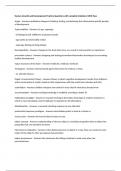
stages - Answers qualitative changes in thinking, feeling, and behaving that characterize specific periods
of development
3 personalities - Answers id, ego, superego
- id (biological self, fulfillment of physical needs)
- ego (seeks to meet bodily needs)
- superego (feeling of doing things)
Neuroplasticity - Answers changes in the brain that occur as a result of some practice or experience
prevention science - Answers designing and testing prevention/intervention techniques for promoting
healthy development
major structures of the brain - Answers hindbrain, midbrain, forebrain
Teratogens - Answers environmental agents that harm the embryo or fetus
- ex: alchold, tobacco
Piaget's Constructivist Theory - Answers theory in which cognitive development results from children's
active construction of reality, based on their experiences with the world (new stimulus and info)
assimilation - Answers children interpret new stimuli in ways that fit what they already know
accommodation - Answers existing knowledge is modified, providing a better fit
habituation paradigm - Answers A research technique that takes advantage of a baby's tendency to
orient to new stimulation and to habituate to repeated or old stimulation.
dishabituation - Answers a renewed orienting response (a new stimulus)
preferential response paradigms - Answers what babies prefer to look at or listen to
visual acuity - Answers the level of detail a baby can see
object concept - Answers understanding of what an object is, including recognition that an object has
properties that can stimulate all senses
intersensory integration - Answers when babies perceive an object in 1 way, they can construct some
notion of the object's other perceptual characteristics
object permanence - Answers the awareness that things continue to exist even when not
perceived/seen
stages - Answers qualitative changes in thinking, feeling, and behaving that characterize specific periods
of development
3 personalities - Answers id, ego, superego
- id (biological self, fulfillment of physical needs)
- ego (seeks to meet bodily needs)
- superego (feeling of doing things)
Neuroplasticity - Answers changes in the brain that occur as a result of some practice or experience
prevention science - Answers designing and testing prevention/intervention techniques for promoting
healthy development
major structures of the brain - Answers hindbrain, midbrain, forebrain
Teratogens - Answers environmental agents that harm the embryo or fetus
- ex: alchold, tobacco
Piaget's Constructivist Theory - Answers theory in which cognitive development results from children's
active construction of reality, based on their experiences with the world (new stimulus and info)
assimilation - Answers children interpret new stimuli in ways that fit what they already know
accommodation - Answers existing knowledge is modified, providing a better fit
habituation paradigm - Answers A research technique that takes advantage of a baby's tendency to
orient to new stimulation and to habituate to repeated or old stimulation.
dishabituation - Answers a renewed orienting response (a new stimulus)
preferential response paradigms - Answers what babies prefer to look at or listen to
visual acuity - Answers the level of detail a baby can see
object concept - Answers understanding of what an object is, including recognition that an object has
properties that can stimulate all senses
intersensory integration - Answers when babies perceive an object in 1 way, they can construct some
notion of the object's other perceptual characteristics
object permanence - Answers the awareness that things continue to exist even when not
perceived/seen