Financial markets Marc de Ceuster
1. The Financial System
The Actors
- Haves havenots
o Stakeholders, households corporates, government, financial industry
Main actor = households => owners of all assets but also bearers of all risks
o Net wealth = assets – liabilities
A house of 100 – mortgage debt of 80 = net wealth of 20
Growth drivers
Value changes in assets and liabilities
Net-income from labour, capital or transfers
Inheritances, gifts
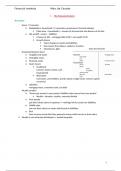
- Household balance sheet
o Tangible/real assets
o Intangible assets
o Financial assets
o Asset classes
Traditional
common stocks, bonds, cash
(equivalents)
Alternative
real estate, commodities, private equity, hedge funds, venture capital,
currencies
o Liabilities
mortgage loans, consumer loans, tax debt
- Wealth creation
o “Assets put money in your pocket, liabilities take money from your pocket”
Wealth = dynamic, relative, unevenly divided
o Poor people
put their whole salary in expenses => nothings left for assets nor liabilities
o Middle class
also use their salary for assets which leads to liabilities
o Rich
have so many assets that they generate money which serves as their salary
Wealth is not uniformly distributed => wealth inequality
1
,Financial markets Marc de Ceuster
How do the balance sheets of other actors look?
2
,Financial markets Marc de Ceuster
- Corporates
o Liabilities
Equity = shareholder funds (70%)
Debt = loans (30%)
=> leverage/garing
profit
ROE = return on equity =
equity
profit
ROA = return on assets =
assets
assets
LM = leverage multiplier =
equity
ROE = ROA x LM
o Assets
Fixed assets = LT
Current assets = ST
- Bank
o Liabilities
=> leverage for bank is extremely important
Equity (5%)
Debts (95%)
o Assets
Trading book
= inventory of shares for trading, ST
Banking book
= loans, LT
Bond portfolio
3
, Financial markets Marc de Ceuster
- Government
o Debt > assets
o Negative amount of equity
=> pays off these depts with taxes collected from households
Financial system
- Importance
o Economic growth is linked to financial development
o Role
facilitate production, employment and consumption
o Funnel resources
=> resources flow to their most efficient uses
- (Semi-) Direct finance
=> financial markets
o Primary market
securities are created, borrowers (havenots) sell securities directly to lenders (haves)
o Secondary market
securities are traded by investors, after issuance securities can be traded
Money market = trading in ST debt investments
Capital market = savings/investments are channelled between suppliers and
those in need
o Provides financing for governments and corporations
- Indirect finance
=> financial intermediaries
o Institution between lender and borrower
Loan from bank to buy car
- Methods
to get money from haves to havenots
o Direct
Taking a loan from your parents (informal financial market) to buy car
o Semi – direct
direct link but there is also a third party involved
When buying shares from a company (havenots) the bank will take a fee
from your (haves) invested money
o Indirect
You put money on a bank and the bank loans the money to a havenot
o Shadow banking
4
1. The Financial System
The Actors
- Haves havenots
o Stakeholders, households corporates, government, financial industry
Main actor = households => owners of all assets but also bearers of all risks
o Net wealth = assets – liabilities
A house of 100 – mortgage debt of 80 = net wealth of 20
Growth drivers
Value changes in assets and liabilities
Net-income from labour, capital or transfers
Inheritances, gifts
- Household balance sheet
o Tangible/real assets
o Intangible assets
o Financial assets
o Asset classes
Traditional
common stocks, bonds, cash
(equivalents)
Alternative
real estate, commodities, private equity, hedge funds, venture capital,
currencies
o Liabilities
mortgage loans, consumer loans, tax debt
- Wealth creation
o “Assets put money in your pocket, liabilities take money from your pocket”
Wealth = dynamic, relative, unevenly divided
o Poor people
put their whole salary in expenses => nothings left for assets nor liabilities
o Middle class
also use their salary for assets which leads to liabilities
o Rich
have so many assets that they generate money which serves as their salary
Wealth is not uniformly distributed => wealth inequality
1
,Financial markets Marc de Ceuster
How do the balance sheets of other actors look?
2
,Financial markets Marc de Ceuster
- Corporates
o Liabilities
Equity = shareholder funds (70%)
Debt = loans (30%)
=> leverage/garing
profit
ROE = return on equity =
equity
profit
ROA = return on assets =
assets
assets
LM = leverage multiplier =
equity
ROE = ROA x LM
o Assets
Fixed assets = LT
Current assets = ST
- Bank
o Liabilities
=> leverage for bank is extremely important
Equity (5%)
Debts (95%)
o Assets
Trading book
= inventory of shares for trading, ST
Banking book
= loans, LT
Bond portfolio
3
, Financial markets Marc de Ceuster
- Government
o Debt > assets
o Negative amount of equity
=> pays off these depts with taxes collected from households
Financial system
- Importance
o Economic growth is linked to financial development
o Role
facilitate production, employment and consumption
o Funnel resources
=> resources flow to their most efficient uses
- (Semi-) Direct finance
=> financial markets
o Primary market
securities are created, borrowers (havenots) sell securities directly to lenders (haves)
o Secondary market
securities are traded by investors, after issuance securities can be traded
Money market = trading in ST debt investments
Capital market = savings/investments are channelled between suppliers and
those in need
o Provides financing for governments and corporations
- Indirect finance
=> financial intermediaries
o Institution between lender and borrower
Loan from bank to buy car
- Methods
to get money from haves to havenots
o Direct
Taking a loan from your parents (informal financial market) to buy car
o Semi – direct
direct link but there is also a third party involved
When buying shares from a company (havenots) the bank will take a fee
from your (haves) invested money
o Indirect
You put money on a bank and the bank loans the money to a havenot
o Shadow banking
4