
Marketing Nathalie Dens
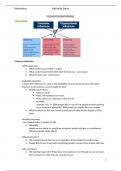
Consumer buying behaviour
Consumer behaviour
- Confirmation bias
o What confirms your beliefs = foolish
o What confirms your beliefs AND what the facts say = overvalued
o What the facts say = undervalued
- Availability heuristics
= Assess the frequency of a class or the probability of an event by the ease with which
instances or occurrences can be brought to mind
o Biased by info that is
Easier to recall
Vivid, well-publicized or recent
More salient (our attention is drawn to it)
Available
example: 9/11 => 3000 people died => out of fear people started travelling
by car instead of planes BUT 3000 people per month die in car crashes
o What is covered by the news is only a small part of what actually happens in the
world
- Likeability heuristics
= we respond better to people we like
o Likeability
people we are similar to, people we recognize, people who pay us compliments,
attractive people (‘halo-effect’)
- Endowment effect:
o We overvalue goods that we own, regardless of their objective market value
o People find it hard to part with something (product, service) they already own/use
- Sunk cost fallacy
o Not wanting to get rid of things that were expensive even though you do not need
them anymore or could even be a burden to you
1
, Marketing Nathalie Dens
- Blind-spot bias
= failing to recognize your own cognitive biases is a bias in itself, you are biased because you
think you are less biased than everyone else
o Now what?
accept that you could be wrong, research, invite a third party, …
Proposition acquisition
Evaluation
Need Information Re-
of Decision Buy
recognition search evaluation
alternatives
- Motive development
= decide that we wish to obtain an offering
o Recognize the need to solve a ‘problem
o Implication
Be aware of needs
Be aware of need inhibitors
Needs can be stimulated
- Information gathering
o AWARENESS
o Over active VS passive
o Internal search VS external search
o Stimulus => ZMOT => FMOT => SMOT
Stimulus: wanting to buy something
ZMOT = zero moment of truth: all the research consumers do online before
making a purchase
FMOT = first moment of truth: the first interaction between a shopper and a
product on a store’s shelf
SMOT = second moment of truth: your experience with the products which
becomes the next person’s ZMOT
- Proposition evaluation
o CONSIDERATION
o Determine the choice criteria
Technical
reliability, durability, performance, style/looks, comfort, delivery,
convenience, taste
Economic
price, value for money, running costs, residual value, life-cycle costs
Social
status, social belonging, convention, fashion
Personal
self-image, risk reduction, ethics, emotions
o Evaluate the alternatives
2
Consumer buying behaviour
Consumer behaviour
- Confirmation bias
o What confirms your beliefs = foolish
o What confirms your beliefs AND what the facts say = overvalued
o What the facts say = undervalued
- Availability heuristics
= Assess the frequency of a class or the probability of an event by the ease with which
instances or occurrences can be brought to mind
o Biased by info that is
Easier to recall
Vivid, well-publicized or recent
More salient (our attention is drawn to it)
Available
example: 9/11 => 3000 people died => out of fear people started travelling
by car instead of planes BUT 3000 people per month die in car crashes
o What is covered by the news is only a small part of what actually happens in the
world
- Likeability heuristics
= we respond better to people we like
o Likeability
people we are similar to, people we recognize, people who pay us compliments,
attractive people (‘halo-effect’)
- Endowment effect:
o We overvalue goods that we own, regardless of their objective market value
o People find it hard to part with something (product, service) they already own/use
- Sunk cost fallacy
o Not wanting to get rid of things that were expensive even though you do not need
them anymore or could even be a burden to you
1
, Marketing Nathalie Dens
- Blind-spot bias
= failing to recognize your own cognitive biases is a bias in itself, you are biased because you
think you are less biased than everyone else
o Now what?
accept that you could be wrong, research, invite a third party, …
Proposition acquisition
Evaluation
Need Information Re-
of Decision Buy
recognition search evaluation
alternatives
- Motive development
= decide that we wish to obtain an offering
o Recognize the need to solve a ‘problem
o Implication
Be aware of needs
Be aware of need inhibitors
Needs can be stimulated
- Information gathering
o AWARENESS
o Over active VS passive
o Internal search VS external search
o Stimulus => ZMOT => FMOT => SMOT
Stimulus: wanting to buy something
ZMOT = zero moment of truth: all the research consumers do online before
making a purchase
FMOT = first moment of truth: the first interaction between a shopper and a
product on a store’s shelf
SMOT = second moment of truth: your experience with the products which
becomes the next person’s ZMOT
- Proposition evaluation
o CONSIDERATION
o Determine the choice criteria
Technical
reliability, durability, performance, style/looks, comfort, delivery,
convenience, taste
Economic
price, value for money, running costs, residual value, life-cycle costs
Social
status, social belonging, convention, fashion
Personal
self-image, risk reduction, ethics, emotions
o Evaluate the alternatives
2


