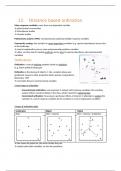
12. Distance based ordination
Many response variables: more than one dependent variable
plant/animal communities
Microbiome studies
Genetic studies
Multivariate analysis (MVA): simultaneously analysing multiple response variables
Community ecology: the variation in many dependent variables (e.g. species abundance) across sites
in the landscape
may be explained by one or more environmental predictor variables
often, we thus look for spatial gradients across sites (in species abundance and environmental
variables)
Ordination
Ordination: a way of ordering samples based on similarity
(e.g. Dutch political landscape)
Ordination is the placing of objects (= site, samples) along axes
(gradients), based on their properties (often species composition). –
Ramensky, 1929
and relate these to environmental variables
2 main types of ordination
- Unconstrained ordination: only examines 1 dataset with response variables; the resulting
output reflects overall variation in the data, which is good for exploring data
- Constrained ordination: focussing on particular effects of interest: it attempts to explain the
variation in a set of response variables by the variation in a set of explanatory variables.
3 types of ordination plots
Scatterplot Biplot Triplot
Sites Sites + species Sites + species + predictors
the closer the point are, the more similar they are
triplots plots both variables, so also the predictors
,Polar ordination
Polar ordination: a foundational ordination technique
Steps of polar ordination:
1. Compute distance between sites in terms of species composition and plot in a distance
matrix
2. Select two most different sites: these are placed on opposite ends (poles) of axis 1
3. Order the remaining sites between the poles
eventually leading to calculate an ordination score x, where x is coordinates of the site
4. Choose sites for axis 2 perpendicular to axis 1: select 2 other sies which are close together on
axis 2, but very dissimilar
5. Order all sites between these poles on axis 2
Start of dataset
Compute distances between sites (objects)
Distance: dissimilarity between objects
Euclidean distance: form of computing distances
d jk= √∑ ( y − y )
j k
2
, For a bigger dataset
Select two most different sites
Find the biggest value of difference between two sites in
the matrix
the two sides are placed on opposite ends (poles) of
axis 1
Order remaining sites between the poles
E.g. axis score of site S2
take the distance from S2 from both poles on the matrix and plot it
on the axis
Distance S2 – S1 = 128
Distance S2 – S5 = 74
Repeat that for every site
Can be computed by using the altered theorem of Pythagoras
2 2 2
X =( L + D1−D2 )/2 L
L = Distance between poles
D1 = Distance from pole 1
D2 = Distance from pole 2
Many response variables: more than one dependent variable
plant/animal communities
Microbiome studies
Genetic studies
Multivariate analysis (MVA): simultaneously analysing multiple response variables
Community ecology: the variation in many dependent variables (e.g. species abundance) across sites
in the landscape
may be explained by one or more environmental predictor variables
often, we thus look for spatial gradients across sites (in species abundance and environmental
variables)
Ordination
Ordination: a way of ordering samples based on similarity
(e.g. Dutch political landscape)
Ordination is the placing of objects (= site, samples) along axes
(gradients), based on their properties (often species composition). –
Ramensky, 1929
and relate these to environmental variables
2 main types of ordination
- Unconstrained ordination: only examines 1 dataset with response variables; the resulting
output reflects overall variation in the data, which is good for exploring data
- Constrained ordination: focussing on particular effects of interest: it attempts to explain the
variation in a set of response variables by the variation in a set of explanatory variables.
3 types of ordination plots
Scatterplot Biplot Triplot
Sites Sites + species Sites + species + predictors
the closer the point are, the more similar they are
triplots plots both variables, so also the predictors
,Polar ordination
Polar ordination: a foundational ordination technique
Steps of polar ordination:
1. Compute distance between sites in terms of species composition and plot in a distance
matrix
2. Select two most different sites: these are placed on opposite ends (poles) of axis 1
3. Order the remaining sites between the poles
eventually leading to calculate an ordination score x, where x is coordinates of the site
4. Choose sites for axis 2 perpendicular to axis 1: select 2 other sies which are close together on
axis 2, but very dissimilar
5. Order all sites between these poles on axis 2
Start of dataset
Compute distances between sites (objects)
Distance: dissimilarity between objects
Euclidean distance: form of computing distances
d jk= √∑ ( y − y )
j k
2
, For a bigger dataset
Select two most different sites
Find the biggest value of difference between two sites in
the matrix
the two sides are placed on opposite ends (poles) of
axis 1
Order remaining sites between the poles
E.g. axis score of site S2
take the distance from S2 from both poles on the matrix and plot it
on the axis
Distance S2 – S1 = 128
Distance S2 – S5 = 74
Repeat that for every site
Can be computed by using the altered theorem of Pythagoras
2 2 2
X =( L + D1−D2 )/2 L
L = Distance between poles
D1 = Distance from pole 1
D2 = Distance from pole 2