100% satisfaction guarantee Immediately available after payment Both online and in PDF No strings attached 4.2 TrustPilot
logo-home
Exam (elaborations)

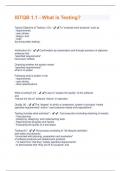
ISTQB 1.1 - What is Testing? Questions And Answers Latest Updates

Rating
-
Sold
-
Pages
5
Grade
A+
Uploaded on
02-10-2024
Written in
2024/2025

Typical Objective of Testing 1 (O) - ️️To *evaluate work products* such as - requirements, - user stories, - design, and - code (by doing static testing). Verification (K) - ️️Confirmation by examination and through provision of objective evidence that *specified requirements* have been fulfilled. Checking whether the system meets *specified requirements*; what is on paper. Following what is written in the - requirements, - user stories, - other specifications. What is testing? (O) - ️️A way to *assess the quality* of the software and *reduce the risk of* software *failure* in operation. Quality (K) - ️️The *degree* to which a component, system or process *meets specified requirements* and/or *user/customer needs and expectations*. Testing includes what activities? - ️️- Test execution (including checking of results) - Test planning - Analyzing, designing, and implementing tests - Reporting test progress and results - Evaluating the quality of a test object Testing (K) - ️️The process consisting of *all lifecycle activities*, both static and dynamic, *concerned with planning, preparation and evaluation* of software products and related work products - *to determine* that they *satisfy specified requirements*, - to demonstrate that *they are fit for purpose* and- to *detect defects*. (Execute the software and find the failures that are caused by defects in the software.) Dynamic Testing - ️️Testing that *involves the execution* of the software of a component or system being tested. Static Testing - ️️Testing that *does not involve the execution* of the component or system being tested. Includes reviewing work products such as - requirements - user stories - source code Business Analyst and Tester - ️️The Business Analyst sits with the customer and gathers requirements. The Tester reviews if they testable and achievable. Examples of "work products" - ️️- Requirements - User stories - Design - Code - Source code Validation (K) - ️️Confirmation by examination and through provision of objective evidence that *the requirements for a specific intended use or application* have been fulfilled. Checking whether the system meets *user and other stakeholder needs* in its operational environment. Going the extra step of making sure (beyond verifying with written requirement documents) that this is what the customer wants. Test Object (K) - ️️The component or system to be tested. Requirement - ️️A provision that contains criteria to be fulfilled.User Story - ️️See Also: Agile software development, requirement A *high-level user or business requirement* commonly used in Agile software development, typically consisting of one sentence in the everyday or business language *capturing what functionality a user needs and the reason behind this, any non-functional criteria, and also includes acceptance criteria*. Typical Objective of Testing 2 (O) - ️️To *verify whether all specified requirements have been fulfilled*... (open the requirements document, compare it to the software that has been developed, find any differences between them. Are the requirements fulfilled or not?) Typical Objective of Testing 3 (O) - ️️To *validate whether* the test object is *complete* and *works as* the users and other stakeholders *expect*. (You have something that you're testing, you need to ensure that - it is complete, - all the requirements are done, - validate it, whether or not it satisfies the users.) Typical Objective of Testing 4 (O) - ️️To *build confidence in the level of quality* of the test object. (make sure that the quality of the test objects are satisfying.) Typical Objective of Testing 5 (O) - ️️To *prevent defects*. (Done by static testing.) Typical Objective of Testing 6 (O) - ️️To *find failure and defects*. Typical Objective of Testing 7 (O) - ️️To *provide sufficient information to stakeholders* to allow them to make informed decisions, especially regarding the level of quality of the test object.(Provide the stakeholders sufficient information so that they can make the decision of whether they are ready to release the software or if it needs more development.) Typical Objective of Testing 8 (O) - ️️To *reduce the level of risk of inadequate software quality* (e.g. previously undetected failures occurring in operation). (Finding failures and defects in testing reduces the risk of them occurring in operation.) Typical Objective of Testing 9 (O) - ️️To *comply with contractual, legal, or regulatory requirements or standards*, and/or to *verify the test object's compliance with such requirements or standards*. (Make sure what you are testing doesn't have any legal or contractual problems and that it complies with the laws of the country you're living in and with the contract that you signed with the customer.) Component testing - ️️Synonyms: module testing , unit testing The testing of individual hardware or software components. (The *first level of testing*. - to find as many failures as possible to get them fixed early - to increase code coverage of the component test) Unit testing - ️️Component testing Acceptance Testing - ️️See Also: user acceptance testing Formal testing with respect to *user needs, requirements, and business processes* conducted to determine *whether or not a system satisfies the acceptance criteria and to enable the user, customers or other authorized entity to determine whether or not to accept the system*. (Testing to confirm that the system works as it's supposed to and satisfies the requirements.) (The *last level of testing*. Object can be released once completed. Let the Stakeholders know the risks of releasing it at this time. Stakeholders will decide if they are ready or not.) Debugging (K) - ️️The *process of finding, analyzing and removing the causes of failures* in software. (This is done by the developer. He finds and fixes the defects. In Agile, testers may also be responsible for this.)(Identifying the cause of a defect, repairing the code and checking the fix is correct.) Defect (K) - ️️Synonyms: bug , fault An *imperfection or deficiency in a work product* where it *does not meet its requirements or specifications*. Failure (K) - ️️An event in which a component or system *does not perform a required function* within specified limits. Confirmation Testing - ️️Synonyms: re-testing *Dynamic testing* conducted after fixing defects with the objective *to confirm that failures* caused by those defects *do not occur anymore*. (To confirm that the developer debugged the code and solved the problem.) An important objective of testing activities in the software development lifecycle is... - ️️Providing decision making information. When test cases are designed early in the lifecycle, verifying the test basis via the test design, which common test objective is being achieved? - ️️Preventing defects (The steps that we are following as we test.) What is an example of a defect that causes harm? - ️️A defect that causes raw sewage to be dumped in the ocean. What is a valid goal for a test team? - ️️Cause as many failures as possible so that faults can be identified and corrected. What best describes the difference between testing and debugging? - ️️Dynamic testing shows failures caused by defects. De Test Case (K) - ️️A set of - preconditions, - inputs, - actions (where applicable), - expected results and postconditions, developed based on test conditions. bugging finds, analyzes, and removes the causes of failures in the software.

Show more Read less
Institution
ISTQB 1.1
Course
ISTQB 1.1


Whoops! We can’t load your doc right now. Try again or contact support.

Written for

Institution
ISTQB 1.1
Course
ISTQB 1.1

Document information

Uploaded on
October 2, 2024
Number of pages
5
Written in
2024/2025
Type
Exam (elaborations)
Contains
Questions & answers

Subjects

Content preview

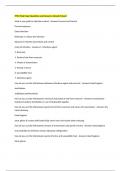
ISTQB 1.1 - What is Testing?
Typical Objective of Testing 1 (O) - ✔️✔️To *evaluate work products* such as
- requirements,
- user stories,
- design, and
- code
(by doing static testing).


Verification (K) - ✔️✔️Confirmation by examination and through provision of objective
evidence that
*specified requirements*
have been fulfilled.

Checking whether the system meets
*specified requirements*;
what is on paper.

Following what is written in the
- requirements,
- user stories,
- other specifications.


What is testing? (O) - ✔️✔️A way to *assess the quality* of the software
and
*reduce the risk of* software *failure* in operation.

Quality (K) - ✔️✔️The *degree* to which a component, system or process *meets
specified requirements* and/or *user/customer needs and expectations*.

Testing includes what activities? - ✔️✔️- Test execution (including checking of results)
- Test planning
- Analyzing, designing, and implementing tests
- Reporting test progress and results
- Evaluating the quality of a test object

Testing (K) - ✔️✔️The process consisting of *all lifecycle activities*,
both static and dynamic,
*concerned with planning, preparation and evaluation*
of software products and related work products
- *to determine* that they *satisfy specified requirements*,
- to demonstrate that *they are fit for purpose* and

, - to *detect defects*.

(Execute the software and find the failures that are caused by defects in the software.)

Dynamic Testing - ✔️✔️Testing that
*involves the execution*
of the software of a component or system being tested.

Static Testing - ✔️✔️Testing that
*does not involve the execution*
of the component or system being tested.

Includes reviewing work products such as
- requirements
- user stories
- source code

Business Analyst and Tester - ✔️✔️The Business Analyst
sits with the customer and gathers requirements.
The Tester
reviews if they testable and achievable.

Examples of "work products" - ✔️✔️- Requirements
- User stories
- Design
- Code
- Source code

Validation (K) - ✔️✔️Confirmation by examination and through provision of objective
evidence that
*the requirements for a specific intended use or application*
have been fulfilled.

Checking whether the system meets
*user and other stakeholder needs*
in its operational environment.

Going the extra step of making sure
(beyond verifying with written requirement documents)
that this is what the customer wants.

Test Object (K) - ✔️✔️The component or system to be tested.

Requirement - ✔️✔️A provision that contains criteria to be fulfilled.

Get to know the seller

Seller avatar
Reputation scores are based on the amount of documents a seller has sold for a fee and the reviews they have received for those documents. There are three levels: Bronze, Silver and Gold. The better the reputation, the more your can rely on the quality of the sellers work.
ACADEMICMATERIALS City University New York
View profile
Follow You need to be logged in order to follow users or courses
Sold
560
Member since
2 year
Number of followers
186
Documents
10590
Last sold
2 days ago

4.1

94 reviews

5
53
4
11
3
21
2
3
1
6

Recently viewed by you

Why students choose Stuvia

Created by fellow students, verified by reviews

Quality you can trust: written by students who passed their tests and reviewed by others who've used these notes.

Didn't get what you expected? Choose another document

No worries! You can instantly pick a different document that better fits what you're looking for.

Pay as you like, start learning right away

No subscription, no commitments. Pay the way you're used to via credit card and download your PDF document instantly.

Student with book image

“Bought, downloaded, and aced it. It really can be that simple.”

Alisha Student

Frequently asked questions