100% satisfaction guarantee Immediately available after payment Both online and in PDF No strings attached 4.2 TrustPilot
logo-home
Exam (elaborations)

ISTQB Foundation - Chapter 3 - Static Testing Latest(2024/2025) Questions and Answers 100% Correct.

Rating
-
Sold
-
Pages
2
Grade
A+
Uploaded on
02-10-2024
Written in
2024/2025

Review roles - ️️1) Manager - decides on what to review 2) Moderator - leads the review 3) Author - person who wrote the document 4) Reviewers - performs the review of documents 5) Scribe - documents the review Success factors for reviews - ️️1) Each review should have predefined and agreed objective 2) Any defects should be welcomes 3) Conducted in an atmosphere of trust 4) Techniques are suitable to work-product type 5) Emphasis on learning 6) Management support Reviews - ️️Systematic examination of a document by one of more people with the main aim of finding and removing errors Types of defects found in reviews - ️️1) Deviations from standards 2) Requirements defects 3) Design defects 4) Insufficient maintainability 5) Incorrect interface specifications Basic review process - ️️1) Document under review is studied 2) Reviewers identify issues and inform the author 3) Author decides on action to take and updates as needed Two main static testing techniques - ️️1) Reviews 2) Static analysis Formal review process - ️️1) Planning (select personnel, allocate roles, defining entry and exit criteria, selecting parts of document to review) 2) Kick-off 3) Review entry criteria 4) Individual preparation5) Noting incidents 6) Review meeting 7) Examine 8) Rework 9) Fixing defects 10) Follow-up 11) Checking exit criteria Four types of reviews - ️️1) Informal 2) Walkthrough 3) Technical review 4) Inspection Informal review - ️️Main purpose is to find defects and uses no real formal process Inspection - ️️Main purpose is to find defects and process improvement Static analysis - ️️Used to find defects in software source code and software models Benefits of static analysis - ️️1) Early detection of issues prior to test execution 2) Early warning about suspicious code or design 3) Identification of defects not easily found by dynamic testing 4) Improved maintainability 5) Prevention of defects Walktrhough - ️️Enable learning of the content of the document and find defects Technical review - ️️Enable decision making, finding defects, solving technical problems, and checking conformance of document

Show more Read less
Institution
ISTQB Foundation - Chapter 3 - Static Testing
Course
ISTQB Foundation - Chapter 3 - Static Testing


Whoops! We can’t load your doc right now. Try again or contact support.

Written for

Institution
ISTQB Foundation - Chapter 3 - Static Testing
Course
ISTQB Foundation - Chapter 3 - Static Testing

Document information

Uploaded on
October 2, 2024
Number of pages
2
Written in
2024/2025
Type
Exam (elaborations)
Contains
Questions & answers

Subjects

Content preview

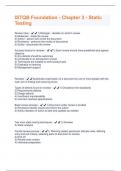
ISTQB Foundation - Chapter 3 - Static
Testing
Review roles - ✔️✔️1) Manager - decides on what to review
2) Moderator - leads the review
3) Author - person who wrote the document
4) Reviewers - performs the review of documents
5) Scribe - documents the review

Success factors for reviews - ✔️✔️1) Each review should have predefined and agreed
objective
2) Any defects should be welcomes
3) Conducted in an atmosphere of trust
4) Techniques are suitable to work-product type
5) Emphasis on learning
6) Management support


Reviews - ✔️✔️Systematic examination of a document by one of more people with the
main aim of finding and removing errors

Types of defects found in reviews - ✔️✔️1) Deviations from standards
2) Requirements defects
3) Design defects
4) Insufficient maintainability
5) Incorrect interface specifications

Basic review process - ✔️✔️1) Document under review is studied
2) Reviewers identify issues and inform the author
3) Author decides on action to take and updates as needed


Two main static testing techniques - ✔️✔️1) Reviews
2) Static analysis

Formal review process - ✔️✔️1) Planning (select personnel, allocate roles, defining
entry and exit criteria, selecting parts of document to review)
2) Kick-off
3) Review entry criteria
4) Individual preparation

Get to know the seller

Seller avatar
Reputation scores are based on the amount of documents a seller has sold for a fee and the reviews they have received for those documents. There are three levels: Bronze, Silver and Gold. The better the reputation, the more your can rely on the quality of the sellers work.
ACADEMICMATERIALS City University New York
View profile
Follow You need to be logged in order to follow users or courses
Sold
560
Member since
2 year
Number of followers
186
Documents
10590
Last sold
2 days ago

4.1

94 reviews

5
53
4
11
3
21
2
3
1
6

Recently viewed by you

Why students choose Stuvia

Created by fellow students, verified by reviews

Quality you can trust: written by students who passed their tests and reviewed by others who've used these notes.

Didn't get what you expected? Choose another document

No worries! You can instantly pick a different document that better fits what you're looking for.

Pay as you like, start learning right away

No subscription, no commitments. Pay the way you're used to via credit card and download your PDF document instantly.

Student with book image

“Bought, downloaded, and aced it. It really can be that simple.”

Alisha Student

Frequently asked questions