Finance Summary
Financial accounting fundamentals:
- Matching principle: it requires that a company records expenses in the same period
in which its related revenues are earned.
- accrual basis: requires recording revenues when they are earned and not when they
are received in cash and recording expenses when they are incurred and not when
they are paid.
- recognition: selling goods or services are recognized in the period in which the
goods are sold and delivered and the Services when are performed.
accruals/ prepayments → rising current assets and current liabilities.
- conservatism: requires companies not to overstate revenues, understate expenses,
overstate assets, understate liabilities.
- materiality: refers to the impact of incorrect or missing information in financial
statements.
- full disclosure: concerns the need to disclose all material and relevant information
about all business activities within a reporting period in the financial statements.
- going concern: concerns the assumption that a firm will operate indefinitely in the
future, therefore the continuity of its business is assumed.
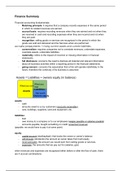
Assets = Liabilities + owners equity (in balance)
What you
What you own owe
Liabilities
Assets
Net worth
Owners equity
assets:
- cash
- amounts owed to us by customers (accounts receivable),
- cars, buildings, suppliers, land and equipment, etc.
liabilities:
- loan
- owe money to a company or to our employees (wages payable or salaries payable)
- accounts payable, bought something on credit (unearned revenue)
(payable: we would have to pay it at some point)
equity:
- capital account (startkapitaal): that tracks the owner or owner’s balance
- withdrawals (dividends) the amount an owner takes from built equity
- revenues/sales: the amount you would earn from selling goods or services.
- expenses: the amounts that we pay out for (salaries, gas)
when revenues and expenses are recognized either before or after the flow of cash, there
are 4 accrual combinations:
, 1. unearned revenue: cash received before revenue is earned
2. accrued revenue: sales revenue is recognized before cash is received (Asset)
3. accrued expense: expense or obligation is recognized before cash is paid
4. prepaid expenses: cash is paid before expense or obligation is recognized.
Supplies / inventory = voorraad
Beginning Inventory + purchases + shipping - Ending Inventory = cost of goods sold
Income statement: shows what a company has earned, what it has paid, what is the
resulting profit or losses over a certain period of time.
Balance sheet: shows what the company owns, what it owes, and what it´s worth.
Statement of cash flow: shows how much cash the company has brought in, and how
much it is paid out.
Total assets:
● current assets: used within one year (cash, inventory, accounts receivable)
● non-current assets: last more than a year
- tangible: you can touch (car, plan and equipment, property)
- intangible: you can´t touch (patents, trademarks)
Total Liabilities:
- current liabilities: must be paid within 1 year (accounts payable)
- non-current liabilities: due in more than a year (Leases, long term debt)
Shareholders equity:
- common shares
- retained earnings, these can either remain and therefore invested or they can be paid
out in dividends, reducing retained earnings.
income statement = revenues - expenses
provides detailed results of a company´s operations over a period of time.
unearned revenue: liabilities, you already received the money for services/goods you will
provide somewhere in the future.
gross profit = contract price - EAC
taxes = btw
Financial accounting fundamentals:
- Matching principle: it requires that a company records expenses in the same period
in which its related revenues are earned.
- accrual basis: requires recording revenues when they are earned and not when they
are received in cash and recording expenses when they are incurred and not when
they are paid.
- recognition: selling goods or services are recognized in the period in which the
goods are sold and delivered and the Services when are performed.
accruals/ prepayments → rising current assets and current liabilities.
- conservatism: requires companies not to overstate revenues, understate expenses,
overstate assets, understate liabilities.
- materiality: refers to the impact of incorrect or missing information in financial
statements.
- full disclosure: concerns the need to disclose all material and relevant information
about all business activities within a reporting period in the financial statements.
- going concern: concerns the assumption that a firm will operate indefinitely in the
future, therefore the continuity of its business is assumed.
Assets = Liabilities + owners equity (in balance)
What you
What you own owe
Liabilities
Assets
Net worth
Owners equity
assets:
- cash
- amounts owed to us by customers (accounts receivable),
- cars, buildings, suppliers, land and equipment, etc.
liabilities:
- loan
- owe money to a company or to our employees (wages payable or salaries payable)
- accounts payable, bought something on credit (unearned revenue)
(payable: we would have to pay it at some point)
equity:
- capital account (startkapitaal): that tracks the owner or owner’s balance
- withdrawals (dividends) the amount an owner takes from built equity
- revenues/sales: the amount you would earn from selling goods or services.
- expenses: the amounts that we pay out for (salaries, gas)
when revenues and expenses are recognized either before or after the flow of cash, there
are 4 accrual combinations:
, 1. unearned revenue: cash received before revenue is earned
2. accrued revenue: sales revenue is recognized before cash is received (Asset)
3. accrued expense: expense or obligation is recognized before cash is paid
4. prepaid expenses: cash is paid before expense or obligation is recognized.
Supplies / inventory = voorraad
Beginning Inventory + purchases + shipping - Ending Inventory = cost of goods sold
Income statement: shows what a company has earned, what it has paid, what is the
resulting profit or losses over a certain period of time.
Balance sheet: shows what the company owns, what it owes, and what it´s worth.
Statement of cash flow: shows how much cash the company has brought in, and how
much it is paid out.
Total assets:
● current assets: used within one year (cash, inventory, accounts receivable)
● non-current assets: last more than a year
- tangible: you can touch (car, plan and equipment, property)
- intangible: you can´t touch (patents, trademarks)
Total Liabilities:
- current liabilities: must be paid within 1 year (accounts payable)
- non-current liabilities: due in more than a year (Leases, long term debt)
Shareholders equity:
- common shares
- retained earnings, these can either remain and therefore invested or they can be paid
out in dividends, reducing retained earnings.
income statement = revenues - expenses
provides detailed results of a company´s operations over a period of time.
unearned revenue: liabilities, you already received the money for services/goods you will
provide somewhere in the future.
gross profit = contract price - EAC
taxes = btw