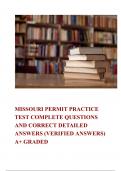
2020 MISSOURI POST TEST STUDY
GUIDE COMPLETE QUESTIONS
AND CORRECT DETAILED
ANSWERS (VERIFIED ANSWERS)
A+ GRADED
, Tort - ANS A private or civil wrong or injury, other than a breach of contract.
Preponderance of evidence - ANS The amount of information needed to decide in favor of a
party in a civil suit. It consists of more than fifty percent of the believable evidence in favor of the
party's suit or defense. One more fact than the other party has established.
Proof beyond a reasonable doubt - ANS The amount of information needed to convict a person
of a crime. It is enough evidence to eliminate all reasonable objections to the prosecution's case
against a suspect. It is not absolute proof, but it is more than probable cause.
Summons - ANS Papers requiring you to appear in civil or criminal court.
Bill of Rights - ANS First 10 amendments of the constitution that guarantees rights to all U.S.
citizens.
Exceptions to the First Amendment - ANS Obscenities, fighting words, commercial speech,
defamation: slander (spoken) or libel (written), incendiary speech, and time, place, and manner
restrictions on speech.
Nexus - ANS Connection
Amendments typically applied to LEO's - ANS 1st, 4th, 5th, 6th, and 8th
4th Amendment - ANS Citizens are protected against unreasonable searches and seizures
against their person, property, and papers.
5th Amendment - ANS Protection against self-incrimination and double jeopardy. Can not hold
a person without presentment or indictment of a grand jury.
6th Amendment - ANS Right to a speedy and public trial. Right to face accuser. Right to have
counsel.
8th Amendment - ANS Right not to have excessive bail, unjust fines, or unjust punishment.
14th Amendment - ANS Establishes primacy of federal government over state government.
U.S. citizen first.
Branches of the Government - ANS Legislative, Executive, Judicial
Branch of government LEO's a part of - ANS Executive, but evidence is part of the judicial
Exclusionary Rule - ANS Any evidence which is obtained illegally must be excluded from trial.
GUIDE COMPLETE QUESTIONS
AND CORRECT DETAILED
ANSWERS (VERIFIED ANSWERS)
A+ GRADED
, Tort - ANS A private or civil wrong or injury, other than a breach of contract.
Preponderance of evidence - ANS The amount of information needed to decide in favor of a
party in a civil suit. It consists of more than fifty percent of the believable evidence in favor of the
party's suit or defense. One more fact than the other party has established.
Proof beyond a reasonable doubt - ANS The amount of information needed to convict a person
of a crime. It is enough evidence to eliminate all reasonable objections to the prosecution's case
against a suspect. It is not absolute proof, but it is more than probable cause.
Summons - ANS Papers requiring you to appear in civil or criminal court.
Bill of Rights - ANS First 10 amendments of the constitution that guarantees rights to all U.S.
citizens.
Exceptions to the First Amendment - ANS Obscenities, fighting words, commercial speech,
defamation: slander (spoken) or libel (written), incendiary speech, and time, place, and manner
restrictions on speech.
Nexus - ANS Connection
Amendments typically applied to LEO's - ANS 1st, 4th, 5th, 6th, and 8th
4th Amendment - ANS Citizens are protected against unreasonable searches and seizures
against their person, property, and papers.
5th Amendment - ANS Protection against self-incrimination and double jeopardy. Can not hold
a person without presentment or indictment of a grand jury.
6th Amendment - ANS Right to a speedy and public trial. Right to face accuser. Right to have
counsel.
8th Amendment - ANS Right not to have excessive bail, unjust fines, or unjust punishment.
14th Amendment - ANS Establishes primacy of federal government over state government.
U.S. citizen first.
Branches of the Government - ANS Legislative, Executive, Judicial
Branch of government LEO's a part of - ANS Executive, but evidence is part of the judicial
Exclusionary Rule - ANS Any evidence which is obtained illegally must be excluded from trial.