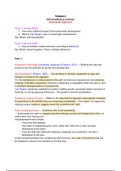
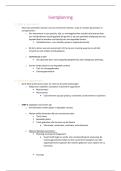
Problem 3
Self-Actualising or Learning:
Humanistic Approach
Case 1 Learning Goals:
1. How does childhood impact future personality development.
2. What is Carl Roger’s view on personality development?
Key Words: Self-Actualisation
Case 2 Learning Goals:
1. How do children imitate behaviour according to Bandura?
Key Words: Social Cognitive Theory, Imitative Behaviour
Case 1:
Humanistic Psychology (Schneider, Bugental, & Pierson, 2001) → Reflects the idea that
everyone has the potential for growth and development.
Self-Actualisation (Rogers, 1959) → The tendency to develop capabilities in ways that
maintain or enhance the organism.
It is the maintenance or enhancement of the self; enriches your experiences and enhances
creativity. Promotes congruence (harmony), wholeness or integration within the person, and
it minimizes disorganisation or incongruence.
Carl Rogers viewed the potential for positive, healthy growth, expresses itself in everyone if
there are no strong opposing influences. - This growth is termed actualisation.
Organismic Valuing Process → Refers to the idea that the organism automatically evaluates
its experience to tell whether they are enhancing actualisation. - If the aren’t, the organismic
valuing process creates a nagging sense that something isn’t right.
Fully Functioning Person → Someone who is self-actualising.
→ Such people are open to experiencing their feelings and are not threatened by them, no
matter what their feelings are.
Characteristics/Traits Include:
- They trust their feelings
- Also open to experiencing the world, rather than hide from it; they immerse
themselves in the world.
- They live their lives filled with meaning, challenge, and excitement, but also a
willingness to risk pain.
A fully functioning person isn’t a particular kind of person, it’s a way of functioning that can
be adopted by anyone who chooses to live that way.
, The Need For Positive Regard:
Positive Regard → The need for acceptance, love, friendship, and the affection of others -
particularly others who matter to them. Positive regard can come in the form of two different
ways:
1. Unconditional Positive Regard → Affection is given without special conditions - with
“no strings attached”.
2. Conditional Positive Regard → Affection is given only if certain conditions are
satisfied. (E.g. “I’ll like and accept you, but only if you act in a particular way.”)
Conditional Self-Regard → We give ourselves affection and acceptance only w hen we
satisfy those conditions. Conditional self-regard makes you behave so as to fit conditions of
worth you’re applying to yourself (Crocker & Wolfe, 2001).
Conditions Of Worth → The condition under which people are judged worthy of positive
regard; doing something for positive regard not because we desire it. → When people act to
confirm to a condition of worth, they’re doing so not because the act is intrinsically desirable,
but to get a positive regard from other people. (E.g. A child doing something that appeases a
parent; good or bad.)
Accepting conditions of worth may interfere with self-actualisation.
Journey Into Selfhood: Positive Regard And Conditions Of Worth:
- According to Rogers, all children are born wanting to be loved and accepted by their
parents and others → He called this inborn need for desire: positive regard.
- Parents frequently make their positive regard contingent on conditions, such as the
conditions expressed in the statements:
- “Show me you are a good child and earn all A’s on your report card.”
- “I would really like it if you warn the star role in your school play.”
- → Another example, parents push children into sports, and the children might stay in
the sports, not because they like sports, but to earn the love and positive regard of
their parents.
- Parents can set conditions of worth for their children → Children may become
preoccupied with living up to these conditions of worth, rather than discovering what
makes them happy.
Contingent Self Worth → People who use their performance in some area of life as a
condition for self-acceptance (which especially means the same thing as conditioned
self-regard). → People use something in a specific area as conditions of worth, applying
them to themselves. E.g. Demanding about their academic performance or appearance.
Self-Actualising or Learning:
Humanistic Approach
Case 1 Learning Goals:
1. How does childhood impact future personality development.
2. What is Carl Roger’s view on personality development?
Key Words: Self-Actualisation
Case 2 Learning Goals:
1. How do children imitate behaviour according to Bandura?
Key Words: Social Cognitive Theory, Imitative Behaviour
Case 1:
Humanistic Psychology (Schneider, Bugental, & Pierson, 2001) → Reflects the idea that
everyone has the potential for growth and development.
Self-Actualisation (Rogers, 1959) → The tendency to develop capabilities in ways that
maintain or enhance the organism.
It is the maintenance or enhancement of the self; enriches your experiences and enhances
creativity. Promotes congruence (harmony), wholeness or integration within the person, and
it minimizes disorganisation or incongruence.
Carl Rogers viewed the potential for positive, healthy growth, expresses itself in everyone if
there are no strong opposing influences. - This growth is termed actualisation.
Organismic Valuing Process → Refers to the idea that the organism automatically evaluates
its experience to tell whether they are enhancing actualisation. - If the aren’t, the organismic
valuing process creates a nagging sense that something isn’t right.
Fully Functioning Person → Someone who is self-actualising.
→ Such people are open to experiencing their feelings and are not threatened by them, no
matter what their feelings are.
Characteristics/Traits Include:
- They trust their feelings
- Also open to experiencing the world, rather than hide from it; they immerse
themselves in the world.
- They live their lives filled with meaning, challenge, and excitement, but also a
willingness to risk pain.
A fully functioning person isn’t a particular kind of person, it’s a way of functioning that can
be adopted by anyone who chooses to live that way.
, The Need For Positive Regard:
Positive Regard → The need for acceptance, love, friendship, and the affection of others -
particularly others who matter to them. Positive regard can come in the form of two different
ways:
1. Unconditional Positive Regard → Affection is given without special conditions - with
“no strings attached”.
2. Conditional Positive Regard → Affection is given only if certain conditions are
satisfied. (E.g. “I’ll like and accept you, but only if you act in a particular way.”)
Conditional Self-Regard → We give ourselves affection and acceptance only w hen we
satisfy those conditions. Conditional self-regard makes you behave so as to fit conditions of
worth you’re applying to yourself (Crocker & Wolfe, 2001).
Conditions Of Worth → The condition under which people are judged worthy of positive
regard; doing something for positive regard not because we desire it. → When people act to
confirm to a condition of worth, they’re doing so not because the act is intrinsically desirable,
but to get a positive regard from other people. (E.g. A child doing something that appeases a
parent; good or bad.)
Accepting conditions of worth may interfere with self-actualisation.
Journey Into Selfhood: Positive Regard And Conditions Of Worth:
- According to Rogers, all children are born wanting to be loved and accepted by their
parents and others → He called this inborn need for desire: positive regard.
- Parents frequently make their positive regard contingent on conditions, such as the
conditions expressed in the statements:
- “Show me you are a good child and earn all A’s on your report card.”
- “I would really like it if you warn the star role in your school play.”
- → Another example, parents push children into sports, and the children might stay in
the sports, not because they like sports, but to earn the love and positive regard of
their parents.
- Parents can set conditions of worth for their children → Children may become
preoccupied with living up to these conditions of worth, rather than discovering what
makes them happy.
Contingent Self Worth → People who use their performance in some area of life as a
condition for self-acceptance (which especially means the same thing as conditioned
self-regard). → People use something in a specific area as conditions of worth, applying
them to themselves. E.g. Demanding about their academic performance or appearance.