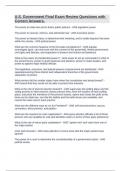
U.S. Government Exam Review with
complete solutions 2024/2025
What is the purpose of the government? - ANSWER-Protect, maintain public
order, resolve social conflicts, responsibility for a stable economy, and provide
public services.
Limited Government - ANSWER-A system in which government's powers are
restricted and individuals' rights are protected.
Declaration of Independence - ANSWER-Written by Thomas Jefferson, Declares
Independence, List of complaints against Britain,expresses enduring beliefs of
American society. Defines liberty, order, equality, democracy, and justice.
John Locke - ANSWER-Enlightenment philosopher who wrote the "Second
Treasties of Government", greatly influenced the Declaration of Independence.
Principles:Natural Rights and Consent of The Governed.
Surpremacy Clause and changes - ANSWER-Created to keep elastic clause from
being stretched, and to restrict governmental powers. Overlooked during
McCulloch VS. Maryland case. During the civil war, supremacy clause guaranteed
that the union could not be dissolved.
Unitary System - ANSWER-A form of government in which all powers of the
government are held by a single unit or agency.
,Federal System - ANSWER-A form of government in which governmental powers
are divided between a central authority and a number of regional political
subdivisions.
Confederacy - ANSWER-A political system in which a weak central government
has limited authority, and the states have all of the power.
Socialism - ANSWER-The economic system that advocates government
ownership of the means of products.
Capitalism - ANSWER-An economic system characterized by open competition in
a free market and based on private ownership.
Communism - ANSWER-A system of government in which the state controls the
means of production.
Parliamentary Government - ANSWER-A form of government in which the
executive leaders are chosen by and responsible to the legislature.
Presidential Government - ANSWER-A form of government in which the
legislative and executive branches are separate and function independently.
Democracy - ANSWER-A system of government by the people, exercised either
directly or through elected representatives.
Direct Democracy - ANSWER-A democratic system of government in which all
citizens participate in politics and decision-making.
Representative Democracy - ANSWER-A democratic system of government in
which policies are made by officials accountable to the people who elected them.
Dictatorship - ANSWER-A form of government in which an absolute ruler controls
the power, often through fear or force, and ignores the will of the people.
Monarchy - ANSWER-A government in which the ruler's power is hereditary.
, Popular Sovereignty - ANSWER-The fundamental principle that the power to
govern belongs to the people and that the government must be based on the
consent of the governed.
Second Treasties of Government - ANSWER-Written by John Locke, and
expresses enlightenment philosophy and the principles of the consent of the
governed and natural rights.
Checks and Balances - ANSWER-A system in which the political power is divided
among the three branches of government, each having some control over the
others.
Preamble - ANSWER-Lists the six goals of government: form a more perfect
union, establish justice, ensure domestic peace, provide for common defense,
promote the general welfare, and secure liberty.
First Amendment - ANSWER-Freedom of speech and press including pure
speech, speech plus, symbolic speech, and flag burning.
Second Amendment - ANSWER-Right to bear arms
Tenth Amendment - ANSWER-Powers of states and people
Fourteenth Amendment - ANSWER-Citizenship and Civil Rights
Fifthteenth Amendment - ANSWER-Right to Vote
Seventeenth Amendment - ANSWER-Direct election of senators
Nineteenth Amendment - ANSWER-Women's suffrage
Twenty-First Amendment - ANSWER-Repeal of prohibition
Twenty-Fourth Amendment - ANSWER-Abolition of poll taxes
complete solutions 2024/2025
What is the purpose of the government? - ANSWER-Protect, maintain public
order, resolve social conflicts, responsibility for a stable economy, and provide
public services.
Limited Government - ANSWER-A system in which government's powers are
restricted and individuals' rights are protected.
Declaration of Independence - ANSWER-Written by Thomas Jefferson, Declares
Independence, List of complaints against Britain,expresses enduring beliefs of
American society. Defines liberty, order, equality, democracy, and justice.
John Locke - ANSWER-Enlightenment philosopher who wrote the "Second
Treasties of Government", greatly influenced the Declaration of Independence.
Principles:Natural Rights and Consent of The Governed.
Surpremacy Clause and changes - ANSWER-Created to keep elastic clause from
being stretched, and to restrict governmental powers. Overlooked during
McCulloch VS. Maryland case. During the civil war, supremacy clause guaranteed
that the union could not be dissolved.
Unitary System - ANSWER-A form of government in which all powers of the
government are held by a single unit or agency.
,Federal System - ANSWER-A form of government in which governmental powers
are divided between a central authority and a number of regional political
subdivisions.
Confederacy - ANSWER-A political system in which a weak central government
has limited authority, and the states have all of the power.
Socialism - ANSWER-The economic system that advocates government
ownership of the means of products.
Capitalism - ANSWER-An economic system characterized by open competition in
a free market and based on private ownership.
Communism - ANSWER-A system of government in which the state controls the
means of production.
Parliamentary Government - ANSWER-A form of government in which the
executive leaders are chosen by and responsible to the legislature.
Presidential Government - ANSWER-A form of government in which the
legislative and executive branches are separate and function independently.
Democracy - ANSWER-A system of government by the people, exercised either
directly or through elected representatives.
Direct Democracy - ANSWER-A democratic system of government in which all
citizens participate in politics and decision-making.
Representative Democracy - ANSWER-A democratic system of government in
which policies are made by officials accountable to the people who elected them.
Dictatorship - ANSWER-A form of government in which an absolute ruler controls
the power, often through fear or force, and ignores the will of the people.
Monarchy - ANSWER-A government in which the ruler's power is hereditary.
, Popular Sovereignty - ANSWER-The fundamental principle that the power to
govern belongs to the people and that the government must be based on the
consent of the governed.
Second Treasties of Government - ANSWER-Written by John Locke, and
expresses enlightenment philosophy and the principles of the consent of the
governed and natural rights.
Checks and Balances - ANSWER-A system in which the political power is divided
among the three branches of government, each having some control over the
others.
Preamble - ANSWER-Lists the six goals of government: form a more perfect
union, establish justice, ensure domestic peace, provide for common defense,
promote the general welfare, and secure liberty.
First Amendment - ANSWER-Freedom of speech and press including pure
speech, speech plus, symbolic speech, and flag burning.
Second Amendment - ANSWER-Right to bear arms
Tenth Amendment - ANSWER-Powers of states and people
Fourteenth Amendment - ANSWER-Citizenship and Civil Rights
Fifthteenth Amendment - ANSWER-Right to Vote
Seventeenth Amendment - ANSWER-Direct election of senators
Nineteenth Amendment - ANSWER-Women's suffrage
Twenty-First Amendment - ANSWER-Repeal of prohibition
Twenty-Fourth Amendment - ANSWER-Abolition of poll taxes