7.1 OWNERSHIP AND GOVERNANCE OF FIRMS
- The private sector consists of firms that are owned by individuals or other nongovernmental entities and whose owners may earn a profit. Examples are Apple, Heinz, and Toyota. In almost every country, this sector provides most of that country’s gross domestic product (75% of G D P U S A).
- The public sector consists of firms and other organizations that are owned by governments or government agencies, called state-owned enterprises. Examples are the armed forces, the court system, most schools, colleges, universities, and Amtrak. This sector may be small or large (12% of G D P USA.)
- The nonprofit sector consists of organizations that are neither government-owned nor intended to earn a profit, but typically pursue social or public interest objectives (nongovernment, not-for-profit sector). Examples include Greenpeace, Alcoholics Anonymous, the Salvation Army, and other
charitable, educational, health, and religious organizations.
Ownership of For-Profit Firms
• Sole proprietorships are firms owned and controlled by a single individual.
• Partnerships are businesses jointly owned and controlled by two or more people operating under a partnership agreement.
• Corporations are firms owned by shareholders, who own the firm’s shares or stocks.
Each share is a unit of ownership in the firm. Therefore, shareholders own the firm in proportion to the number of shares they hold. Shareholders elect a board of directors to represent them. In turn, the board of directors usually hires managers who manage the firm’s operations. The legal
name of a corporation often includes the term Incorporated (Inc.) or Limited (Ltd) to indicate its corporate status.
Publicly Traded and Closely Held Corporations
• Shares of public corporations can be readily bought and sold by the general public. Shares may be available at the New York Stock Exchange, the N A S D A Q, the Tokyo Stock Exchange, the Toronto Stock Exchange, or the London Stock Exchange.
• Shares of closely held corporations are not available for purchase or sale on an organized exchange. Typically, its stock is owned by a small group of individuals (private equity).
To make the transition from privately held to publicly traded status, the closely held firm makes an initial public offering (I P O) of its shares on an organized stock exchange. One major advantage of going public is to raise money. However, a major disadvantage is that ownership of the firm
becomes broadly distributed, possibly causing the original owners to lose control of the firm.
• It is also possible for a publicly traded firm to go private and convert to closely held status. Examples are Toys-R-Us and Burger King.
Liability
• Owners of a corporation are not personally liable for the firm’s debts. They have limited liability: personal assets cannot be taken to pay a corporation’s debts even if it goes into bankruptcy.
• Owners of sole proprietorships and partnerships were fully liable, individually and collectively, for any debts of the firm. Now they can be a limited liability company (L L C). The precise regulations for L L Cs vary from country to country and from state to state within the United States.
Firm Size
• According to the 2015 ProQuest Statistical Abstract of the United States, most large firms are corporations.
U.S. corporations are only 18% of all nonfarm firms but make 81% of sales revenue and 58% of net income. Nonfarm sole proprietorships are 72% of firms but make only 4% of the sales revenue and earn 15% of net income.
Corporations that earn over $50 million are less than 1% of all corporations, but they make 77% of revenue.
Firm Governance
• In a small private sector firm with a single owner-manager, the governance of the firm is straightforward. The owner-manager makes the important decisions for the firm.
• In publicly traded corporations, the shareholders own the corporation. However, most of them play no meaningful role in day-to-day decision making or even in long-range planning. Shareholders elect a board of directors and delegate many of their ownership rights to them. The
board of a large publicly traded corporation normally includes outside directors and inside directors, such as the chief executive officer (C E O) of the corporation and other senior executives.
• Economic profit = Revenue minus Opportunity Cost (Opportunity Cost = Explicit Costs + Implicit Costs)
• Accounting Profit = Revenue minus Explicit Costs (If implicit costs are left out, then accounting profit > economic profit)
• Common Confusion: You should operate your firm if you are making an accounting profit.
For small firms owned and managed by one person, the main difference between explicit and implicit costs is the opportunity cost of the owner-manager’s time.
If the owner-manager invests other resources, the opportunity cost of these other resources is also implicit costs.
• Normal profit is the amount needed to cover all implicit costs of the owners. Economic profit is the amount above the normal profit.
- Corporate Social Responsibility (C S R): C S R is the pursuit of social objectives rather than profit maximization. It could be also E S G (environmental, social, and governance objective).
While Milton Friedman argued the social responsibility of businesses is to increase its profits (sole responsibility with the owners of the firm), Edward Freeman argued managers have obligations with shareholders, workers, customers, and the communities where firms reside and operate.
- Charitable Activities: C S R or E S G contributions may reduce returns to shareholders and generate court litigations. Courts have increasingly decided that businesses have implicit obligations to various stakeholders that often go beyond what is explicitly covered in formal contracts.
- Strategic E S G: C S R activities intended to increase profits are called strategic C S R, “doing well by doing good.”
- Forcing Firms to Maximize Profit: The Survivor Principle and Competition for Corporate Control: Not all private-sector managers try to maximize profits. Why, then, do economists assume that most private-sector firms maximize profit?
- Survivor Principle: In perfectly competitive markets, the only firms that survive are those that maximize profit. Firms that fail to maximize profit lose money and are driven out of business.
- The Struggle for Corporate Control
• Outside investors could buy enough shares to take over control of an underperforming publicly traded firm (market for corporate control).
• Firms can defend with a shareholder rights plan (poison pill defense) in the United States. Poison pills may not prevent a takeover, but usually benefits the original managers or board of directors. See Table 7.1 for a list of takeover defense terminology.
back-end plan: Provision that gives shareholders the right to cash or debt securities at an above-market price previously defined by the company’s board in the event of a hostile takeover.
dead-hand: Provision that allows only the directors who introduce the poison pill to remove it for a fixed period after they have been replaced, thereby delaying a new board’s ability to sell the firm.
flip-in: Provision that gives current shareholders of the firm other than the hostile acquirer the right to purchase additional shares of stocks at a discount price after the acquirer obtains a certain percentage of the firm’s shares (usually between 20% and 50%).
flip-over: Provision that allows shareholders to buy the acquiring firm’s shares at a discount price after a merger or takeover.
golden handcuffs: Employment clauses that require top employees to give back lucrative bonuses or incentives if they leave the firm within a specified period. As a poison pill, these clauses cease to hold after a hostile takeover so that the employees may quit immediately after cashing their stock
options.
macaroni defense (similar to a flip-over): The issuance of many bonds with the condition they must be redeemed at an above-market price if the company is taken over.
poison pill, porcupine provision, shareholder rights plan, or shark repellent: Defensive provisions that corporate boards include in the firm’s corporate charter or bylaws that make a takeover less profitable.
poison puts: The issuance of bonds that investors may cash before they mature in the event of a hostile takeover attempt.
2 DECISIONS: Horizontal dimension: Size of the firm in its primary market // Vertical dimension: Stages of the production process in which the firm participates
• Supply chain management: To produce and sell a good involves many sequential stages of production, marketing, and distribution activities. A manager decides how many stages the firm will undertake itself. Otherwise, the firm will pay for
it to be done by others.
Vertical Integration
• A firm that participates in more than one successive stage of the production or distribution of goods or services is vertically integrated.
• A firm may vertically integrate backward and produce its own inputs, or forward and buy its former customer.
• A firm can be partially vertically integrated. It may produce a good but rely on others to market it. Or it may produce some inputs itself and buy others from the market.
Quasi-Vertical Integration
• Some firms buy from a small number of suppliers or sell through a small number of distributors. These firms often control the actions of the firms with whom they deal with by writing contractual vertical restraints that create quasi-vertical
integration (franchisor and franchisee).
Contracts Versus Spot Markets
• Firms, instead of using contracts for quasi-vertical integration, can sign long-term contracts to secure inputs at specified quantities and prices.
• Finally, firms willing to avoid any contract at all, can just buy inputs at spot markets or cash markets.
Degrees of Vertical Integration
• All firms are vertically integrated to some degree.
• At one extreme, we have firms that perform only one major task and rely on markets and outsourcing for all others. For example, a computer retailer.
• At the other extreme, we have firms that perform most stages of the production process. For instance, Foster Farms.
• However, no firm is completely integrated: It would have to run the entire economy. As Carl Sagan observed, “If you want to make an apple pie from scratch, you must first create the universe.”
Profitability and the Supply Chain Decision
• Firms decide whether to vertically integrate, quasi-vertically integrate, or buy goods and services from markets or other firms depending on which approach is the most profitable.
• Key considerations for profitable vertical integration:
First, the firm has to take into account all relevant costs including some that are not easy to quantify such as transaction costs.
Second, the firm must ensure a secure and flexible supply of needed inputs to its production process.
Third, the firm may vertically integrate even if doing so raises its cost of doing business so as to avoid government regulations.
Transaction Costs and Opportunistic Behavior
• Important reasons to integrate are to reduce transaction costs and avoid opportunistic behavior.
Transaction costs are especially the costs of writing and enforcing contracts.
Opportunistic behavior refers to others take advantage of the firm when circumstances permit.
• A manufacturing firm may decide to vertically integrate forward (downstream) into distribution if the expense from trying to prevent opportunistic behavior by these firms is high.
• Opportunistic behavior is particularly likely when a firm deals with only one other firm: a classic principal-agent problem.
If an electronic game manufacturer can buy computer chips from only one firm, it is at the mercy of that chip supplier. To prevent the supplier taking advantage of it, the game manufacturer may vertically integrate.
Security and Flexibility of Supply
• A common reason for vertical integration is to ensure supply of important inputs.
• Having inputs available on a timely basis is very important. Costs would skyrocket if a car manufacturer had to stop assembling cars while waiting for a part. Backward integration (upstream integration) to produce the part itself may help to ensure timely arrival of parts.
Backward vertical integration is common in the aluminum industry. Each firm’s production process includes four stages: mining, refining, smelting, and fabricating.
• Alternatively, this problem may be eliminated through quasi-vertical integration contracts (reward prompt delivery and penalize delays), or just-in-time systems.
• It is also important to be able to vary production quickly. A firm may want to cut output during a recession and reduce its use of essential inputs. By vertically integrating, firms may gain greater flexibility.
Government Regulations
• Firms may also vertically integrate to avoid government price controls, lower their taxes, and avoid regulations that limit profits.
A vertically integrated firm avoids price controls by selling to itself. For example, steel buyers bought steel producers that didn’t want to sell as much as before the U.S. government price controls.
More commonly, firms integrate to lower their taxes. Tax rates vary by country, state, and type of product. A vertically integrated firm can shift profit from a high-tax country/state to a low-tax
country/state by changing its transfer price between the firm’s divisions.
When one type of business is regulated but not others, firms may also want to vertically integrate their businesses to shift profits from the regulated division to the unregulated division.
Market Size and the Life Cycle of a Firm
• If there is relatively little demand for a product at current prices, the entire industry is small, each firm produces all successive steps of the production process. All firms are vertically
integrated. Vertically integrated firms can take advantage of specialization and division of labor internally. Adam Smith saw it in the production of pins in the 1700s and Henry Ford applied
it to the car mass production in the early 1900s.
• As the market and the industry grows, firms vertically disintegrate. Each firm buys services or products from specialized firms. When the market for cars is big, a separate tire, or parts
manufacturers develop and there is further specialization.
• As an industry matures further, new products often develop and reduce much of the demand for the original product. The industry shrinks in size. Firms vertically integrate again.
When making horizontal and vertical decisions, managers need to consider the behavior of actual and potential rival firms. The behavior of firms depends on market structure: The number of firms in the
market, the ease with which firms can enter and leave the market, and the ability of firms to differentiate their products from those of their rivals.
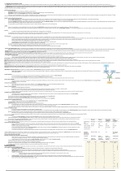
The Four Main Market Structures: TABLA
Disruptive Innovations and the Evolution of Market Structure
• Market structure is not static and can be affected by technological or organizational innovation. Most innovations are incremental, but some are sufficiently disruptive to dramatically
change the way an industry is structured—or even to create new industries and destroy old ones.
• Joseph Schumpeter (1942) referred to this process as creative destruction, while Christensen (1997) called it disruptive innovation.
A market disruption often arises from using “off-the-shelf” technologies in new and creative ways.
Small start-up companies often have a stronger incentive to innovate than incumbents.
Disruptions may change the industry from oligopoly to more competitive (Apple initially and before forming a new oligopoly).
Disruptions may also transform competitive industries into more concentrated markets (Uber and Amazon).
8.1. PERFECT COMPETITION
Perfect competition is a market structure in which buyers and sellers are price takers. A price-taking firm cannot affect the market price for a product, it faces a horizontal demand and it sells at the market price.
Characteristics of a Perfect Competitive Market
Large Number of Buyers and Sellers: If the sellers in a market are small and numerous, no single firm can raise or lower the market price.
Identical Products: Buyers perceive firms sell identical or homogeneous products. Granny Smith apples are identical, all farmers charge the same price.
Full Information: Buyers know the prices charged by all firms and that products are identical. No single firm can unilaterally raise its price above the market equilibrium price.
Negligible Transaction Costs
o Buyers and sellers do not have to spend much time and money finding each other or hiring lawyers to write contracts to make a trade.
o Perfectly competitive markets have very low transaction costs.
Free Entry and Exit: The ability of firms to enter and exit a market freely in the long run leads to a large number of firms in a market and promotes price taking.
Perfect Competition in the Chicago Mercantile Exchange: It has the five characteristics of perfect competition: many buyers and sellers; they trade identical products; have full price information;
waste no time to make a trade; and anyone can be a buyer or seller.
- The private sector consists of firms that are owned by individuals or other nongovernmental entities and whose owners may earn a profit. Examples are Apple, Heinz, and Toyota. In almost every country, this sector provides most of that country’s gross domestic product (75% of G D P U S A).
- The public sector consists of firms and other organizations that are owned by governments or government agencies, called state-owned enterprises. Examples are the armed forces, the court system, most schools, colleges, universities, and Amtrak. This sector may be small or large (12% of G D P USA.)
- The nonprofit sector consists of organizations that are neither government-owned nor intended to earn a profit, but typically pursue social or public interest objectives (nongovernment, not-for-profit sector). Examples include Greenpeace, Alcoholics Anonymous, the Salvation Army, and other
charitable, educational, health, and religious organizations.
Ownership of For-Profit Firms
• Sole proprietorships are firms owned and controlled by a single individual.
• Partnerships are businesses jointly owned and controlled by two or more people operating under a partnership agreement.
• Corporations are firms owned by shareholders, who own the firm’s shares or stocks.
Each share is a unit of ownership in the firm. Therefore, shareholders own the firm in proportion to the number of shares they hold. Shareholders elect a board of directors to represent them. In turn, the board of directors usually hires managers who manage the firm’s operations. The legal
name of a corporation often includes the term Incorporated (Inc.) or Limited (Ltd) to indicate its corporate status.
Publicly Traded and Closely Held Corporations
• Shares of public corporations can be readily bought and sold by the general public. Shares may be available at the New York Stock Exchange, the N A S D A Q, the Tokyo Stock Exchange, the Toronto Stock Exchange, or the London Stock Exchange.
• Shares of closely held corporations are not available for purchase or sale on an organized exchange. Typically, its stock is owned by a small group of individuals (private equity).
To make the transition from privately held to publicly traded status, the closely held firm makes an initial public offering (I P O) of its shares on an organized stock exchange. One major advantage of going public is to raise money. However, a major disadvantage is that ownership of the firm
becomes broadly distributed, possibly causing the original owners to lose control of the firm.
• It is also possible for a publicly traded firm to go private and convert to closely held status. Examples are Toys-R-Us and Burger King.
Liability
• Owners of a corporation are not personally liable for the firm’s debts. They have limited liability: personal assets cannot be taken to pay a corporation’s debts even if it goes into bankruptcy.
• Owners of sole proprietorships and partnerships were fully liable, individually and collectively, for any debts of the firm. Now they can be a limited liability company (L L C). The precise regulations for L L Cs vary from country to country and from state to state within the United States.
Firm Size
• According to the 2015 ProQuest Statistical Abstract of the United States, most large firms are corporations.
U.S. corporations are only 18% of all nonfarm firms but make 81% of sales revenue and 58% of net income. Nonfarm sole proprietorships are 72% of firms but make only 4% of the sales revenue and earn 15% of net income.
Corporations that earn over $50 million are less than 1% of all corporations, but they make 77% of revenue.
Firm Governance
• In a small private sector firm with a single owner-manager, the governance of the firm is straightforward. The owner-manager makes the important decisions for the firm.
• In publicly traded corporations, the shareholders own the corporation. However, most of them play no meaningful role in day-to-day decision making or even in long-range planning. Shareholders elect a board of directors and delegate many of their ownership rights to them. The
board of a large publicly traded corporation normally includes outside directors and inside directors, such as the chief executive officer (C E O) of the corporation and other senior executives.
• Economic profit = Revenue minus Opportunity Cost (Opportunity Cost = Explicit Costs + Implicit Costs)
• Accounting Profit = Revenue minus Explicit Costs (If implicit costs are left out, then accounting profit > economic profit)
• Common Confusion: You should operate your firm if you are making an accounting profit.
For small firms owned and managed by one person, the main difference between explicit and implicit costs is the opportunity cost of the owner-manager’s time.
If the owner-manager invests other resources, the opportunity cost of these other resources is also implicit costs.
• Normal profit is the amount needed to cover all implicit costs of the owners. Economic profit is the amount above the normal profit.
- Corporate Social Responsibility (C S R): C S R is the pursuit of social objectives rather than profit maximization. It could be also E S G (environmental, social, and governance objective).
While Milton Friedman argued the social responsibility of businesses is to increase its profits (sole responsibility with the owners of the firm), Edward Freeman argued managers have obligations with shareholders, workers, customers, and the communities where firms reside and operate.
- Charitable Activities: C S R or E S G contributions may reduce returns to shareholders and generate court litigations. Courts have increasingly decided that businesses have implicit obligations to various stakeholders that often go beyond what is explicitly covered in formal contracts.
- Strategic E S G: C S R activities intended to increase profits are called strategic C S R, “doing well by doing good.”
- Forcing Firms to Maximize Profit: The Survivor Principle and Competition for Corporate Control: Not all private-sector managers try to maximize profits. Why, then, do economists assume that most private-sector firms maximize profit?
- Survivor Principle: In perfectly competitive markets, the only firms that survive are those that maximize profit. Firms that fail to maximize profit lose money and are driven out of business.
- The Struggle for Corporate Control
• Outside investors could buy enough shares to take over control of an underperforming publicly traded firm (market for corporate control).
• Firms can defend with a shareholder rights plan (poison pill defense) in the United States. Poison pills may not prevent a takeover, but usually benefits the original managers or board of directors. See Table 7.1 for a list of takeover defense terminology.
back-end plan: Provision that gives shareholders the right to cash or debt securities at an above-market price previously defined by the company’s board in the event of a hostile takeover.
dead-hand: Provision that allows only the directors who introduce the poison pill to remove it for a fixed period after they have been replaced, thereby delaying a new board’s ability to sell the firm.
flip-in: Provision that gives current shareholders of the firm other than the hostile acquirer the right to purchase additional shares of stocks at a discount price after the acquirer obtains a certain percentage of the firm’s shares (usually between 20% and 50%).
flip-over: Provision that allows shareholders to buy the acquiring firm’s shares at a discount price after a merger or takeover.
golden handcuffs: Employment clauses that require top employees to give back lucrative bonuses or incentives if they leave the firm within a specified period. As a poison pill, these clauses cease to hold after a hostile takeover so that the employees may quit immediately after cashing their stock
options.
macaroni defense (similar to a flip-over): The issuance of many bonds with the condition they must be redeemed at an above-market price if the company is taken over.
poison pill, porcupine provision, shareholder rights plan, or shark repellent: Defensive provisions that corporate boards include in the firm’s corporate charter or bylaws that make a takeover less profitable.
poison puts: The issuance of bonds that investors may cash before they mature in the event of a hostile takeover attempt.
2 DECISIONS: Horizontal dimension: Size of the firm in its primary market // Vertical dimension: Stages of the production process in which the firm participates
• Supply chain management: To produce and sell a good involves many sequential stages of production, marketing, and distribution activities. A manager decides how many stages the firm will undertake itself. Otherwise, the firm will pay for
it to be done by others.
Vertical Integration
• A firm that participates in more than one successive stage of the production or distribution of goods or services is vertically integrated.
• A firm may vertically integrate backward and produce its own inputs, or forward and buy its former customer.
• A firm can be partially vertically integrated. It may produce a good but rely on others to market it. Or it may produce some inputs itself and buy others from the market.
Quasi-Vertical Integration
• Some firms buy from a small number of suppliers or sell through a small number of distributors. These firms often control the actions of the firms with whom they deal with by writing contractual vertical restraints that create quasi-vertical
integration (franchisor and franchisee).
Contracts Versus Spot Markets
• Firms, instead of using contracts for quasi-vertical integration, can sign long-term contracts to secure inputs at specified quantities and prices.
• Finally, firms willing to avoid any contract at all, can just buy inputs at spot markets or cash markets.
Degrees of Vertical Integration
• All firms are vertically integrated to some degree.
• At one extreme, we have firms that perform only one major task and rely on markets and outsourcing for all others. For example, a computer retailer.
• At the other extreme, we have firms that perform most stages of the production process. For instance, Foster Farms.
• However, no firm is completely integrated: It would have to run the entire economy. As Carl Sagan observed, “If you want to make an apple pie from scratch, you must first create the universe.”
Profitability and the Supply Chain Decision
• Firms decide whether to vertically integrate, quasi-vertically integrate, or buy goods and services from markets or other firms depending on which approach is the most profitable.
• Key considerations for profitable vertical integration:
First, the firm has to take into account all relevant costs including some that are not easy to quantify such as transaction costs.
Second, the firm must ensure a secure and flexible supply of needed inputs to its production process.
Third, the firm may vertically integrate even if doing so raises its cost of doing business so as to avoid government regulations.
Transaction Costs and Opportunistic Behavior
• Important reasons to integrate are to reduce transaction costs and avoid opportunistic behavior.
Transaction costs are especially the costs of writing and enforcing contracts.
Opportunistic behavior refers to others take advantage of the firm when circumstances permit.
• A manufacturing firm may decide to vertically integrate forward (downstream) into distribution if the expense from trying to prevent opportunistic behavior by these firms is high.
• Opportunistic behavior is particularly likely when a firm deals with only one other firm: a classic principal-agent problem.
If an electronic game manufacturer can buy computer chips from only one firm, it is at the mercy of that chip supplier. To prevent the supplier taking advantage of it, the game manufacturer may vertically integrate.
Security and Flexibility of Supply
• A common reason for vertical integration is to ensure supply of important inputs.
• Having inputs available on a timely basis is very important. Costs would skyrocket if a car manufacturer had to stop assembling cars while waiting for a part. Backward integration (upstream integration) to produce the part itself may help to ensure timely arrival of parts.
Backward vertical integration is common in the aluminum industry. Each firm’s production process includes four stages: mining, refining, smelting, and fabricating.
• Alternatively, this problem may be eliminated through quasi-vertical integration contracts (reward prompt delivery and penalize delays), or just-in-time systems.
• It is also important to be able to vary production quickly. A firm may want to cut output during a recession and reduce its use of essential inputs. By vertically integrating, firms may gain greater flexibility.
Government Regulations
• Firms may also vertically integrate to avoid government price controls, lower their taxes, and avoid regulations that limit profits.
A vertically integrated firm avoids price controls by selling to itself. For example, steel buyers bought steel producers that didn’t want to sell as much as before the U.S. government price controls.
More commonly, firms integrate to lower their taxes. Tax rates vary by country, state, and type of product. A vertically integrated firm can shift profit from a high-tax country/state to a low-tax
country/state by changing its transfer price between the firm’s divisions.
When one type of business is regulated but not others, firms may also want to vertically integrate their businesses to shift profits from the regulated division to the unregulated division.
Market Size and the Life Cycle of a Firm
• If there is relatively little demand for a product at current prices, the entire industry is small, each firm produces all successive steps of the production process. All firms are vertically
integrated. Vertically integrated firms can take advantage of specialization and division of labor internally. Adam Smith saw it in the production of pins in the 1700s and Henry Ford applied
it to the car mass production in the early 1900s.
• As the market and the industry grows, firms vertically disintegrate. Each firm buys services or products from specialized firms. When the market for cars is big, a separate tire, or parts
manufacturers develop and there is further specialization.
• As an industry matures further, new products often develop and reduce much of the demand for the original product. The industry shrinks in size. Firms vertically integrate again.
When making horizontal and vertical decisions, managers need to consider the behavior of actual and potential rival firms. The behavior of firms depends on market structure: The number of firms in the
market, the ease with which firms can enter and leave the market, and the ability of firms to differentiate their products from those of their rivals.
The Four Main Market Structures: TABLA
Disruptive Innovations and the Evolution of Market Structure
• Market structure is not static and can be affected by technological or organizational innovation. Most innovations are incremental, but some are sufficiently disruptive to dramatically
change the way an industry is structured—or even to create new industries and destroy old ones.
• Joseph Schumpeter (1942) referred to this process as creative destruction, while Christensen (1997) called it disruptive innovation.
A market disruption often arises from using “off-the-shelf” technologies in new and creative ways.
Small start-up companies often have a stronger incentive to innovate than incumbents.
Disruptions may change the industry from oligopoly to more competitive (Apple initially and before forming a new oligopoly).
Disruptions may also transform competitive industries into more concentrated markets (Uber and Amazon).
8.1. PERFECT COMPETITION
Perfect competition is a market structure in which buyers and sellers are price takers. A price-taking firm cannot affect the market price for a product, it faces a horizontal demand and it sells at the market price.
Characteristics of a Perfect Competitive Market
Large Number of Buyers and Sellers: If the sellers in a market are small and numerous, no single firm can raise or lower the market price.
Identical Products: Buyers perceive firms sell identical or homogeneous products. Granny Smith apples are identical, all farmers charge the same price.
Full Information: Buyers know the prices charged by all firms and that products are identical. No single firm can unilaterally raise its price above the market equilibrium price.
Negligible Transaction Costs
o Buyers and sellers do not have to spend much time and money finding each other or hiring lawyers to write contracts to make a trade.
o Perfectly competitive markets have very low transaction costs.
Free Entry and Exit: The ability of firms to enter and exit a market freely in the long run leads to a large number of firms in a market and promotes price taking.
Perfect Competition in the Chicago Mercantile Exchange: It has the five characteristics of perfect competition: many buyers and sellers; they trade identical products; have full price information;
waste no time to make a trade; and anyone can be a buyer or seller.