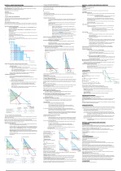
CHAPTER 10 – MARKET POWER AND PRICING ▪ 3rd Degree: GROUP PRICE DISCRIMINATION CHAPTER 11 – OLIGOPOLY AND MONIPOLISTIC COMPETITION
- Monopoly with one price → sells only to customers who see value on that price (CS). ◦ Different price to different consumer groups (differing in age, location…). ▪ CARTELS:
- Earn higher profit using non-uniform pricing: P > MC ◦ A firm must have market power and prevent resale. Resale not possible (warranty only in the ◦ Raise profits by coordinating actions.
→ Price discrimination: a firm charges different prices for a good. Assumes same cost. However, country the product was sold). ◦ Fail: incentives to cheat.
many (but not all) firms can profit by price discriminating. ◦ Different elasticity of demand. ◦ To maintain:
◦ Individual characteristics: students/senior → - “Most-favored-customer clause”: same price to all buyers (current and future)
→
◦ Membership - Sales regions
◦ Groups formed on:
◦ Quantity purchased - Why Cartels Succeed or Fail
- Observable characteristics (age)
◦ Two-part pricing: fee to buy • Oligopolistic firms have an incentive to form cartels in which they collude in setting
- Actions (depending on their opportunity cost of time, consumers self-select their group).
◦ Bundling prices or quantities so as to increase their profits.
◦ Deadweight turned into profit.
– The Organization of Petroleum Exporting Countries (O P E C) is
▪ 1st Degree: PERFECT PRICE DISCRIMINATION a well-known example of an international cartel.
◦ The firm sells each unit at the maximum amount any customer is willing to pay. - Managerial Implication: Discounts • Typically, each member of a cartel agrees to reduce its output from the level it
◦ Price differs across consumers and may differ too for a given consumer. • To make sure that price discrimination pays, managers should only give discounts to would produce if it acted independently. As a result, the market price rises and the
◦ Last price = MC those consumers who are willing to incur a cost, such as their time, to obtain the firms earn higher profits.
◦ Rarely achieved discount. • If the firms reduce market output to the monopoly level, they achieve the highest
◦ All the surplus goes to the firm. CS is zero. • Consumers willing to spend extra time to obtain a discount are typically more price possible collective profit.
→ Individual price discrimination: used by hotels, car and truck rental companies, cruise lines and sensitive than others. • However, each member has an incentive to cheat.
airlines. Transaction costs: costs of gathering information about each customer’s reservation price. • Skilled managers use a variety of methods to induce customers to self-identify as - Why Cartels Form
being price sensitive by incurring a cost. • A cartel forms if members of the cartel believe that they can raise their profits by
- How a Firm Perfectly Price Discriminates o Coupons—firms divide customers into two groups, charging coupon coordinating their actions.
• A firm with market power that can prevent resale and has full information about its clippers less than nonclippers. – A cartel takes into account how changes in any one firm’s output
customers’ willingness to o Airline Tickets—airline customers indicate whether they are likely to be affect the profits of all members of the cartel.
pay price discriminates by selling each unit at its reservation price—the maximum business travelers or vacationers. Airlines offer high-price tickets with no – Therefore, the aggregate profit of a cartel can exceed the combined
amount any consumer strings attached and low-price fares with restrictions. profits of the same firms acting independently.
would pay for it. o Reverse Auctions—Priceline.com and others use a name-your-own-price - Why Cartels Fail
• The maximum price for any unit of output is given by the height of the demand curve or “reverse” auction to identify price-sensitive customers. • External reasons:
at that output level.
o Rebates—Why do many firms offer a rebate of, say, $5 instead of – Cartels are generally illegal in developed countries. High fines and jail terms
• Perfectly Price Discrimination: Price = M R
reducing the price on their product by $5? The reason is that a consumer may prevent collusion.
– A perfectly price-discriminating firm’s marginal revenue is the same as its price. So, the
must incur an extra, time-consuming step to receive the rebate. – Some cartels fail because they do not control enough of the market to
firm’s marginal
revenue curve is the same as its demand curve. Effects of Group Price Discrimination on Total Surplus significantly raise the price.
– In Figure 10.1, the monopoly sells 4 units at prices equal to M R1, M R2, M R 3, and M R4 • Group price discrimination results in inefficient production and consumption. • Internal reasons:
($6, $5, $4, and $3). However, how T S compares to other results? – Cartel members have incentives to cheat if a member thinks its firm is just one
Group Price Discrimination Versus Competition of many firms so its extra output hardly affects the market price and the other
• C S is greater and more output is produced with perfect competition than with firms in the cartel can’t tell who is producing more.
group price discrimination. – In panel a of Figure 11.1, each firm agreed to q m. However, a price taker firm
• Group price discrimination transfers some of the competitive C S to the firm as maximizes profit selling q*, where p m= M C. It makes extra money by
additional profit and causes deadweight loss due to reduced output. producing more than q m, as long as M R > M C.
Group Price Discrimination Versus Single-Price Monopoly – As more and more firms cheat, p m falls. Eventually, the cartel collapses.
• From theory alone, we cannot tell whether T S is higher if the monopoly uses group price - Maintaining Cartels: To keep firms from violating a cartel agreement, the cartel must detect
discrimination or if it sets a single price. cheating and punish violators.
• The closer the firm comes to perfect price discrimination using group price discrimination - Detection and Enforcement
(many groups rather than just two), the more output it produces, and the less production • Cartels use different techniques to detect cheating.
inefficiency—the greater the T S. – Some cartels may give members the right to inspect each other’s accounts or
divide the market by region or by customers.
– Cartels may turn to industry organizations to collect data on a firm’s market
share.
• Cartels use various methods to enforce their agreements.
– Most-favored-customer clause: The seller would not offer a lower price to any
other current or future buyer without offering the same price decrease to the
firms that signed these contracts.
→ Common Confusion: Requiring government agencies to report which company had the lowest
bid for a government contract and the level of the bid is good for the public.
Although society benefits in many ways from government transparency, disclosing this type of
information can help a cartel enforce its agreement.
- Perfect Price Discrimination is Efficient But Harms Some Consumers - Government Support and Barriers to Entry
• Perfect price discrimination is efficient: It maximizes the sum of consumer surplus • Sometimes governments help create and enforce cartels, exempting them from
and producer surplus. antitrust and competition laws.
• But, all the surplus goes to the firm, consumer surplus is zero. • With high barriers to entry, cartel members are few. The fewer the firms in a
– In Figure 10.2, at the competitive market equilibrium, e c, consumer surplus is market, the easier to find cheaters and to impose penalties.
A + B + C and producer surplus is D + E.
– At the perfect price discrimination equilibrium, Q d=Q c, no deadweight loss ▪ COURNOT OLIGOPOLY:
occurs, all surplus goes to the monopoly. ◦ Small # of firms.
• Consumer surplus is the greatest with competition, lower with single-price ◦ Set quantity independently and at the same time (simultaneously).
monopoly, and eliminated by perfect price discrimination. ◦ Identical costs.
- Why Price Discrimination Pays: For almost any good or service, some consumers are willing to pay
- Individual Price Discrimination ◦ Identical products.
more than others.
• Perfect price discrimination is rarely fully achieved in practice. - Ex: Total market demand: Q = 339 – P // MC =147
- Conditions for Price Discrimination:
• Firms can still increase profits significantly with imperfect individual price Q = qA + qB
Price discrimination increases profit above the uniform pricing level through two channels:
discrimination:
→ Channel 1: Higher Prices for Some qA = 339 – P - qB → Inverse: P = 339 - qA - qB
– Charge individual-specific prices to different consumers, which may or may not
◦Price discrimination can extract additional C S from consumers who place a high value on the good. MR slope: 2 times as steep
be the consumers’ reservation prices.
◦In panel a of Table 10.1, the theater sells the same number of seats but makes more money from MR = 339 - 2qA - qB
• Transaction Costs and Price Discrimination
the college students. Students pay $20, seniors pay $10, and the theater captures all C S from both
– It is often too difficult or costly to gather information about each customer’s MR = MC → 339 - 2qA - qB = 147 → qA = 96 – ½ qB
groups.
reservation price for each unit of the product (high transaction costs). ◦ Best response function: graphs intersect at equilibrium.
→ Channel 2: Attract New Customers
– However, recent advances in computer technologies have lowered these qA = 96 – ½ qB // qB = 96 – ½ qA
◦Price discrimination can simultaneously sell to new customers who would not be willing to pay the
transaction costs. ◦ Number of firms: increases → price approaches competitive price.
profit-maximizing uniform price.
– Hotels, car and truck rental companies, cruise lines, airlines, and other firms ◦ Unequal costs: firms with lower costs → produce more (taking market share)
◦In panel b of Table 10.1, the theater increases profit by selling five more tickets to seniors.
are increasingly using individual price discrimination. ◦ Product differentiation: allow to create a monopoly by product. Market power.
Students pay $20 as before, seniors pay $10, and neither group enjoys any C S.
- Merger: two or more firms combine their assets and operations into one firm with the
- Which Firms Can Price Discriminate
objective to increase profits.
→ First Condition, A Firm Must Have Market Power
→ A vertical merge between a firm and a supplier may lower cost by allowing for a more
◦A monopoly, oligopoly, or monopolistically competitive firm might be able to price
efficient supply chain.
discriminate. A perfectly competitive firm cannot.
→ Horizontal mergers may increase market power and reduce competition.
→ Second Condition, A Firm Must Identify Groups with Different Price Sensitivity
◦A firm must identify how consumers have different demands.
▪ BERTRAND OLIGOPOLY (setting price):
◦Disneyland knows tourists and local residents differ in their willingness to pay and use driver
- Identical products: price goes down to competitive price. P = MC.
licenses to identify them.
- Differentiated products: positive profits at equilibrium.
→ Third Condition, A Firm Must Prevent Resale
- Nash-Bertrand equilibrium: The Nash-Bertrand equilibrium is a set of prices such that no firm can
◦If resale is easy, price discrimination doesn’t work because of only low-price sales.
obtain a higher profit by choosing a different price if the other firms continue to charge these
◦The biggest obstacle to price discrimination is a firm’s inability to prevent resale.
prices.
- Preventing Resale →The Nash-Bertrand equilibrium differs from the Nash-Cournot equilibrium; it depends on whether
→Preventing resale is easier in certain industries than in others. firms produce identical or differentiated products.
– Resale is difficult or impossible for most services.
– Even for physical goods, resale is difficult when transaction costs are high. ▪ MONOPOLISTIC COMPETITION:
– The more valuable and widely consumed a product is, the more likely it is that ◦ At equilibrium: MR = MC → P = AC
transaction costs are low enough to allow resale. - The monopolistic competition market structure has the price-setting characteristics of monopoly
→In industries where resale is initially easy, managers can act to make resale more costly. or oligopoly and the free entry of perfect competition. At equilibrium, zero profit (due to free entry)
– Some firms act to raise transaction costs or otherwise make resale difficult. Firms ◦ These firms face downward sloping demand curves and have oligopoly market power.
require I D cards or issue country-specific warranties. ◦ But, they earn zero profit due to free entry.
– Governments frequently aid price discrimination by preventing resale. Government → First Reason for Downward-Sloping Demand: Market demand may be limited so there is
tariffs (taxes on imports) limit resale by making it expensive to buy a branded good room for only few firms. The residual demand curve facing a single firm is downward sloping.
in a low-price country and resell it in a high-price country. – For example in a small town, the market may be large enough to support only a few
plumbing firms, each provides a similar service.
▪ 2nd Degree: NONLINEAR PRICE DISCRIMINATION - Not All Price Differences are Price Discrimination
→ Second Reason for Downward-Sloping Demand: Firms differentiate their products. So each
◦ Price varies according to quantity purchased (different price for larger purchases than for small). →Different Prices and Different Costs
firm can retain those customers who particularly like that firm’s product even if its price is
◦ Block pricing (water utility) – e-book and hardcopy versions of the same book sell for different prices in large part
higher than those of rivals.
→ Many firms, with market power and no resale, are unable to determine high reservation prices. because these different versions have different costs. This price difference reflects
– For example, gourmet food trucks serve differentiated food in monopolistically
However, such firms know a typical customer’s demand curve is downward sloping. the lower marginal cost of selling an e-book. Therefore, it is not price discrimination.
competitive markets.
→Such a firm can price discriminate by letting the price each customer pays vary with the number →Price Discrimination and Equal Costs
of units the customer buys (nonlinear price discrimination). – Price discrimination is based on charging different prices even for units of a good
that cost the same to produce.
CHAPTER 14 – DECISION MAKING UNDER UNCERTAINTY
- Block Pricing Versus Single Price:
– If a magazine standard subscription rate is higher than a college student ▪ 14.1. ASSESING RISK
• A firm charges one price per unit for the first block purchased and a different price
subscription rate, it is price discrimination because the two subscriptions are An event has possible outcomes.
per unit for subsequent blocks. Used by utility firms.
identical in every respect except the price. - Probability: indicates the likelihood that a particular outcome will occur. Number between 0 and 1.
• In panel a of Figure 10.4, the firm charges a price of $70 on any quantity between 1
– Each consumer pays its reservation price, the demand curve is the M R curve. The Weather outcomes are mutually exclusive (either rains or it doesn’t) and exhaustive (no other
and 20—first block—and $50 for the second block. In panel b, the firm can set only a
firm’s revenue is $18 outcome is possible) so probabilities must add up to 100%.
single price of $30. When block pricing, C S is lower, T S is higher and deadweight
and if fixed cost is zero, its profit equals $6 ($18 − $12). - Frequency: 0 = n/N (n: number of years it rained // N: total number of years)
loss is lower. The firm and society are better off but consumers lose.
- Subjective probability: best estimate of the likelihood that the outcome will occur – that is, our
• Common Confusion: Quantity discounts help consumers. However, Changing from
best, informed guess.
uniform monopoly pricing to nonlinear price discrimination often reduces consumer ▪ TWO-PART PRICING: charge each
- Probability distributions: probability of occurrence of each possible outcome.
surplus, as in Figure 10.4. consumer an access fee.
◦ Expected value:
• The more block prices that a firm can set, the closer the firm gets to perfect price Consumer expenditure is: E = Access
◦ Variance:
discrimination. fee + price per unit*quantity
◦ Standard deviation:
- Same consumers:
▪ 14.2. ATTITUDES TOWARD RISK
◦ Access fee = profit = CS
◦ Expected utility (tradeoff between risk and value):
◦ Per unit price = MC
- Fair bet: a bet with an expected value of zero.
- Different consumers:
- Risk attitudes:
◦ Different demand curves (different
1.Risk averse: unwilling to make a fair bet.
CS).
- Concave utility function. Shows diminishing marginal utility of wealth.
◦ Set: P > MC
A risk averse person picks the less risky choice if both choices have equal EV (not always chooses
◦ Set access fee based on lowest
the least risky option!).
demand.
→ Risk premium: maximum amount that a decision maker would pay to avoid taking a risk.
◦ Higher demand customer obtains CS.
Minimum extra compensation (premium) that a decision maker would require to willingly incur a
▪ BUNDLING: selling multiple goods or risk. In calculus: difference between the EV of the uncertain prospect and the certainty equivalent
services for a single price. (if held with certainty, it would yield the same utility as the ucertain prospect).
- Pure: can only buy as a bundle 2.Risk neutral: indifferent about making a fair bet.
(together). Bundles of internet, phone Constant marginal utility of wealth. Utility function: straight line.
and television, no service separately. A risk-neutral person chooses the option with the highest EV because maximizing EV maximizes
MS office. Profitable pure bundling: reservation prices negatively correlated. // Non profitable pure utility. The risk premium is zero.
bundling: reservation prices positively correlated. 3. Risk preferring: person who will make a fair bet.
- Mixed: buy together or individually. Utility function is convex (shows increasing marginal utility of wealth).
- Tie-in sales: requires customers who buy one product from a firm to make all concurrent and A risk-preferring person is willing to pay for the right to make a fair bet (a negative risk premium).
subsequent purchases of a related product from that firm. Printer sellers: only their cartridges. - Risk attitudes of managers: some shareholders want managers to be risk neutral and to maximize
▪ PEAK-LOAD PRICING: higher prices during periods of peak demand than in other periods. expected profit. However, managers may act in their own interests: prefer risk (if there is
◦ Production capacity constraints (rates for electricity: day/night). compensation and no penalty or risk-averse (made a risk premium to avoid and extreme risk of
◦ Dynamic pricing/surge pricing: sellers change prices based on current market conditions(uber,tolls) losing money). Managers may want managers to be risk averse (to try to avoid bankruptcy).
→ If there are more switchers (price sensitive customers) than loyal customers, having sales is more ▪ 14.3. REDUCING RISK
profitable than selling at a uniform price to only loyal customers. All individuals and firms want to reduce risk
- Monopoly with one price → sells only to customers who see value on that price (CS). ◦ Different price to different consumer groups (differing in age, location…). ▪ CARTELS:
- Earn higher profit using non-uniform pricing: P > MC ◦ A firm must have market power and prevent resale. Resale not possible (warranty only in the ◦ Raise profits by coordinating actions.
→ Price discrimination: a firm charges different prices for a good. Assumes same cost. However, country the product was sold). ◦ Fail: incentives to cheat.
many (but not all) firms can profit by price discriminating. ◦ Different elasticity of demand. ◦ To maintain:
◦ Individual characteristics: students/senior → - “Most-favored-customer clause”: same price to all buyers (current and future)
→
◦ Membership - Sales regions
◦ Groups formed on:
◦ Quantity purchased - Why Cartels Succeed or Fail
- Observable characteristics (age)
◦ Two-part pricing: fee to buy • Oligopolistic firms have an incentive to form cartels in which they collude in setting
- Actions (depending on their opportunity cost of time, consumers self-select their group).
◦ Bundling prices or quantities so as to increase their profits.
◦ Deadweight turned into profit.
– The Organization of Petroleum Exporting Countries (O P E C) is
▪ 1st Degree: PERFECT PRICE DISCRIMINATION a well-known example of an international cartel.
◦ The firm sells each unit at the maximum amount any customer is willing to pay. - Managerial Implication: Discounts • Typically, each member of a cartel agrees to reduce its output from the level it
◦ Price differs across consumers and may differ too for a given consumer. • To make sure that price discrimination pays, managers should only give discounts to would produce if it acted independently. As a result, the market price rises and the
◦ Last price = MC those consumers who are willing to incur a cost, such as their time, to obtain the firms earn higher profits.
◦ Rarely achieved discount. • If the firms reduce market output to the monopoly level, they achieve the highest
◦ All the surplus goes to the firm. CS is zero. • Consumers willing to spend extra time to obtain a discount are typically more price possible collective profit.
→ Individual price discrimination: used by hotels, car and truck rental companies, cruise lines and sensitive than others. • However, each member has an incentive to cheat.
airlines. Transaction costs: costs of gathering information about each customer’s reservation price. • Skilled managers use a variety of methods to induce customers to self-identify as - Why Cartels Form
being price sensitive by incurring a cost. • A cartel forms if members of the cartel believe that they can raise their profits by
- How a Firm Perfectly Price Discriminates o Coupons—firms divide customers into two groups, charging coupon coordinating their actions.
• A firm with market power that can prevent resale and has full information about its clippers less than nonclippers. – A cartel takes into account how changes in any one firm’s output
customers’ willingness to o Airline Tickets—airline customers indicate whether they are likely to be affect the profits of all members of the cartel.
pay price discriminates by selling each unit at its reservation price—the maximum business travelers or vacationers. Airlines offer high-price tickets with no – Therefore, the aggregate profit of a cartel can exceed the combined
amount any consumer strings attached and low-price fares with restrictions. profits of the same firms acting independently.
would pay for it. o Reverse Auctions—Priceline.com and others use a name-your-own-price - Why Cartels Fail
• The maximum price for any unit of output is given by the height of the demand curve or “reverse” auction to identify price-sensitive customers. • External reasons:
at that output level.
o Rebates—Why do many firms offer a rebate of, say, $5 instead of – Cartels are generally illegal in developed countries. High fines and jail terms
• Perfectly Price Discrimination: Price = M R
reducing the price on their product by $5? The reason is that a consumer may prevent collusion.
– A perfectly price-discriminating firm’s marginal revenue is the same as its price. So, the
must incur an extra, time-consuming step to receive the rebate. – Some cartels fail because they do not control enough of the market to
firm’s marginal
revenue curve is the same as its demand curve. Effects of Group Price Discrimination on Total Surplus significantly raise the price.
– In Figure 10.1, the monopoly sells 4 units at prices equal to M R1, M R2, M R 3, and M R4 • Group price discrimination results in inefficient production and consumption. • Internal reasons:
($6, $5, $4, and $3). However, how T S compares to other results? – Cartel members have incentives to cheat if a member thinks its firm is just one
Group Price Discrimination Versus Competition of many firms so its extra output hardly affects the market price and the other
• C S is greater and more output is produced with perfect competition than with firms in the cartel can’t tell who is producing more.
group price discrimination. – In panel a of Figure 11.1, each firm agreed to q m. However, a price taker firm
• Group price discrimination transfers some of the competitive C S to the firm as maximizes profit selling q*, where p m= M C. It makes extra money by
additional profit and causes deadweight loss due to reduced output. producing more than q m, as long as M R > M C.
Group Price Discrimination Versus Single-Price Monopoly – As more and more firms cheat, p m falls. Eventually, the cartel collapses.
• From theory alone, we cannot tell whether T S is higher if the monopoly uses group price - Maintaining Cartels: To keep firms from violating a cartel agreement, the cartel must detect
discrimination or if it sets a single price. cheating and punish violators.
• The closer the firm comes to perfect price discrimination using group price discrimination - Detection and Enforcement
(many groups rather than just two), the more output it produces, and the less production • Cartels use different techniques to detect cheating.
inefficiency—the greater the T S. – Some cartels may give members the right to inspect each other’s accounts or
divide the market by region or by customers.
– Cartels may turn to industry organizations to collect data on a firm’s market
share.
• Cartels use various methods to enforce their agreements.
– Most-favored-customer clause: The seller would not offer a lower price to any
other current or future buyer without offering the same price decrease to the
firms that signed these contracts.
→ Common Confusion: Requiring government agencies to report which company had the lowest
bid for a government contract and the level of the bid is good for the public.
Although society benefits in many ways from government transparency, disclosing this type of
information can help a cartel enforce its agreement.
- Perfect Price Discrimination is Efficient But Harms Some Consumers - Government Support and Barriers to Entry
• Perfect price discrimination is efficient: It maximizes the sum of consumer surplus • Sometimes governments help create and enforce cartels, exempting them from
and producer surplus. antitrust and competition laws.
• But, all the surplus goes to the firm, consumer surplus is zero. • With high barriers to entry, cartel members are few. The fewer the firms in a
– In Figure 10.2, at the competitive market equilibrium, e c, consumer surplus is market, the easier to find cheaters and to impose penalties.
A + B + C and producer surplus is D + E.
– At the perfect price discrimination equilibrium, Q d=Q c, no deadweight loss ▪ COURNOT OLIGOPOLY:
occurs, all surplus goes to the monopoly. ◦ Small # of firms.
• Consumer surplus is the greatest with competition, lower with single-price ◦ Set quantity independently and at the same time (simultaneously).
monopoly, and eliminated by perfect price discrimination. ◦ Identical costs.
- Why Price Discrimination Pays: For almost any good or service, some consumers are willing to pay
- Individual Price Discrimination ◦ Identical products.
more than others.
• Perfect price discrimination is rarely fully achieved in practice. - Ex: Total market demand: Q = 339 – P // MC =147
- Conditions for Price Discrimination:
• Firms can still increase profits significantly with imperfect individual price Q = qA + qB
Price discrimination increases profit above the uniform pricing level through two channels:
discrimination:
→ Channel 1: Higher Prices for Some qA = 339 – P - qB → Inverse: P = 339 - qA - qB
– Charge individual-specific prices to different consumers, which may or may not
◦Price discrimination can extract additional C S from consumers who place a high value on the good. MR slope: 2 times as steep
be the consumers’ reservation prices.
◦In panel a of Table 10.1, the theater sells the same number of seats but makes more money from MR = 339 - 2qA - qB
• Transaction Costs and Price Discrimination
the college students. Students pay $20, seniors pay $10, and the theater captures all C S from both
– It is often too difficult or costly to gather information about each customer’s MR = MC → 339 - 2qA - qB = 147 → qA = 96 – ½ qB
groups.
reservation price for each unit of the product (high transaction costs). ◦ Best response function: graphs intersect at equilibrium.
→ Channel 2: Attract New Customers
– However, recent advances in computer technologies have lowered these qA = 96 – ½ qB // qB = 96 – ½ qA
◦Price discrimination can simultaneously sell to new customers who would not be willing to pay the
transaction costs. ◦ Number of firms: increases → price approaches competitive price.
profit-maximizing uniform price.
– Hotels, car and truck rental companies, cruise lines, airlines, and other firms ◦ Unequal costs: firms with lower costs → produce more (taking market share)
◦In panel b of Table 10.1, the theater increases profit by selling five more tickets to seniors.
are increasingly using individual price discrimination. ◦ Product differentiation: allow to create a monopoly by product. Market power.
Students pay $20 as before, seniors pay $10, and neither group enjoys any C S.
- Merger: two or more firms combine their assets and operations into one firm with the
- Which Firms Can Price Discriminate
objective to increase profits.
→ First Condition, A Firm Must Have Market Power
→ A vertical merge between a firm and a supplier may lower cost by allowing for a more
◦A monopoly, oligopoly, or monopolistically competitive firm might be able to price
efficient supply chain.
discriminate. A perfectly competitive firm cannot.
→ Horizontal mergers may increase market power and reduce competition.
→ Second Condition, A Firm Must Identify Groups with Different Price Sensitivity
◦A firm must identify how consumers have different demands.
▪ BERTRAND OLIGOPOLY (setting price):
◦Disneyland knows tourists and local residents differ in their willingness to pay and use driver
- Identical products: price goes down to competitive price. P = MC.
licenses to identify them.
- Differentiated products: positive profits at equilibrium.
→ Third Condition, A Firm Must Prevent Resale
- Nash-Bertrand equilibrium: The Nash-Bertrand equilibrium is a set of prices such that no firm can
◦If resale is easy, price discrimination doesn’t work because of only low-price sales.
obtain a higher profit by choosing a different price if the other firms continue to charge these
◦The biggest obstacle to price discrimination is a firm’s inability to prevent resale.
prices.
- Preventing Resale →The Nash-Bertrand equilibrium differs from the Nash-Cournot equilibrium; it depends on whether
→Preventing resale is easier in certain industries than in others. firms produce identical or differentiated products.
– Resale is difficult or impossible for most services.
– Even for physical goods, resale is difficult when transaction costs are high. ▪ MONOPOLISTIC COMPETITION:
– The more valuable and widely consumed a product is, the more likely it is that ◦ At equilibrium: MR = MC → P = AC
transaction costs are low enough to allow resale. - The monopolistic competition market structure has the price-setting characteristics of monopoly
→In industries where resale is initially easy, managers can act to make resale more costly. or oligopoly and the free entry of perfect competition. At equilibrium, zero profit (due to free entry)
– Some firms act to raise transaction costs or otherwise make resale difficult. Firms ◦ These firms face downward sloping demand curves and have oligopoly market power.
require I D cards or issue country-specific warranties. ◦ But, they earn zero profit due to free entry.
– Governments frequently aid price discrimination by preventing resale. Government → First Reason for Downward-Sloping Demand: Market demand may be limited so there is
tariffs (taxes on imports) limit resale by making it expensive to buy a branded good room for only few firms. The residual demand curve facing a single firm is downward sloping.
in a low-price country and resell it in a high-price country. – For example in a small town, the market may be large enough to support only a few
plumbing firms, each provides a similar service.
▪ 2nd Degree: NONLINEAR PRICE DISCRIMINATION - Not All Price Differences are Price Discrimination
→ Second Reason for Downward-Sloping Demand: Firms differentiate their products. So each
◦ Price varies according to quantity purchased (different price for larger purchases than for small). →Different Prices and Different Costs
firm can retain those customers who particularly like that firm’s product even if its price is
◦ Block pricing (water utility) – e-book and hardcopy versions of the same book sell for different prices in large part
higher than those of rivals.
→ Many firms, with market power and no resale, are unable to determine high reservation prices. because these different versions have different costs. This price difference reflects
– For example, gourmet food trucks serve differentiated food in monopolistically
However, such firms know a typical customer’s demand curve is downward sloping. the lower marginal cost of selling an e-book. Therefore, it is not price discrimination.
competitive markets.
→Such a firm can price discriminate by letting the price each customer pays vary with the number →Price Discrimination and Equal Costs
of units the customer buys (nonlinear price discrimination). – Price discrimination is based on charging different prices even for units of a good
that cost the same to produce.
CHAPTER 14 – DECISION MAKING UNDER UNCERTAINTY
- Block Pricing Versus Single Price:
– If a magazine standard subscription rate is higher than a college student ▪ 14.1. ASSESING RISK
• A firm charges one price per unit for the first block purchased and a different price
subscription rate, it is price discrimination because the two subscriptions are An event has possible outcomes.
per unit for subsequent blocks. Used by utility firms.
identical in every respect except the price. - Probability: indicates the likelihood that a particular outcome will occur. Number between 0 and 1.
• In panel a of Figure 10.4, the firm charges a price of $70 on any quantity between 1
– Each consumer pays its reservation price, the demand curve is the M R curve. The Weather outcomes are mutually exclusive (either rains or it doesn’t) and exhaustive (no other
and 20—first block—and $50 for the second block. In panel b, the firm can set only a
firm’s revenue is $18 outcome is possible) so probabilities must add up to 100%.
single price of $30. When block pricing, C S is lower, T S is higher and deadweight
and if fixed cost is zero, its profit equals $6 ($18 − $12). - Frequency: 0 = n/N (n: number of years it rained // N: total number of years)
loss is lower. The firm and society are better off but consumers lose.
- Subjective probability: best estimate of the likelihood that the outcome will occur – that is, our
• Common Confusion: Quantity discounts help consumers. However, Changing from
best, informed guess.
uniform monopoly pricing to nonlinear price discrimination often reduces consumer ▪ TWO-PART PRICING: charge each
- Probability distributions: probability of occurrence of each possible outcome.
surplus, as in Figure 10.4. consumer an access fee.
◦ Expected value:
• The more block prices that a firm can set, the closer the firm gets to perfect price Consumer expenditure is: E = Access
◦ Variance:
discrimination. fee + price per unit*quantity
◦ Standard deviation:
- Same consumers:
▪ 14.2. ATTITUDES TOWARD RISK
◦ Access fee = profit = CS
◦ Expected utility (tradeoff between risk and value):
◦ Per unit price = MC
- Fair bet: a bet with an expected value of zero.
- Different consumers:
- Risk attitudes:
◦ Different demand curves (different
1.Risk averse: unwilling to make a fair bet.
CS).
- Concave utility function. Shows diminishing marginal utility of wealth.
◦ Set: P > MC
A risk averse person picks the less risky choice if both choices have equal EV (not always chooses
◦ Set access fee based on lowest
the least risky option!).
demand.
→ Risk premium: maximum amount that a decision maker would pay to avoid taking a risk.
◦ Higher demand customer obtains CS.
Minimum extra compensation (premium) that a decision maker would require to willingly incur a
▪ BUNDLING: selling multiple goods or risk. In calculus: difference between the EV of the uncertain prospect and the certainty equivalent
services for a single price. (if held with certainty, it would yield the same utility as the ucertain prospect).
- Pure: can only buy as a bundle 2.Risk neutral: indifferent about making a fair bet.
(together). Bundles of internet, phone Constant marginal utility of wealth. Utility function: straight line.
and television, no service separately. A risk-neutral person chooses the option with the highest EV because maximizing EV maximizes
MS office. Profitable pure bundling: reservation prices negatively correlated. // Non profitable pure utility. The risk premium is zero.
bundling: reservation prices positively correlated. 3. Risk preferring: person who will make a fair bet.
- Mixed: buy together or individually. Utility function is convex (shows increasing marginal utility of wealth).
- Tie-in sales: requires customers who buy one product from a firm to make all concurrent and A risk-preferring person is willing to pay for the right to make a fair bet (a negative risk premium).
subsequent purchases of a related product from that firm. Printer sellers: only their cartridges. - Risk attitudes of managers: some shareholders want managers to be risk neutral and to maximize
▪ PEAK-LOAD PRICING: higher prices during periods of peak demand than in other periods. expected profit. However, managers may act in their own interests: prefer risk (if there is
◦ Production capacity constraints (rates for electricity: day/night). compensation and no penalty or risk-averse (made a risk premium to avoid and extreme risk of
◦ Dynamic pricing/surge pricing: sellers change prices based on current market conditions(uber,tolls) losing money). Managers may want managers to be risk averse (to try to avoid bankruptcy).
→ If there are more switchers (price sensitive customers) than loyal customers, having sales is more ▪ 14.3. REDUCING RISK
profitable than selling at a uniform price to only loyal customers. All individuals and firms want to reduce risk