NCLEX Practice Questions
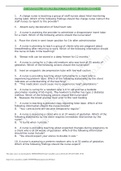
After receiving report at the start of the evening shift, which of the following
clients should the nurse attend to first?
(a) A 34-year-old man undergoing treatment for non-Hodgkin lymphoma with a
potassium level of 7.5 mEq/L.
(b) A 21-year-old woman with sickle cell anemia with pain of 6 on a scale of 1-10.
(c) A 55-year-old woman with ovarian cancer waiting to be discharged.
(d) A 72-year-old man with chronic obstructive pulmonary disease (COPD) and a
pulse oximetry of 96% on room air. - ANSWERS-Correct answer: (a) A 34-year-old
man undergoing treatment for non-Hodgkin lymphoma with a potassium level of
7.5 mEq/L.
Rationale: Hyperkalemia is a potentially serious condition that, in a client
undergoing treatment for non-Hodgkin lymphoma, could indicate tumour lysis
syndrome. Patient (b) should be attended to, but her condition is not as urgent.
Patients (c) and (d) do not require immediate attention.
A 34-year-old woman who developed Stevens-Johnson syndrome while
undergoing treatment with carbamazepine (Tegretol) is being transferred in
stable condition from the intensive care unit to the medical unit. There are 4 beds
available. The nurse knows the best choice of roommates for this client is which
of the following?
(a) A 40-year-old man with methicillin-resistant Staphylococcus aureus (MRSA).
, (b) A 28-year-old woman diagnosed with diarrhea.
(c) A 72-year-old man with fever of unknown origin.
(d) A 68-year-old woman with atrial fibrillation . - ANSWERS-Correct answer: (d) A
68-year-old woman with atrial fibrillation.
Rationale: A client with Stevens-Johnson syndrome is likely to have severe skin
integrity issues, including blistering and skin shedding, which can place the client
at high risk for infection. Atrial fibrillation is not an infectious process. All other
patients may be an infection risk for an individual with altered skin integrity.
A 72-year-old man who had a stroke is being transferred from a medical unit to a
rehabilitation centre. The nurse case manager is assisting in the process. The
nurse knows that the goals of case management include which of the following?
Select all that apply.
(a) Improving the coordination of care
(b) Increasing referrals to local organizations
(c) Reducing the fragmentation of care
(d) Discharging clients quickly - ANSWERS-Correct answer: (a) Improving the
coordination of care; and (c) Reducing the fragmentation of care
Rationale: Some of the primary goals of case management are to improve the
coordination of care and to reduce fragmentation of care. The other options are
not goals of case management.
A pregnant woman at 15 weeks' gestation is scheduled for an amniocentesis. As
the client is being prepped for the procedure, it becomes clear to the nurse that
the client doesn't fully understand the risks and benefits associated with the
pg. 2
After receiving report at the start of the evening shift, which of the following
clients should the nurse attend to first?
(a) A 34-year-old man undergoing treatment for non-Hodgkin lymphoma with a
potassium level of 7.5 mEq/L.
(b) A 21-year-old woman with sickle cell anemia with pain of 6 on a scale of 1-10.
(c) A 55-year-old woman with ovarian cancer waiting to be discharged.
(d) A 72-year-old man with chronic obstructive pulmonary disease (COPD) and a
pulse oximetry of 96% on room air. - ANSWERS-Correct answer: (a) A 34-year-old
man undergoing treatment for non-Hodgkin lymphoma with a potassium level of
7.5 mEq/L.
Rationale: Hyperkalemia is a potentially serious condition that, in a client
undergoing treatment for non-Hodgkin lymphoma, could indicate tumour lysis
syndrome. Patient (b) should be attended to, but her condition is not as urgent.
Patients (c) and (d) do not require immediate attention.
A 34-year-old woman who developed Stevens-Johnson syndrome while
undergoing treatment with carbamazepine (Tegretol) is being transferred in
stable condition from the intensive care unit to the medical unit. There are 4 beds
available. The nurse knows the best choice of roommates for this client is which
of the following?
(a) A 40-year-old man with methicillin-resistant Staphylococcus aureus (MRSA).
, (b) A 28-year-old woman diagnosed with diarrhea.
(c) A 72-year-old man with fever of unknown origin.
(d) A 68-year-old woman with atrial fibrillation . - ANSWERS-Correct answer: (d) A
68-year-old woman with atrial fibrillation.
Rationale: A client with Stevens-Johnson syndrome is likely to have severe skin
integrity issues, including blistering and skin shedding, which can place the client
at high risk for infection. Atrial fibrillation is not an infectious process. All other
patients may be an infection risk for an individual with altered skin integrity.
A 72-year-old man who had a stroke is being transferred from a medical unit to a
rehabilitation centre. The nurse case manager is assisting in the process. The
nurse knows that the goals of case management include which of the following?
Select all that apply.
(a) Improving the coordination of care
(b) Increasing referrals to local organizations
(c) Reducing the fragmentation of care
(d) Discharging clients quickly - ANSWERS-Correct answer: (a) Improving the
coordination of care; and (c) Reducing the fragmentation of care
Rationale: Some of the primary goals of case management are to improve the
coordination of care and to reduce fragmentation of care. The other options are
not goals of case management.
A pregnant woman at 15 weeks' gestation is scheduled for an amniocentesis. As
the client is being prepped for the procedure, it becomes clear to the nurse that
the client doesn't fully understand the risks and benefits associated with the
pg. 2