Exam 1 Material
1. Photosynthesis in green plants captures energy from light and stores it
as chemical energy in organic molecules. What Big Idea is this a great
example of?
a. Evolution
b. Cell Theory
c. Energy Transformation
d. Regulation
2. The Cell Theory tells us that all living organisms are made of cells. What
is the second very important thing it tells us about cells?
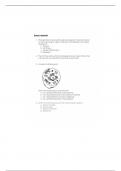
3. Consider the following cell:
Which of the following is true for this cell?
a. It is a prokaryote because it has ribosomes
b. It is a eukaryote because it has a plasma membrane
c. It is a eukaryote because it has a Golgi body
d. It is a prokaryote because it has cytoplasm
4. Which of the following is part of the endomembrane system?
a. Nuclear envelope
b. Mitochondria
c. Plasma membrane
d. Ribosomes
, 5. What advantage does compartmentalization give eukaryotes as
compared to their prokaryotic ancestors?
6. Name ONE organelle that was likely acquired by endosymbiosis:
________________
7. Match the cell component to its function, and indicate if that
component is present in a prokartyote, animal cell, or plant cell.
Component Function Prokaryotes? Animal Plant Cell?
Cell?
Cell Wall
Cell Membrane
Cytoplasm
Ribosome
Chromatin
(DNA)
Nucleus
(nuclear
envelope)
Rough ER
Smooth ER
Golgi apparatus
Lysosome
Mitochondria
Chloroplast
Central Vacuole
,1. External support for the cell
2. Transport of molecules into or out of the cell
3. Digestion or breakdown of large molecules
4. Storing genetic information
5. Building proteins
6. Making membrane components
7. Lipid synthesis
8. Sorting proteins for transport in the cell
9. Environment for chemical reactions in cell
10. Transformation of energy from the sun
11. Transformation of energy from molecules
12. Internal support and storage for the cell
8. Label each part of these cells that you recognize and identify what type
of cell they are.
, 9. Atoms have electrons organized in layers called shells, and within a shell
paired electrons are found in different ___________.
a. shells
b. domains
c. orbitals
d. periods
10. Why are some elements chemically reactive and tend to combine with
other elements to form molecules?
a. All elements are chemically reactive
b. Because they have unpaired valence electrons
c. Because they are high energy
d. Because they have unused shells
11. What is the basis for chemical bonds in molecules? AND how do you
know how many bonds an element will form in a molecule?
12. Answer the following questions about the element nitrogen, which has
an atomic number of 7.
I. How many valence electrons will nitrogen have?
II. How many unpaired valence electrons will nitrogen have?
III. How many bonds should nitrogen make in a molecule?
13. Which of the following statements would you expect to be true if you
know that two atoms are joined by a non-polar covalent bond?
a. They have the same number of unpaired valance electrons.
b. The atoms will ionize in water.
c. There is a significant difference in electronegativity between the
atoms.
d. The elements are similar in electronegativity.
14. Which of the following is a characteristic of orbitals in an atom?
1. Photosynthesis in green plants captures energy from light and stores it
as chemical energy in organic molecules. What Big Idea is this a great
example of?
a. Evolution
b. Cell Theory
c. Energy Transformation
d. Regulation
2. The Cell Theory tells us that all living organisms are made of cells. What
is the second very important thing it tells us about cells?
3. Consider the following cell:
Which of the following is true for this cell?
a. It is a prokaryote because it has ribosomes
b. It is a eukaryote because it has a plasma membrane
c. It is a eukaryote because it has a Golgi body
d. It is a prokaryote because it has cytoplasm
4. Which of the following is part of the endomembrane system?
a. Nuclear envelope
b. Mitochondria
c. Plasma membrane
d. Ribosomes
, 5. What advantage does compartmentalization give eukaryotes as
compared to their prokaryotic ancestors?
6. Name ONE organelle that was likely acquired by endosymbiosis:
________________
7. Match the cell component to its function, and indicate if that
component is present in a prokartyote, animal cell, or plant cell.
Component Function Prokaryotes? Animal Plant Cell?
Cell?
Cell Wall
Cell Membrane
Cytoplasm
Ribosome
Chromatin
(DNA)
Nucleus
(nuclear
envelope)
Rough ER
Smooth ER
Golgi apparatus
Lysosome
Mitochondria
Chloroplast
Central Vacuole
,1. External support for the cell
2. Transport of molecules into or out of the cell
3. Digestion or breakdown of large molecules
4. Storing genetic information
5. Building proteins
6. Making membrane components
7. Lipid synthesis
8. Sorting proteins for transport in the cell
9. Environment for chemical reactions in cell
10. Transformation of energy from the sun
11. Transformation of energy from molecules
12. Internal support and storage for the cell
8. Label each part of these cells that you recognize and identify what type
of cell they are.
, 9. Atoms have electrons organized in layers called shells, and within a shell
paired electrons are found in different ___________.
a. shells
b. domains
c. orbitals
d. periods
10. Why are some elements chemically reactive and tend to combine with
other elements to form molecules?
a. All elements are chemically reactive
b. Because they have unpaired valence electrons
c. Because they are high energy
d. Because they have unused shells
11. What is the basis for chemical bonds in molecules? AND how do you
know how many bonds an element will form in a molecule?
12. Answer the following questions about the element nitrogen, which has
an atomic number of 7.
I. How many valence electrons will nitrogen have?
II. How many unpaired valence electrons will nitrogen have?
III. How many bonds should nitrogen make in a molecule?
13. Which of the following statements would you expect to be true if you
know that two atoms are joined by a non-polar covalent bond?
a. They have the same number of unpaired valance electrons.
b. The atoms will ionize in water.
c. There is a significant difference in electronegativity between the
atoms.
d. The elements are similar in electronegativity.
14. Which of the following is a characteristic of orbitals in an atom?