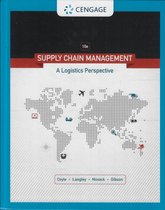
Supply Chain
Management
IB YEAR 2 PERIOD 2
,SUPPLY CHAIN MANAGEMENT: AN
OVERVIEW
EXTERNAL CHANGE DRIVERS:
Globalization:
- More competitive environment economic and political opportunities and threats
- Time and distance have been compressed
- Economic and political risk: e.g. terrorism or natural catastrophes that could interrupt
supply chains
- Shorter product life cycles Inventory management challenges
- Faster duplicability of products and services
- Faster reduction in demand
- Requirement of new pricing policies
- Higher risk of obsolescence
- Blurring of organizational boundaries
- Outsourcing longer and more complex supply chains
Technology:
- Internet
- Search engines
- Social networks: customer demand and speed of information transfers
- World’s “knowledge pools”: opportunities for collaboration in supply chains
Organizational Consolidation and Power Shifts:
- 1980s/1990s: economic power shift from product manufacturers to the retail end of
the supply chain
- More collaboration among organizations in supply chains shared cost savings and
improved customer service
- Scheduled deliveries, “rainbow” pallets, advanced shipment notices (ASNs),
shrink-wrapped pallets
The Empowered Consumer:
- Empowered by information and product sources that they have at their disposal
comparing prices, quality, and services
- Increased pressure on supply chain due to increased demands at the retail level in
terms of:
- Competitive prices
, - High quality in products and services
- Tailored or customized products
- Convenience and responsiveness – 24/7 availability with a minimum of wait
time
- Flexibility: Omnichannel distribution
Government Policy and Regulation
- Deregulations in U.S. in 1980s and 1990s: transportation industry, financial sector,
communication industry
SUPPLYY CHAINS: DEVELOPMENT AND SHAPING
Integrated Logistics: inbound and outbound logistics (started in 1980s) opportunities
for increased efficiency and improved customer service
Supply Chain Management:
- Science: applications and models
- Art: because of the dynamic and complex environment, collaboration along supply
chains and continuous analysis and planning is required
Flows:
- Product/Services Flow: physical movement of goods and materials; reverse
logistics: returning products that are unacceptable to the buyer
- Information Flow: enabling physical flow of products, decision making, supply chain
collaborations
- Cash Flow: management of working capital
- Demand Flow: detect and understand demand signals, synchronize demand vs
supply
MAJOR SUPPLY CHAIN ISSUES
- Supply Chain Networks: network system (facilities and supporting transportation
services) must be capable and flexible to respond and change with market dynamics
- Complexity: increased requirements in simplifying and continually evaluating areas
of complexity in the various aspects of supply chains
- Inventory Development: increased requirements for coordination or integration to
reduce inventory levels on horizontal (single-firm) and vertical (multiple firms) levels
in the supply chain
- Information: sharing information along the supply chain and the discipline to ensure
the integrity of the vast amount of data collected and stored
- Cost and Value: prevention of sub-optimization
Management
IB YEAR 2 PERIOD 2
,SUPPLY CHAIN MANAGEMENT: AN
OVERVIEW
EXTERNAL CHANGE DRIVERS:
Globalization:
- More competitive environment economic and political opportunities and threats
- Time and distance have been compressed
- Economic and political risk: e.g. terrorism or natural catastrophes that could interrupt
supply chains
- Shorter product life cycles Inventory management challenges
- Faster duplicability of products and services
- Faster reduction in demand
- Requirement of new pricing policies
- Higher risk of obsolescence
- Blurring of organizational boundaries
- Outsourcing longer and more complex supply chains
Technology:
- Internet
- Search engines
- Social networks: customer demand and speed of information transfers
- World’s “knowledge pools”: opportunities for collaboration in supply chains
Organizational Consolidation and Power Shifts:
- 1980s/1990s: economic power shift from product manufacturers to the retail end of
the supply chain
- More collaboration among organizations in supply chains shared cost savings and
improved customer service
- Scheduled deliveries, “rainbow” pallets, advanced shipment notices (ASNs),
shrink-wrapped pallets
The Empowered Consumer:
- Empowered by information and product sources that they have at their disposal
comparing prices, quality, and services
- Increased pressure on supply chain due to increased demands at the retail level in
terms of:
- Competitive prices
, - High quality in products and services
- Tailored or customized products
- Convenience and responsiveness – 24/7 availability with a minimum of wait
time
- Flexibility: Omnichannel distribution
Government Policy and Regulation
- Deregulations in U.S. in 1980s and 1990s: transportation industry, financial sector,
communication industry
SUPPLYY CHAINS: DEVELOPMENT AND SHAPING
Integrated Logistics: inbound and outbound logistics (started in 1980s) opportunities
for increased efficiency and improved customer service
Supply Chain Management:
- Science: applications and models
- Art: because of the dynamic and complex environment, collaboration along supply
chains and continuous analysis and planning is required
Flows:
- Product/Services Flow: physical movement of goods and materials; reverse
logistics: returning products that are unacceptable to the buyer
- Information Flow: enabling physical flow of products, decision making, supply chain
collaborations
- Cash Flow: management of working capital
- Demand Flow: detect and understand demand signals, synchronize demand vs
supply
MAJOR SUPPLY CHAIN ISSUES
- Supply Chain Networks: network system (facilities and supporting transportation
services) must be capable and flexible to respond and change with market dynamics
- Complexity: increased requirements in simplifying and continually evaluating areas
of complexity in the various aspects of supply chains
- Inventory Development: increased requirements for coordination or integration to
reduce inventory levels on horizontal (single-firm) and vertical (multiple firms) levels
in the supply chain
- Information: sharing information along the supply chain and the discipline to ensure
the integrity of the vast amount of data collected and stored
- Cost and Value: prevention of sub-optimization