,
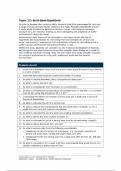
, 12-Acid-Base Equilibria
Brosted -
lowry
· Bronsted lowry acid is a proton donor
· Bronsted lowry base is a proton acceptor
Acid/Base Pairs
· every it acid will form a L base consusate basel
· every L base will form a L acid conjugate acid
e.s. NO laa) kOtraal kNOgrqa 20r1) +
8acid ↳C base conjugate conjugate
base acid
·
An alkaliis a base is
that soluble in water
· e.s. Calcium carbonate is) is a base, sodium hydroxide is an
alkaliand a base
pf
· determined by concentration of Hions in solution
o affected by 2 factors:
concentration oforiginal acid
-
-
extent to which thatacid dissociates
strong/weak acids
o a strong acid is one that
is considered to be
fully
dissociated in Water -
equilibrium lies far to the right
o a weak acid is one thatonly dissociates to a small extent -
equilibrium
lies to the left
pH "power
=
of hydrogen
[H 1
+
=- 109
pl ofstrong acids
· if strong acids are fully dissociated in water, then we can calculate
CH"] directly from (acid
· a monoprotic acid will produce 1 mol of Holons per mole ofacid e.g. C
· a diprotic acid will produce 2 moles ofions per mole ofacid
C. S. H2504
-
, 12-Acid-Base Equilibria
Brosted -
lowry
· Bronsted lowry acid is a proton donor
· Bronsted lowry base is a proton acceptor
Acid/Base Pairs
· every it acid will form a L base consusate basel
· every L base will form a L acid conjugate acid
e.s. NO laa) kOtraal kNOgrqa 20r1) +
8acid ↳C base conjugate conjugate
base acid
·
An alkaliis a base is
that soluble in water
· e.s. Calcium carbonate is) is a base, sodium hydroxide is an
alkaliand a base
pf
· determined by concentration of Hions in solution
o affected by 2 factors:
concentration oforiginal acid
-
-
extent to which thatacid dissociates
strong/weak acids
o a strong acid is one that
is considered to be
fully
dissociated in Water -
equilibrium lies far to the right
o a weak acid is one thatonly dissociates to a small extent -
equilibrium
lies to the left
pH "power
=
of hydrogen
[H 1
+
=- 109
pl ofstrong acids
· if strong acids are fully dissociated in water, then we can calculate
CH"] directly from (acid
· a monoprotic acid will produce 1 mol of Holons per mole ofacid e.g. C
· a diprotic acid will produce 2 moles ofions per mole ofacid
C. S. H2504
-