MANG 6020 Financial Risk Management
Seminar 5
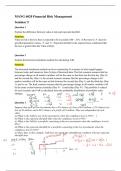
Question 1
Explain the difference between value at risk and expected shortfall.
Solution:
Value at risk is the loss that is expected to be exceeded (100 – X)% of the time in N days for
specified parameter values, X and N . Expected shortfall is the expected loss conditional that
the loss is greater than the Value at Risk.
Question 2
Explain the historical simulation method for calculating VaR.
Solution:
The historical simulation method involves constructing N scenarios of what might happen
between today and tomorrow from N days of historical data. The first scenario assumes that the
percentage change in all market variables will be the same as that between the first day (Day 0)
and the second day (Day 1); the second scenario assumes that the percentage change in all
market variables will be the same as that between the second day (Day 1) and the third day (Day
2); and so on. The final scenario assumes that the percentage change in all market variables will
be the same as that between yesterday (Day N - 1) and today (Day N ). The portfolio is valued
for each scenario and VaR is calculated from the probability distribution of portfolio value -
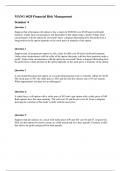
changes. scenario pro , profit aim 376%
2×290×9*8 = O 412%
; ?m%%
aw%
.
°
4%xa% to
-
86×27×2 awk -
" gagaqif -
88.48 2
Question 3 0.367
.xr% 0.04% -2
coal
if
. 1
Suppose that each of two investments has a 4% chance of a loss of $10 million, a 2% chance of a
loss of $1 million, and a 94% chance of a profit of $1 million. They are independent of each
other.
(a) What is the VaR for one of the investments when the confidence level is 95%? A
(b) What is the expected shortfall (ES) when the confidence level is 95%?
(c) What is the VaR for a portfolio consisting of the two investments when the confidence level is
95%?
(d) What is the expected shortfall for a portfolio consisting of the two investments when the
confidence level is 95%?
(e) Show that, in this example, VaR does not satisfy the subadditivity condition whereas expected
shortfall does. cumulative PM → ⑨ vape ,
.
+
cat .
profit carillon, probe
o.GE#cb7ES=SoofXl0t2ofoX1
-
to
-
l
44% T
w,
= 8+0.2=8.2 LES)
goof
-
I
-11
Seminar 5
Question 1
Explain the difference between value at risk and expected shortfall.
Solution:
Value at risk is the loss that is expected to be exceeded (100 – X)% of the time in N days for
specified parameter values, X and N . Expected shortfall is the expected loss conditional that
the loss is greater than the Value at Risk.
Question 2
Explain the historical simulation method for calculating VaR.
Solution:
The historical simulation method involves constructing N scenarios of what might happen
between today and tomorrow from N days of historical data. The first scenario assumes that the
percentage change in all market variables will be the same as that between the first day (Day 0)
and the second day (Day 1); the second scenario assumes that the percentage change in all
market variables will be the same as that between the second day (Day 1) and the third day (Day
2); and so on. The final scenario assumes that the percentage change in all market variables will
be the same as that between yesterday (Day N - 1) and today (Day N ). The portfolio is valued
for each scenario and VaR is calculated from the probability distribution of portfolio value -
changes. scenario pro , profit aim 376%
2×290×9*8 = O 412%
; ?m%%
aw%
.
°
4%xa% to
-
86×27×2 awk -
" gagaqif -
88.48 2
Question 3 0.367
.xr% 0.04% -2
coal
if
. 1
Suppose that each of two investments has a 4% chance of a loss of $10 million, a 2% chance of a
loss of $1 million, and a 94% chance of a profit of $1 million. They are independent of each
other.
(a) What is the VaR for one of the investments when the confidence level is 95%? A
(b) What is the expected shortfall (ES) when the confidence level is 95%?
(c) What is the VaR for a portfolio consisting of the two investments when the confidence level is
95%?
(d) What is the expected shortfall for a portfolio consisting of the two investments when the
confidence level is 95%?
(e) Show that, in this example, VaR does not satisfy the subadditivity condition whereas expected
shortfall does. cumulative PM → ⑨ vape ,
.
+
cat .
profit carillon, probe
o.GE#cb7ES=SoofXl0t2ofoX1
-
to
-
l
44% T
w,
= 8+0.2=8.2 LES)
goof
-
I
-11