A&P CH.9
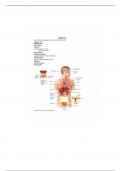
Major Endocrine glands and their location in the body:
Location: Brain
Hypothalamus
Pineal Gland
Pituitary
Location: Neck, anterior
surface of trachea
Thyroid Gland
Parathyroid Glands
Location: Superior surface of kidneys
Adrenal Glands
Location: Abdominopelvic region
Pancreas
Ovaries (female)
Testes (male)
,What does the endocrine system do?
This system helps to maintain day-to-day homeostasis through chemicals called
hormones
This system works with the nervous system, which maintains moment-by-moment
homeostasis
Endocrine vs. Exocrine Glands:
Endocrine glands
Glands that secrete a chemical signal directly into the bloodstream
Endocrine cells can also be found in organs that have primary roles in other
organ systems
Ex. hypothalamus, pancreas
Endocrine cells can also be found in tissues
Ex. adipose tissue
Exocrine glands
Secrete chemicals through ducts or tubes
Ex. salivary glands
General Hormone Action:
Hormones are released into the bloodstream
Hormones act on their specific target cells
The hormone and its target cell interact at the hormone receptor on the target cell
surface
Hormones are released as a response to a change in the environment, and once the
hormone and target cells interact, homeostasis is restored
Once homeostasis is restored, hormone secretion stops through a negative feedback
mechanism
Two major types of hormones:
Steroid hormones
Dissolve in fats or lipids, therefore can go through target cell membrane
Made from cholesterol
Takes longer to act, but generally effects last longer than nonsteroid hormones
Nonsteroid hormones
Dissolve in water
Made from small amino acids, peptides, or large proteins
Bind to hormone receptor on target cell membrane
Act faster, but effects are more short-lived than steroid hormones
Steroid hormones go directly into the target cells:
Steroid hormones pass through the cell membrane of the target cell
The hormone binds to its receptor inside the cell and stimulates specific genes to make
new proteins
The new proteins alter the activity of the cell
, How Steroid hormones work:
Examples of steroid hormones:
Ovaries, testes, adrenals produce androgens (sex hormones) for male or female
characteristics
Adrenal cortex secrete mineralocorticoids that act on kidneys to increase sodium and
water reabsorption, potassium excretion
Nonsteriod hormones bind to receptors on the target cell membrane:
Nonsteroids cannot pass through the cell membrane, so they bind to cell surface
receptors on the membrane
A hormone-receptor complex is formed
The complex triggers a second messenger to be formed inside the cell
The second messenger alters the activity of the target cell
There is an amplified and diversified set of responses
Examples of nonsteriod hormones:
Cyclic AMP (cAMP)
Made from ATP
Major Endocrine glands and their location in the body:
Location: Brain
Hypothalamus
Pineal Gland
Pituitary
Location: Neck, anterior
surface of trachea
Thyroid Gland
Parathyroid Glands
Location: Superior surface of kidneys
Adrenal Glands
Location: Abdominopelvic region
Pancreas
Ovaries (female)
Testes (male)
,What does the endocrine system do?
This system helps to maintain day-to-day homeostasis through chemicals called
hormones
This system works with the nervous system, which maintains moment-by-moment
homeostasis
Endocrine vs. Exocrine Glands:
Endocrine glands
Glands that secrete a chemical signal directly into the bloodstream
Endocrine cells can also be found in organs that have primary roles in other
organ systems
Ex. hypothalamus, pancreas
Endocrine cells can also be found in tissues
Ex. adipose tissue
Exocrine glands
Secrete chemicals through ducts or tubes
Ex. salivary glands
General Hormone Action:
Hormones are released into the bloodstream
Hormones act on their specific target cells
The hormone and its target cell interact at the hormone receptor on the target cell
surface
Hormones are released as a response to a change in the environment, and once the
hormone and target cells interact, homeostasis is restored
Once homeostasis is restored, hormone secretion stops through a negative feedback
mechanism
Two major types of hormones:
Steroid hormones
Dissolve in fats or lipids, therefore can go through target cell membrane
Made from cholesterol
Takes longer to act, but generally effects last longer than nonsteroid hormones
Nonsteroid hormones
Dissolve in water
Made from small amino acids, peptides, or large proteins
Bind to hormone receptor on target cell membrane
Act faster, but effects are more short-lived than steroid hormones
Steroid hormones go directly into the target cells:
Steroid hormones pass through the cell membrane of the target cell
The hormone binds to its receptor inside the cell and stimulates specific genes to make
new proteins
The new proteins alter the activity of the cell
, How Steroid hormones work:
Examples of steroid hormones:
Ovaries, testes, adrenals produce androgens (sex hormones) for male or female
characteristics
Adrenal cortex secrete mineralocorticoids that act on kidneys to increase sodium and
water reabsorption, potassium excretion
Nonsteriod hormones bind to receptors on the target cell membrane:
Nonsteroids cannot pass through the cell membrane, so they bind to cell surface
receptors on the membrane
A hormone-receptor complex is formed
The complex triggers a second messenger to be formed inside the cell
The second messenger alters the activity of the target cell
There is an amplified and diversified set of responses
Examples of nonsteriod hormones:
Cyclic AMP (cAMP)
Made from ATP