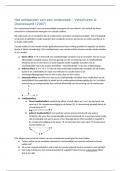
Het ontwerpen van een onderzoek – Verschuren &
Doorewaard (2007)
Een conceptueel model is een vereenvoudigde weergave van een theorie, met nadruk op direct
overzicht en schematische weergave van causale relaties.
Elk onderzoek omvat variabelen die de onderzochte concepten vertegenwoordigen. Het is belangrijk
om precies te definiëren welke waarden deze variabelen kunnen aannemen en welke waarden je in
je studie onderzoekt.
Causale relaties in een model worden gekarakteriseerd door richting (positief of negatief) en sterkte
(grote of kleine verandering). Vier hoofdpatronen van causale relaties kunnen worden onderscheiden
in zo'n model.
a) Direct effect: X Z. Het heeft een onafhankelijke variabele (wat je verandert, hier X) en een
afhankelijke variabele (wat je meet als gevolg van die verandering, hier Z). Onafhankelijk
betekent dat we in een (deel van een) bepaald model mogelijke oorzaken van de
onafhankelijke niet in de analyse betrekken. “(On)afhankelijk” is dus een relatief begrip.
b) Indirect effect: X Y Z. Y is hier de interveniërende/mediërende variabele, die de relatie
tussen X en Z bemiddelt. De regel voor effecten in causale ketens is de
vermenigvuldigingsregel (min en min is plus, plus en min is plus).
c) Interactie-effect: het effect van iets op de onafhankelijke variabele (voor welke deel van de
werkelijkheid (lees populatie) je denkt dat de onderzoeksresultaten geldig zijn, bv. het effect
van training op werkprestaties kan variëren afhankelijk van de ervaring van de werknemer.
Z
X Y
d) Feedbackeffect:
a. Direct feedbackeffect: wederkerig effect, x heeft effect op Y, en Y op zijn beurt ook
weer op X. Bv. temperatuurstijging in de kamer (X) thermostaat schakelt direct de
verwarming uit (Y).
X Y
b. Indirect feedbackeffect: het resultaat van het proces beïnvloedt een andere
variabele, die weer het oorspronkelijke proces beïnvloedt. Er is een tussenstap nodig.
Het is belangrijk om aan te geven of een bepaald direct effect positief of negatief is.
Bv. temperatuurstijging in de kamer iemand doet het raam open temperatuur
neemt indirect af.
X Y
Z
Drie dingen waar je bij het maken van een conceptueel model goed op moet letten:
a) Tussen welke van de variabelen bestaat er (vermoedelijk) een causaal verband en tussen
welke niet?
b) Als er een causaal verband is, wat is dan de causale volgorde (wat is oorzaak en wat gevolg)?
c) Wat is de richting van het verband (positief of negatief)? Alleen bij een substantieel effect
trek je een pijl.
, Research Methods in Social Relations ch. 2 Doing Social
Science Research – Maruyama & Ryan
Theory: Explains why something happens by linking related ideas to show how different factors are
connected. It has three key features:
1. Explains Constructs: Offers an understanding of a concept or phenomenon.
2. Describes Relationships: Details how constructs are causally related.
3. Links to Observable Variables: Connects constructs to measurable variables for empirical
research (e.g., IQ).
Hypothesis: Predicts what will happen in a specific situation based on the theory. Types of theories:
1. Associations Among Constructs: Suggests a causal relationship, such as "Construct A causes
Construct B for population X under condition Y."
2. Associations with Observable Indicators: Proposes that a specific behaviour or response
(e.g., behaviour X) is a valid measure of a construct (e.g., construct A).
A productive social science theory is
Falsifiable: Can be tested and potentially refuted.
Specific: States clear, precise hypotheses.
Parsimonious: As simple as possible.
Relevant: Addresses important phenomena.
Consistent: Hypotheses don’t contradict each other.
Coherent: Easy to understand.
Empirically Grounded: Specifies and measures relevant constructs.
Advanced: Offers better explanations than existing theories.
Aligned: Consistent with related theories.
Insightful: Provides new understanding.
Measurement research examines whether different methods of measuring the same construct yield
similar results. Ensures that constructs are accurately and consistently measured to test hypotheses
effectively.
Though empirical research often serves multiple functions, we can distinguish four:
1. Discovery: Identifies potential causes of constructs inductively, guided by theoretical beliefs.
Key focus is on construct validity.
2. Demonstration: Tests hypotheses deductively, adjusting them based on findings. Combines
inductive and deductive approaches. Focus on internal validity.
3. Refutation: Disproves competing hypotheses to build confidence in the original hypothesis.
4. Replication: Reproduces findings in different settings and samples to ensure external validity.
Criteria for evaluating social science research:
Construct Validity: Measures how well variables measure and reflect the intended
constructs. Critical in discovery research. Maximise by using multiple measurement methods
to avoid misleading results.
Internal Validity: Determines if causal conclusions are valid based on the research design.
Avoid correlational fallacies (correlation does not imply causation). Maximise by using
randomized experiments. Quasi-experiments can also provide valuable insights when
random assignment is impractical or unethical.
Doorewaard (2007)
Een conceptueel model is een vereenvoudigde weergave van een theorie, met nadruk op direct
overzicht en schematische weergave van causale relaties.
Elk onderzoek omvat variabelen die de onderzochte concepten vertegenwoordigen. Het is belangrijk
om precies te definiëren welke waarden deze variabelen kunnen aannemen en welke waarden je in
je studie onderzoekt.
Causale relaties in een model worden gekarakteriseerd door richting (positief of negatief) en sterkte
(grote of kleine verandering). Vier hoofdpatronen van causale relaties kunnen worden onderscheiden
in zo'n model.
a) Direct effect: X Z. Het heeft een onafhankelijke variabele (wat je verandert, hier X) en een
afhankelijke variabele (wat je meet als gevolg van die verandering, hier Z). Onafhankelijk
betekent dat we in een (deel van een) bepaald model mogelijke oorzaken van de
onafhankelijke niet in de analyse betrekken. “(On)afhankelijk” is dus een relatief begrip.
b) Indirect effect: X Y Z. Y is hier de interveniërende/mediërende variabele, die de relatie
tussen X en Z bemiddelt. De regel voor effecten in causale ketens is de
vermenigvuldigingsregel (min en min is plus, plus en min is plus).
c) Interactie-effect: het effect van iets op de onafhankelijke variabele (voor welke deel van de
werkelijkheid (lees populatie) je denkt dat de onderzoeksresultaten geldig zijn, bv. het effect
van training op werkprestaties kan variëren afhankelijk van de ervaring van de werknemer.
Z
X Y
d) Feedbackeffect:
a. Direct feedbackeffect: wederkerig effect, x heeft effect op Y, en Y op zijn beurt ook
weer op X. Bv. temperatuurstijging in de kamer (X) thermostaat schakelt direct de
verwarming uit (Y).
X Y
b. Indirect feedbackeffect: het resultaat van het proces beïnvloedt een andere
variabele, die weer het oorspronkelijke proces beïnvloedt. Er is een tussenstap nodig.
Het is belangrijk om aan te geven of een bepaald direct effect positief of negatief is.
Bv. temperatuurstijging in de kamer iemand doet het raam open temperatuur
neemt indirect af.
X Y
Z
Drie dingen waar je bij het maken van een conceptueel model goed op moet letten:
a) Tussen welke van de variabelen bestaat er (vermoedelijk) een causaal verband en tussen
welke niet?
b) Als er een causaal verband is, wat is dan de causale volgorde (wat is oorzaak en wat gevolg)?
c) Wat is de richting van het verband (positief of negatief)? Alleen bij een substantieel effect
trek je een pijl.
, Research Methods in Social Relations ch. 2 Doing Social
Science Research – Maruyama & Ryan
Theory: Explains why something happens by linking related ideas to show how different factors are
connected. It has three key features:
1. Explains Constructs: Offers an understanding of a concept or phenomenon.
2. Describes Relationships: Details how constructs are causally related.
3. Links to Observable Variables: Connects constructs to measurable variables for empirical
research (e.g., IQ).
Hypothesis: Predicts what will happen in a specific situation based on the theory. Types of theories:
1. Associations Among Constructs: Suggests a causal relationship, such as "Construct A causes
Construct B for population X under condition Y."
2. Associations with Observable Indicators: Proposes that a specific behaviour or response
(e.g., behaviour X) is a valid measure of a construct (e.g., construct A).
A productive social science theory is
Falsifiable: Can be tested and potentially refuted.
Specific: States clear, precise hypotheses.
Parsimonious: As simple as possible.
Relevant: Addresses important phenomena.
Consistent: Hypotheses don’t contradict each other.
Coherent: Easy to understand.
Empirically Grounded: Specifies and measures relevant constructs.
Advanced: Offers better explanations than existing theories.
Aligned: Consistent with related theories.
Insightful: Provides new understanding.
Measurement research examines whether different methods of measuring the same construct yield
similar results. Ensures that constructs are accurately and consistently measured to test hypotheses
effectively.
Though empirical research often serves multiple functions, we can distinguish four:
1. Discovery: Identifies potential causes of constructs inductively, guided by theoretical beliefs.
Key focus is on construct validity.
2. Demonstration: Tests hypotheses deductively, adjusting them based on findings. Combines
inductive and deductive approaches. Focus on internal validity.
3. Refutation: Disproves competing hypotheses to build confidence in the original hypothesis.
4. Replication: Reproduces findings in different settings and samples to ensure external validity.
Criteria for evaluating social science research:
Construct Validity: Measures how well variables measure and reflect the intended
constructs. Critical in discovery research. Maximise by using multiple measurement methods
to avoid misleading results.
Internal Validity: Determines if causal conclusions are valid based on the research design.
Avoid correlational fallacies (correlation does not imply causation). Maximise by using
randomized experiments. Quasi-experiments can also provide valuable insights when
random assignment is impractical or unethical.