Prof Dr Jörg Fliege Semester 2, 2022/2023
School of Mathematical Sciences
University of Southampton
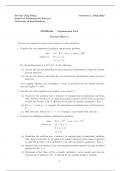
MATH6184 — Optimization Part
Exercise Sheet 3
You are not required to hand in the answers to these problems.
1. Consider the box-constrained nonlinear optimization problem
min (x1 − 5)2 − 2x1 x2 + 10(x2 − 10)2
subject to 0 ≤ x1 ≤ 3,
0 ≤ x2 ≤ 5.
For the starting point x = (2.5, 0)T , do the following:
(a) execute the descent algorithm for box-constrained optimization using the steepest
descent direction,
(b) execute the descent algorithm for box-constrained optimization using Newton’s
direction.
As a stopping criterion, you can employ ε = 0.01. As parameter for the Armijo criterion,
you can employ δ = 0.01.
2. Consider the same optimization problem as in exercise 1.
(a) Transform the problem into a sequence of unconstrained optimization problems
with objective function Fr by using four penalty functions of the form as depicted
on slide 28, Section 3. (It is sufficient to use just one penalty parameter r here.)
(b) For x1 > 3 and x2 > 5, compute the unconstrained minimum x(r) of the function
Fr .
(c) How does x(r) behave for r −→ +∞? Compare your results with exercise 1.
3. Consider the following nonlinear optimization problem:
max 2(x1 − 3)2 − x1 x2 + (x2 − 5)2
subject to x21 + x22 ≤ 1,
0 ≤ x1 ≤ 2,
x2 ≥ 0.
(a) Transform the problem into a sequence of unconstrained optimization problems
with objective function Fr by using four penalty functions of the form as depicted
on slide 28, Section 3. (It is sufficient to use just one penalty parameter r here.)
(b) Explain why local minima of the unconstrained problems in part (a) must be global
minima for all r ≥ 0.
(c) Determine wether there will be a penalty multiplier r large enough such that the
unconstrained optimum of Fr is optimal for the original problem. Explain.
1
School of Mathematical Sciences
University of Southampton
MATH6184 — Optimization Part
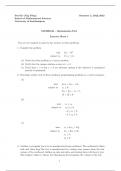
Exercise Sheet 3
You are not required to hand in the answers to these problems.
1. Consider the box-constrained nonlinear optimization problem
min (x1 − 5)2 − 2x1 x2 + 10(x2 − 10)2
subject to 0 ≤ x1 ≤ 3,
0 ≤ x2 ≤ 5.
For the starting point x = (2.5, 0)T , do the following:
(a) execute the descent algorithm for box-constrained optimization using the steepest
descent direction,
(b) execute the descent algorithm for box-constrained optimization using Newton’s
direction.
As a stopping criterion, you can employ ε = 0.01. As parameter for the Armijo criterion,
you can employ δ = 0.01.
2. Consider the same optimization problem as in exercise 1.
(a) Transform the problem into a sequence of unconstrained optimization problems
with objective function Fr by using four penalty functions of the form as depicted
on slide 28, Section 3. (It is sufficient to use just one penalty parameter r here.)
(b) For x1 > 3 and x2 > 5, compute the unconstrained minimum x(r) of the function
Fr .
(c) How does x(r) behave for r −→ +∞? Compare your results with exercise 1.
3. Consider the following nonlinear optimization problem:
max 2(x1 − 3)2 − x1 x2 + (x2 − 5)2
subject to x21 + x22 ≤ 1,
0 ≤ x1 ≤ 2,
x2 ≥ 0.
(a) Transform the problem into a sequence of unconstrained optimization problems
with objective function Fr by using four penalty functions of the form as depicted
on slide 28, Section 3. (It is sufficient to use just one penalty parameter r here.)
(b) Explain why local minima of the unconstrained problems in part (a) must be global
minima for all r ≥ 0.
(c) Determine wether there will be a penalty multiplier r large enough such that the
unconstrained optimum of Fr is optimal for the original problem. Explain.
1