Exam 1
Monday, September 16, 2024 9:53 AM
Exam 1
Slide ID fa...
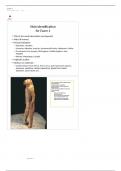
Title: The lion man (Human w/feline head)
Artist: Unknown
Period/Civilization: Paleolithic
Original Location: Found in Holenstein-
Stadel, Germany
Medium/Materials: Made of carved ivory
from a mammoth
Notes:
- First piece found that was
deliberately made
- The Lion-Human may reflect early
man's notion that humans and
animals were part of one group
- Oldest known zoomorphic figure
Art Hist I Page 1
, Title: Venus of Willendorf
Artist: Unknown
Period/Civilization: Paleolithic
Original Location: found in Willendorf,
Austria
Materials/Medium: carved Limestone
Notes:
- Figures such as the Woman of
Willendorf may have functioned to
communicate SHARED VALUES AND
FRINEDLINESS among differing groups
of Paleolithic peoples
- Small scale female sculptures from the
upper paleolithic period were once
called VENUS figures, which implied a
religious association, although this has
not yet been proven.
- Freestanding figure
Title: Hall of Bulls Materials/Medium: Twisted perspective, painted animals some overlapping each other
Artist: unknown Notes:
Period/Civilization: Paleolithic - It was found by some boys and a teacher
Original Location: Lascaux Caves, France - Opened to the public after adding some A/C but was closed down because of buildup and
deterioration of cave paintings
Art Hist I Page 2
, Title: Bison
Artist: Unknown
Periods/Civilization: paleolithic era
Location: Altamira cave, Santander, Spain
Materials/Medium: Paint on limestone
Notes:
- When first found, they though it was a forgery,
but after doing radiocarbon dating, they found
out they were the real deal
Title: Stonehenge
Artist: Unknown
Periods/Civilization: Neolithic era
Location: Salisbury Plain, Wiltshire, England
Materials/Medium: megaliths (great stones),
cromlech (henge circle of stones), bluestones
(volcanic rock)
Notes:
- It might have been a religious site, place for
healing or for the dead, or an astronomical
observatory (who truly knows?)
Art Hist I Page 3
, Title: Warka (Uruk) Vase
Artist: Unknown
Periods/Civilization: Sumerian
Location: Uruk, Iraq (Middle East) in Mesopotamia
Materials/Medium: Alabaster
Notes:
- There are registers (ground line) where they are standing
as well in a hierarchical scale
○ Goddess and priest were on top, servants and then
animals and land
- The uppermost scene of the Warka Vase from Uruk may
represent A REENACTMENT OF A RITUAL MARRIAGE
between the goddess and her consort.
Title: Bull-headed Lyre
Artist: unknown
Periods/Civilization: Sumerian
Location: Royal Cemetery, Ur, Iraq
Materials/Medium: wood, gold, lapis lazuli and shell
Notes:
- Bearded bulls were a royal symbol for kings/deities
- Sir Leonard Wolley excavated the site
- Inlaid images on the sound box of the Great Lyre with
Bull's Head creates an intriguing relationship to THE EPIC
OF GILGAMESH
Art Hist I Page 4
Monday, September 16, 2024 9:53 AM
Exam 1
Slide ID fa...
Title: The lion man (Human w/feline head)
Artist: Unknown
Period/Civilization: Paleolithic
Original Location: Found in Holenstein-
Stadel, Germany
Medium/Materials: Made of carved ivory
from a mammoth
Notes:
- First piece found that was
deliberately made
- The Lion-Human may reflect early
man's notion that humans and
animals were part of one group
- Oldest known zoomorphic figure
Art Hist I Page 1
, Title: Venus of Willendorf
Artist: Unknown
Period/Civilization: Paleolithic
Original Location: found in Willendorf,
Austria
Materials/Medium: carved Limestone
Notes:
- Figures such as the Woman of
Willendorf may have functioned to
communicate SHARED VALUES AND
FRINEDLINESS among differing groups
of Paleolithic peoples
- Small scale female sculptures from the
upper paleolithic period were once
called VENUS figures, which implied a
religious association, although this has
not yet been proven.
- Freestanding figure
Title: Hall of Bulls Materials/Medium: Twisted perspective, painted animals some overlapping each other
Artist: unknown Notes:
Period/Civilization: Paleolithic - It was found by some boys and a teacher
Original Location: Lascaux Caves, France - Opened to the public after adding some A/C but was closed down because of buildup and
deterioration of cave paintings
Art Hist I Page 2
, Title: Bison
Artist: Unknown
Periods/Civilization: paleolithic era
Location: Altamira cave, Santander, Spain
Materials/Medium: Paint on limestone
Notes:
- When first found, they though it was a forgery,
but after doing radiocarbon dating, they found
out they were the real deal
Title: Stonehenge
Artist: Unknown
Periods/Civilization: Neolithic era
Location: Salisbury Plain, Wiltshire, England
Materials/Medium: megaliths (great stones),
cromlech (henge circle of stones), bluestones
(volcanic rock)
Notes:
- It might have been a religious site, place for
healing or for the dead, or an astronomical
observatory (who truly knows?)
Art Hist I Page 3
, Title: Warka (Uruk) Vase
Artist: Unknown
Periods/Civilization: Sumerian
Location: Uruk, Iraq (Middle East) in Mesopotamia
Materials/Medium: Alabaster
Notes:
- There are registers (ground line) where they are standing
as well in a hierarchical scale
○ Goddess and priest were on top, servants and then
animals and land
- The uppermost scene of the Warka Vase from Uruk may
represent A REENACTMENT OF A RITUAL MARRIAGE
between the goddess and her consort.
Title: Bull-headed Lyre
Artist: unknown
Periods/Civilization: Sumerian
Location: Royal Cemetery, Ur, Iraq
Materials/Medium: wood, gold, lapis lazuli and shell
Notes:
- Bearded bulls were a royal symbol for kings/deities
- Sir Leonard Wolley excavated the site
- Inlaid images on the sound box of the Great Lyre with
Bull's Head creates an intriguing relationship to THE EPIC
OF GILGAMESH
Art Hist I Page 4